Average Cost to Build Deck: 2026 Durability & ROI Guide
Discover the true average cost to build deck in 2026. We analyze material lifespans, hidden maintenance expenses, and durability ROI to maximize your investment.

The True Average Cost to Build Deck in 2026 (Beyond the Sticker Price)
When homeowners research the average cost to build deck structures, they typically encounter national baseline estimates ranging from $15 to $50 per square foot. However, evaluating deck costs strictly through the lens of initial installation is a financial trap. A budget-friendly pressure-treated pine deck and a premium cellular PVC deck have vastly different financial trajectories when factoring in material degradation, maintenance cycles, and structural lifespan. In 2026, with lumber volatility and advanced polymer manufacturing, the most accurate metric for outdoor construction is the Annualized Cost of Ownership (ACO).
According to the National Association of Home Builders (NAHB), the life expectancy of exterior wood components varies wildly based on maintenance and climate exposure. A deck built with premium surface materials will still collapse if the substructure fails at year 12. Therefore, calculating the true average cost to build deck spaces requires synthesizing surface material longevity, substructure survivability, and cumulative maintenance expenses over a 25-year horizon.
2026 National Baseline Averages (Installed)
- Pressure-Treated Pine: $18 – $28 per sq. ft.
- Wood-Plastic Composite (Capped): $35 – $50 per sq. ft.
- Cellular PVC: $45 – $65 per sq. ft.
- Marine-Grade Aluminum: $55 – $75 per sq. ft.
- Tropical Hardwood (Ipe/Garapa): $48 – $70 per sq. ft.
Note: Prices reflect a standard 320 sq. ft. (16x20) single-level deck with standard stair access, excluding complex multi-tier framing or extensive site grading.
Material Lifespan vs. Initial Investment Matrix
To understand the durability ROI, we must map the upfront average cost to build deck spaces against their realistic operational lifespan and mandatory maintenance. The table below models a 320 sq. ft. deck over a 25-year period, assuming professional installation and regional climate averages.
| Material Type | Initial Cost (320 sqft) | Expected Lifespan | 25-Yr Maintenance | Annualized Cost |
|---|---|---|---|---|
| Pressure-Treated Pine | $7,360 | 10–15 Years | $8,500 (Staining/Repairs) | $634 / year |
| Capped Composite (e.g., Trex Transcend) | $13,600 | 25–30 Years | $1,200 (Cleaning) | $592 / year |
| Cellular PVC (e.g., AZEK Landmark) | $17,600 | 30–50 Years | $1,000 (Cleaning) | $744 / year |
| Marine Aluminum (e.g., Wahoo) | $20,800 | 50+ Years | $500 (Rinsing) | $852 / year |
Insight: While pressure-treated wood has the lowest initial average cost to build deck structures, its annualized cost often exceeds composite materials due to the mandatory biennial sanding, sealing, and eventual board replacement required to prevent rot and splintering.
The Substructure Paradox: Why Decks Fail Early
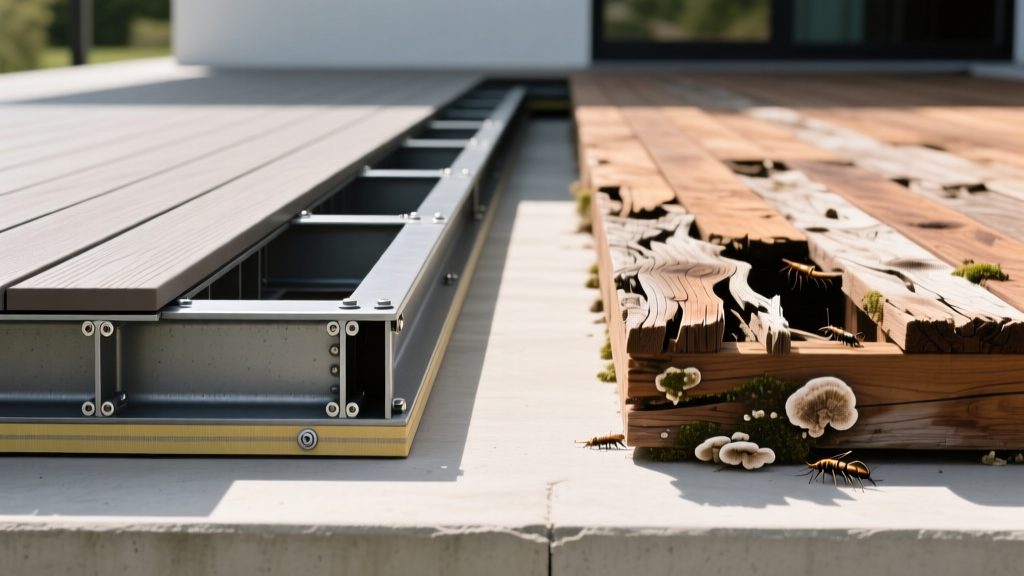
The most critical, yet frequently ignored, variable in deck longevity is the substructure. Homeowners routinely invest $45 per square foot in premium PVC or composite decking, only to mount it on standard ground-contact pressure-treated pine joists. This creates a Substructure Paradox: the surface boards are warranted for 30 to 50 years, but the wooden joists supporting them will succumb to moisture intrusion and rot in 15 to 20 years. The North American Deck and Railing Association (NADRA) frequently cites substructure failure and ledger board detachment as the primary causes of catastrophic deck collapses and premature teardowns.
Upgrading the Skeleton for True Longevity
To ensure your deck's lifespan matches the premium surface materials, you must allocate a portion of your budget to substructure upgrades:
- Joist Flashing Tape: Applying a butyl-based flashing tape (such as Grace Vycor Deck Flashing Tape or Trex Protect) over the top edge of every wooden joist prevents water from pooling on the horizontal surfaces. This single step, costing roughly $1.50 to $2.50 per linear foot, effectively doubles the lifespan of a wood substructure by preventing the freeze-thaw cracking and rot that starts at the screw holes.
- Light-Gauge Steel Framing: Systems like Fortress Evolution or Trex Elevations replace wood joists with galvanized, powder-coated steel. While this increases the framing cost by 30% to 45%, it guarantees a non-combustible, rot-proof, and warp-free skeleton that will easily outlast a 50-year PVC surface.
- Hardware Corrosion Resistance: Standard galvanized connectors will corrode rapidly when in contact with the copper-based preservatives (MCQ or CA-C) used in modern treated lumber. You must specify Simpson Strong-Tie ZMAX (G185) or stainless steel connectors and fasteners to prevent structural hardware failure.
Climate-Specific Degradation & Material Selection
The durability of your deck is inextricably linked to your local microclimate. The average cost to build deck spaces must be adjusted based on the specific environmental stressors that will attack the materials over time.
High UV & Arid Climates (Southwest US)
Primary Threat: UV degradation, thermal expansion, and fading.
Best Choice: Capped composite with UV-inhibitor shells or light-colored cellular PVC. Avoid dark-colored composites which can reach 150°F+ and cause thermal expansion issues, and avoid natural woods which will desiccate and split without monthly conditioning.
High Moisture & Freeze-Thaw (PNW & Northeast)
Primary Threat: Mold, moss, water infiltration, and freeze-thaw spalling.
Best Choice: Marine-grade aluminum or non-porous cellular PVC. Wood-plastic composites with exposed wood fibers (uncapped or older generations) will absorb moisture, leading to internal swelling and mold blooms in shaded, wet environments.
Calculating Your Durability ROI (Decision Framework)
To determine the most financially sound material for your specific situation, apply this decision framework based on your homeownership timeline and maintenance tolerance.
- Define Your Time Horizon: If you plan to sell your home within 5 to 7 years, a high-end composite deck yields the best ROI. According to industry data, composite decks recoup approximately 60% to 70% of their cost at resale, whereas wood decks recoup slightly less but cost significantly less upfront. If this is your 'forever home' (15+ years), PVC or Aluminum becomes mathematically superior due to zero replacement costs.
- Audit Your Maintenance Tolerance: Be brutally honest. If you will not commit to $400–$600 every two years for professional power washing and oil-based sealing, do not build with pressure-treated pine or tropical hardwoods (like Ipe). Neglected wood degrades faster than neglected polymers.
- Factor in Hidden Fasteners: For composite and PVC, budget an additional $3.50 to $5.00 per square foot for hidden fastening systems (e.g., CAMO Edge Fasteners or Trex Hideaway). Top-down screws create water entry points that accelerate localized rot and void manufacturer warranties, directly compromising the lifespan you paid for.
"The biggest mistake in modern deck building is treating the surface boards as the entire investment. A $50,000 PVC deck mounted on untaped, standard pine joists with galvanized nails is essentially a 15-year temporary structure wearing a 50-year coat."
— Industry Structural Standard, Trex Installation & Warranty Guidelines
FAQ: Deck Costs and Longevity
Does adding a deck increase home resale value in 2026?
Yes, but the ROI depends heavily on the material and regional market. Outdoor living spaces remain highly sought after. A well-maintained composite deck typically yields a 65% return on investment at the time of sale, while also providing years of maintenance-free utility for the current homeowner.
How often does a pressure-treated wood deck need to be sealed?
To achieve its maximum lifespan of 15 years, pressure-treated wood requires cleaning and the application of a high-quality penetrating oil sealer every 18 to 24 months. Failure to maintain this schedule will result in severe checking (cracking), warping, and eventual structural rot, drastically increasing the long-term average cost to build deck structures.
Are tropical hardwoods like Ipe worth the high initial cost?
Ipe offers exceptional density and a natural lifespan of 40+ years, rivaling composites. However, it requires specialized carbide-tipped tooling to install, hidden fastener systems to prevent splitting, and annual UV-protectant oiling to maintain its rich brown color. If left untreated, it will weather to a silver-gray but remains structurally sound. It is an excellent choice for luxury builds where natural aesthetics are non-negotiable.
Written by
Sarah WhitfieldSarah Whitfield is a chartered quantity surveyor (MRICS) and construction cost analyst with 15 years of experience in material pricing, procurement strategy, and project budgeting. She earned her degree in Construction Management from the University of Reading (UK) and has worked on projects ranging from $2M custom homes to $180M mixed-use developments across North America and Europe. Sarah currently leads cost estimating for BuildMat Insight, maintaining a proprietary database of 4,000+ material price points updated quarterly. She is a frequent contributor to RSMeans cost data panels and has presented at the International Cost Engineering Council (ICEC) congress. Based in Denver, CO, Sarah is an avid trail runner and volunteer mentor for Women in Construction.
More from Sarah Whitfield
View all
Wood & Lumber
What Are the Different Types of Wood? A Builder's Guide
Compare structural softwoods, finish hardwoods, and engineered lumber. Analyze Janka ratings, MOE values, and 2026 pricing for construction.
Aug 4, 2026

Walls & Panels
Steel Framing vs Wood Framing: Corrosion and Moisture Defense
Compare steel framing vs wood framing for moisture resistance. Learn about galvanized coatings, condensation risks, and corrosion protection strategies.
Jul 21, 2026

Stone & Masonry
How to Cut Stone Veneer: Wet Saw vs Grinder Comparison
Compare the best tools for cutting stone veneer. We review wet saws, angle grinders, and chop saws to help you achieve clean, chip-free cuts.
Jul 21, 2026