Pool Decking Material Selection Framework: Heat, Grip, and Cost
Evaluate pool decking material options using our framework. Compare thermal conductivity, slip resistance, and costs for PVC, composite, and concrete.
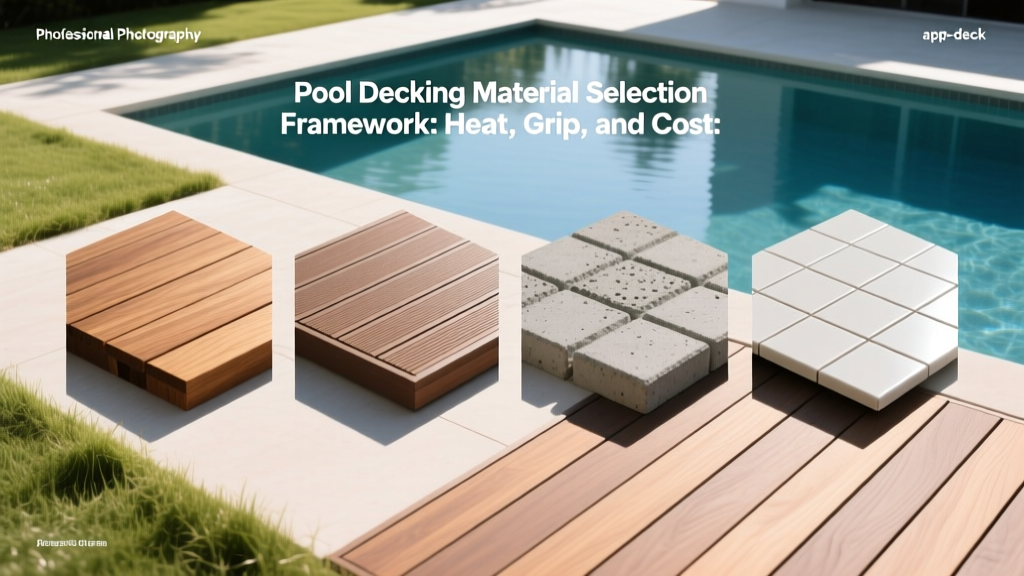
The Barefoot Metric: Thermal Conductivity and Solar Reflectance Index (SRI)
Selecting the optimal pool decking material requires moving beyond aesthetic preferences to evaluate three critical performance metrics: thermal conductivity, wet slip resistance, and chemical degradation. The immediate concern for any pool owner is surface temperature. Barefoot comfort is dictated by a material's Solar Reflectance Index (SRI) and its thermal mass.
Standard capped wood-plastic composites (WPC) possess high thermal mass and low SRI, meaning they absorb and retain solar radiation. In 90°F ambient conditions with direct sunlight, dark composite boards can reach surface temperatures of 145°F, causing second-degree burns in seconds. Conversely, advanced cellular PVC boards (such as AZEK Landmark) utilize a micro-cellular core that resists heat absorption, typically capping at 110°F to 115°F under identical conditions. For poured concrete, applying a specialized acrylic cool-deck coating (like Texture-Plus Cool Deck) can drop surface temperatures by 20°F to 30°F by increasing the SRI value above 50.
Slip Resistance: Navigating ANSI A326.3 and DCOF Ratings
Water and bare feet create a high-risk environment. The industry standard for measuring slip resistance is the Dynamic Coefficient of Friction (DCOF), governed by ANSI A326.3. For wet, level surfaces like pool decks, the minimum acceptable DCOF is 0.50. However, for sloped transition areas or zero-entry beach pools, you must specify materials with a DCOF of 0.65 or higher.
- Brushed Concrete: Achieves a DCOF of 0.60+ naturally through a light broom finish. Stamped concrete with a smooth acrylic sealer can drop below 0.40 when wet, requiring the addition of aluminum oxide anti-slip grit to the sealer.
- Embossed PVC/Composite: Look for deep, multi-directional wood-grain embossing. Shallow, linear embossing channels water directionally, creating a hydroplaning effect that drastically reduces the DCOF.
- Tumbled Natural Stone: Travertine and limestone naturally feature porous, pitted surfaces that provide exceptional micro-traction, routinely exceeding a 0.70 DCOF even when saturated.
Material Matrix: Performance, Cost, and Chemistry
The following matrix compares the four dominant pool decking materials based on 2026 installed costs (including substructure and labor), thermal performance, and chemical resistance. Data synthesized from industry reports and manufacturer specifications.
| Material Type | Brand / Product Example | Installed Cost (per sq. ft.) | Surface Temp (90°F Ambient) | Wet DCOF Rating | Salt/Chlorine Resistance |
|---|---|---|---|---|---|
| Poured Concrete (Cool Deck) | Texture-Plus Coatings | $9.00 - $15.00 | 95°F - 105°F | 0.60+ | High (Requires 3-year resealing) |
| Capped Cellular PVC | AZEK Landmark Series | $19.00 - $28.00 | 105°F - 115°F | 0.55 - 0.65 | Excellent (Impervious to salt) |
| Capped WPC Composite | Trex Transcend Lineage | $16.00 - $24.00 | 125°F - 145°F | 0.45 - 0.55 | Moderate (Stains from algaecides) |
| Natural Stone (Travertine) | Premium Tumbled Bullnose | $24.00 - $38.00 | 90°F - 100°F | 0.70+ | Poor (Reacts to muriatic acid) |
The Climate and Chemistry Decision Tree
Use this framework to eliminate incompatible materials based on your specific pool environment and regional weather patterns.
- If you have a Saltwater Generator (SWG) Pool:
- Avoid: Natural limestone, travertine, and standard concrete. Saltwater splashing and subsequent evaporation leaves behind sodium chloride crystals that spall concrete and degrade calcium carbonate in natural stone.
- Select: Cellular PVC or properly sealed stamped concrete with a high-build polyurethane topcoat.
- If you experience severe Freeze-Thaw Cycles (Northeast/Midwest):
- Avoid: Rigid mortared natural stone over concrete slabs. The differential expansion rates will crack the mortar joints within two winters.
- Select: Floating PVC deck systems over sleepers, or dry-laid travertine with flexible polymeric sand joints that accommodate frost heave.
- If you use Copper-Based Algaecides or Ionizers:
- Avoid: Light-colored porous composites. Copper sulfate will permanently stain the wood fibers encapsulated within the composite shell.
- Select: Non-porous PVC or sealed concrete.

Substructure and Drainage: The Hidden Failure Points
The longevity of your pool decking material is entirely dependent on the substructure. According to the Pool & Hot Tub Alliance (PHTA), improper drainage is the leading cause of premature deck failure. All pool decks must be sloped away from the pool coping at a minimum grade of 1/4 inch per foot.
For elevated composite or PVC decks, the framing requires aggressive moisture management. Standard pressure-treated lumber will rot rapidly under the constant humidity of a pool environment. You must apply a high-grade butyl joist tape (such as Trex Protect) to the top edge of every joist. This tape seals around the screws, preventing water intrusion into the end-grain of the lumber and protecting the framing from chlorine-laden splash-out. Furthermore, utilize hidden clip fastener systems rather than face-screwing; face screws create thousands of micro-pockets where water and debris accumulate, accelerating localized degradation.
Edge Cases: Coping and Expansion Joints
The transition point between the pool shell and the decking material—the coping and expansion joint—is where 80% of structural disputes occur. The pool shell (shotcrete or gunite) and the decking material will expand and contract at vastly different rates.
Never mortar or grout the decking material directly to the pool coping. You must install a 1/2-inch to 3/4-inch expansion joint filled with a closed-cell polyethylene backer rod and sealed with a high-quality, self-leveling polyurethane mastic (such as Sikaflex-1a or Deck-O-Seal). This mastic must remain pliable to absorb the thermal expansion of PVC decking, which can expand up to 1/8 inch per 10 linear feet for every 40°F temperature change. If this joint is rigid, the expanding deck will push against the pool beam, causing the coping to pop off or the pool shell to crack.
Long-Term Maintenance Realities
When calculating the lifetime cost of your pool deck, factor in the maintenance cycle. Poured concrete with a cool-deck overlay requires pressure washing and a fresh coat of acrylic sealer every 24 to 36 months to prevent UV degradation and chalking. Natural stone requires annual application of a penetrating siloxane sealer to prevent water absorption and subsequent freeze-thaw spalling.
Conversely, capped PVC and composite materials require zero sealing. Maintenance is restricted to bi-annual cleaning with a specialized composite deck wash to remove organic mildew and pollen. While the upfront material cost of PVC is 40% to 60% higher than coated concrete, the 10-year total cost of ownership often equalizes when factoring in the labor and materials required for concrete resealing.
By aligning your material choice with your specific pool chemistry, regional climate, and substructure capabilities, you eliminate the most common failure modes and secure a durable, safe outdoor living space.
Written by
David NakamuraDavid Nakamura is a licensed architect (AIA) and construction technology writer focused on sustainable building methods, mass timber engineering, and high-performance building envelopes. He holds a Master of Architecture from the University of Washington and is a certified Passive House Consultant (CPHC). David spent eight years at the Seattle firm Mithun, where he led the design of three LEED Platinum projects, before founding his own practice specializing in net-zero residential design. He serves on the editorial advisory board of GreenBuilder Magazine and has authored peer-reviewed papers on cross-laminated timber (CLT) connections for the Journal of Structural Engineering. In his spare time, David teaches woodworking at Pratt Fine Arts Center and kayaks the Puget Sound.
More from David Nakamura
View all
Construction Cost
Labor Cost to Build a Deck Per Sq Ft: 2026 Installation Guide
Discover the exact labor cost to build a deck per sq ft in 2026. This installation guide breaks down contractor rates, complexity factors, and hidden fees.
Aug 4, 2026

Construction Cost
How Much Does It Cost to Build a 3 Bedroom House? Financing Guide
Learn exactly how much it costs to build a 3 bedroom house and explore 2026 financing options, construction loan types, and budget frameworks for your build.
Aug 4, 2026

Construction Cost
Cost to Build a Tennis Court: 2026 Guide
How much does it cost to build a tennis court in 2026? Breakdowns for asphalt, concrete, and synthetic surfaces plus fencing and lighting.
Jul 30, 2026