What Is the Best Pool Deck Resurfacing Material for Durability?
Discover what is the best pool deck resurfacing material for long-term durability. Compare polyurea, stamped overlays, and pavers with real 2026 costs.
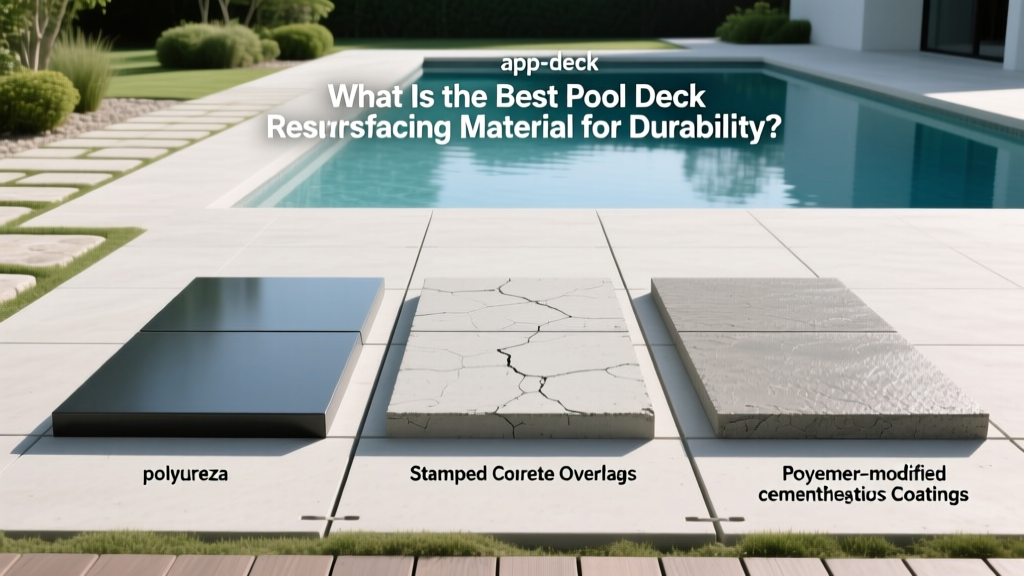
The Durability Hierarchy: Ranking Pool Deck Resurfacing Materials
When evaluating what is the best pool deck resurfacing material, the answer hinges entirely on your definition of durability. Are you prioritizing resistance to UV degradation, structural load-bearing capacity, or chemical resistance to chlorine and saltwater splash-out? A material that excels in heat reflection may fail rapidly in freeze-thaw climates if improperly sealed. As of 2026, the pool construction industry has largely moved away from basic acrylic sealers and standard epoxies, favoring advanced aliphatic polymers and structural porcelain overlays. Below is a definitive, field-tested breakdown of the top resurfacing materials, ranked by their long-term lifespan and failure resistance.
Material Deep-Dive: Lifespan, Costs, and Failure Modes
1. Aliphatic Polyurea and Polyaspartic Coatings (The Premium Standard)
For pure chemical and UV durability, 100% solids aliphatic polyurea is the undisputed leader. Unlike aromatic polyureas (which yellow and chalk when exposed to sunlight), aliphatic formulations contain UV-stable molecular bonds that retain their color and structural integrity for decades. Polyurea cures in a matter of hours, creating a seamless, impermeable membrane that bridges hairline cracks and resists chlorine, muriatic acid, and saltwater.
- Installed Cost (2026): $9.00 – $15.00 per square foot.
- Expected Lifespan: 15 to 20+ years.
- Primary Failure Mode: Delamination due to Moisture Vapor Transmission (MVT) from the substrate. If the concrete slab was not properly tested and primed, hydrostatic pressure will blister the coating from beneath.
- Expert Specification: Demand a minimum dry film thickness (DFT) of 40-60 mils and ensure the topcoat includes a broadcast of aluminum oxide or polymer grit to achieve a Dynamic Coefficient of Friction (DCOF) above 0.42, the wet-area safety threshold recognized by the Tile Council of North America.
2. Stamped Concrete Overlays (The Aesthetic Workhorse)
Stamped overlays utilize a polymer-modified cementitious mixture applied at a thickness of 1/4 to 1/2 inch over existing concrete. They offer the look of natural stone or brick at a fraction of the weight and cost. Modern overlays incorporate acrylic polymers that increase flexural strength, reducing the likelihood of shrinkage cracking compared to standard concrete.
- Installed Cost (2026): $12.00 – $19.00 per square foot.
- Expected Lifespan: 10 to 15 years (highly dependent on maintenance).
- Primary Failure Mode: Surface wear and UV degradation of the acrylic sealer. The overlay itself is durable, but the protective sealer must be reapplied every 2 to 3 years. Neglecting this leads to color fading and water intrusion, which causes spalling in freezing climates.
3. Spray-Texture "Knockdown" Systems (The Heat-Reflective Classic)
Often referred to generically by the legacy brand name Kool Deck, modern spray-texture systems use a Portland cement and polymer base that is sprayed through a hopper and then "knocked down" with a trowel. The resulting porous, textured surface traps air, keeping the deck significantly cooler than bare concrete or stone under direct sunlight.
- Installed Cost (2026): $7.00 – $11.00 per square foot.
- Expected Lifespan: 8 to 12 years.
- Primary Failure Mode: Flaking and pop-outs in regions with severe freeze-thaw cycles. The porous nature that makes it cool also allows water absorption; if unsealed before winter, freezing water expands and fractures the texture.
4. Porcelain Paver Overlay (The Structural Upgrade)
While not a liquid coating, installing 20mm thick exterior porcelain pavers over an existing deck (either mortar-set or on adjustable pedestals) is the ultimate structural resurfacing method. Porcelain is fired at extreme temperatures, resulting in a near-zero water absorption rate (<0.5%), making it completely impervious to freeze-thaw damage, chlorine, and UV fading.
- Installed Cost (2026): $20.00 – $32.00 per square foot.
- Expected Lifespan: 25 to 50+ years.
- Primary Failure Mode: Mortar-set installations can crack if the underlying concrete slab shifts. Pedestal systems avoid this but require precise leveling and may feel slightly hollow underfoot.
⚠️ Critical Warning: The Epoxy Trap
Never use standard epoxy coatings for outdoor pool decks. Epoxy is highly susceptible to photodegradation. Within 12 to 18 months of direct UV exposure, epoxy will amber, chalk, and become brittle. Furthermore, when wet, smooth epoxy drops to a DCOF of less than 0.20, creating a severe slip hazard that violates safety guidelines outlined by the Pool & Hot Tub Alliance.
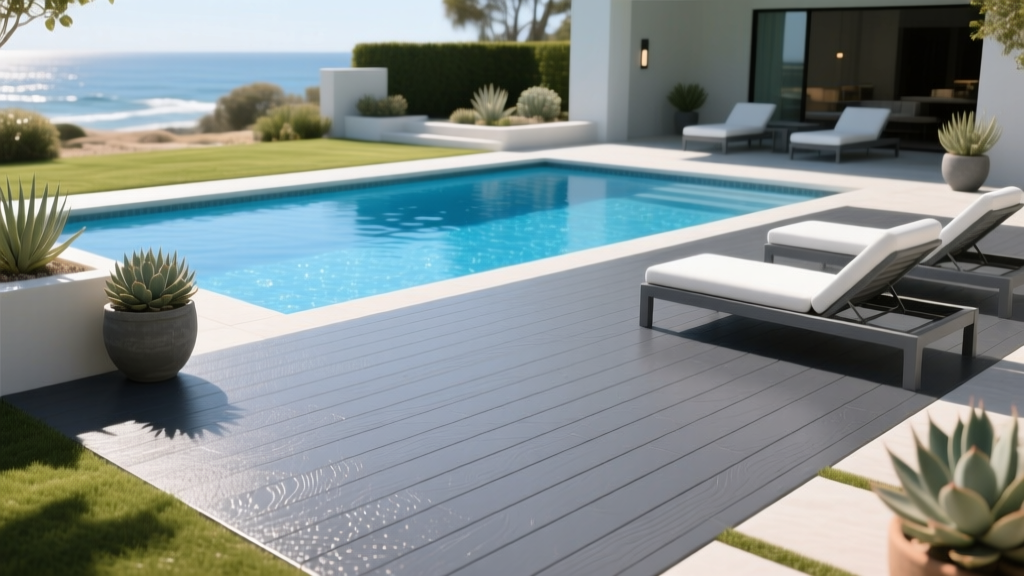
Comparative Matrix: Lifespan vs. Cost vs. Maintenance
| Material | Installed Cost (per sq ft) | Expected Lifespan | UV Stability | Maintenance Cycle | Heat Retention |
|---|---|---|---|---|---|
| Aliphatic Polyurea | $9.00 - $15.00 | 15 - 20+ Years | Excellent (Non-yellowing) | Minimal (Clean only) | Moderate |
| Stamped Overlay | $12.00 - $19.00 | 10 - 15 Years | Good (Sealer dependent) | Reseal every 2-3 yrs | High |
| Spray Knockdown | $7.00 - $11.00 | 8 - 12 Years | Good | Reseal every 2 yrs | Low (Coolest) |
| Porcelain Pavers | $20.00 - $32.00 | 25 - 50+ Years | Perfect (Inorganic) | Joint sand top-off | Moderate to High |
Critical Substrate Preparation: Where 80% of Resurfacing Fails
The most expensive polyurea or stamped overlay will fail prematurely if the substrate preparation is inadequate. The American Concrete Institute emphasizes that surface profiling and moisture testing are non-negotiable steps for any overlay application.
1. Achieving the Correct Concrete Surface Profile (CSP)
Liquid coatings and cementitious overlays require a mechanical bond, not just a chemical one. Acid etching is entirely insufficient for pool decks due to the presence of latent curing compounds and pool chemical contamination. Contractors must use closed-loop shot blasting or diamond grinding to achieve a CSP 3 or CSP 4 profile. This opens the pores of the concrete, creating a micro-texture that allows primers to penetrate deeply and lock in.
2. Moisture Vapor Transmission (MVT) Testing
Pool decks are essentially massive concrete slabs sitting on damp soil. As the sun heats the deck, moisture vapor is driven upward. If an impermeable coating like polyurea is applied over a slab with high MVT, the vapor pressure will exceed the tensile strength of the bond, causing catastrophic blistering.
- The Test: Require your contractor to perform a Calcium Chloride test (ASTM F1869) or use in-situ relative humidity probes (ASTM F2170).
- The Threshold: If MVT exceeds 3 lbs per 1,000 square feet per 24 hours, a specialized moisture-mitigating epoxy primer must be applied before the topcoat.
Decision Framework: Choosing Based on Climate and Usage
To determine what is the best pool deck resurfacing material for your specific project, apply this decision matrix based on your environmental and budgetary constraints:
Scenario A: High-Traffic Commercial or Resort Pool
Recommendation: Aliphatic Polyurea with aluminum oxide broadcast.
Why: Commercial pools face constant exposure to harsh automated cleaning chemicals, heavy foot traffic, and strict liability concerns regarding slip-and-fall accidents. Polyurea offers the highest chemical resistance and allows for rapid 24-hour cure times, minimizing facility downtime.
Scenario B: Residential Pool in a Hot, Sun-Intense Climate (e.g., Arizona, Florida)
Recommendation: Spray-Texture Knockdown or Light-Colored Porcelain Pavers.
Why: Barefoot comfort is the priority. Knockdown textures reduce surface temperatures by up to 30 degrees compared to stamped concrete. If budget allows, light-colored 20mm porcelain pavers on a pedestal system provide permanent structural cooling and zero maintenance.
Scenario C: Residential Pool in a Freeze-Thaw Climate (e.g., Midwest, Northeast)
Recommendation: Stamped Concrete Overlay (with strict sealing protocols) or Porcelain Pavers.
Why: Water intrusion followed by freezing is the primary enemy. Avoid porous knockdown textures unless you commit to rigorous annual sealing. Porcelain pavers are completely impervious to water absorption, making them immune to freeze-thaw spalling, provided the joints are properly grouted with flexible urethane or polymeric sand.
Ultimately, the best pool deck resurfacing material is the one that addresses the specific failure points of your existing slab while aligning with your willingness to perform ongoing maintenance. Always demand written warranties that explicitly cover both material defects and labor-related delamination, and verify that your contractor conducts quantitative moisture testing before a single drop of primer is applied.
Written by
Elena RodriguezElena Rodriguez is a civil engineer and technical writer specializing in concrete technology, masonry systems, and ASTM/ACI compliance. She earned her B.S. in Civil Engineering from Texas A&M University and spent a decade at a materials testing laboratory, performing over 2,000 concrete compressive strength tests and masonry prism evaluations. Elena is an ACI-certified Field Testing Technician (Grade I) and a member of ASTM Committee C12 on Natural Building Stone. She currently consults on forensic engineering cases involving concrete failures and moisture intrusion. Based in San Antonio, TX, Elena is a proud member of the Society of Women Engineers (SWE) and coaches her daughter's FIRST Robotics team.
More from Elena Rodriguez
View all
Walls & Panels
Cost Analysis: Light Gauge Steel Framing Advantages and Disadvantages
Evaluate light gauge steel framing advantages and disadvantages through a strict cost analysis lens, comparing material, labor, and lifecycle expenses.
Aug 4, 2026

Walls & Panels
Gypsum Board Types: Exact Specifications, Thickness & Dimensions
Compare standard, Type X, and moisture-resistant gypsum board types. Get exact specifications, thicknesses, dimensions, and ASTM standards for your project.
Aug 4, 2026

Fire Resistance
Best Fire-Resistant Outdoor Decking Materials: 2026 Buyer Guide
Discover the best fire-resistant outdoor decking materials for 2026. Compare Class A PVC, aluminum, and hardwood options for WUI compliance and safety.
Aug 4, 2026