Labor Cost to Build Deck: Pricing 25-Year Durability
Discover how the labor cost to build deck structures impacts long-term durability. Compare pricing tiers, framing techniques, and 25-year lifespan strategies.

The Substructure Paradox: Why Cheap Labor Destroys Expensive Materials
When homeowners evaluate the labor cost to build deck structures, the focus is overwhelmingly on the visible elements: the color of the composite boards, the style of the aluminum railings, and the layout of the fascia. However, the true lifespan of a deck is dictated entirely by the hidden substructure and the precision of the framing labor. With premium composite and mineral-based decking boards like Trex Transcend Lineage and Deckorators Vault exceeding $12 to $16 per square foot in 2026, pairing high-end materials with builder-grade labor is a critical financial error.
A deck built with top-tier PVC decking but assembled using code-minimum labor practices—such as skipping joist tape, using standard galvanized nails instead of structural screws, and setting posts directly in concrete without standoff brackets—will likely experience substructure rot or fastener failure within 10 to 12 years. At that point, the expensive surface materials must be carefully removed, the rotted framing replaced, and the deck reassembled. Paying a premium for durability-focused labor upfront is the only way to ensure your deck reaches its intended 25- to 30-year lifespan.
Labor Cost to Build Deck: 3 Durability Tiers Compared
The labor cost to build deck frameworks varies drastically based on the contractor's commitment to structural longevity. Below is a breakdown of the three primary labor tiers in the current market, illustrating exactly what you are paying for at each level.
| Durability Tier | Labor Rate (per sq. ft.) | Key Framing & Fastening Techniques | Expected Lifespan |
|---|---|---|---|
| Tier 1: Code-Minimum | $14 - $19 | Standard hot-dipped galvanized nails; 4x4 notched posts; no joist flashing; posts buried in concrete. | 8 - 12 Years |
| Tier 2: Enhanced | $20 - $27 | Structural screws for framing; basic asphalt joist tape; 6x6 posts with standard metal post bases. | 15 - 20 Years |
| Tier 3: Heirloom | $28 - $38+ | Butyl joist tape; hidden composite fasteners; elevated standoff brackets; bell-bottom frost footings. | 25 - 30+ Years |
High-Impact Labor Techniques for 25+ Year Lifespans
To justify the Tier 3 labor cost to build deck structures, contractors must execute specific, time-intensive techniques that directly combat the primary enemies of deck longevity: moisture intrusion, frost heave, and thermal expansion.
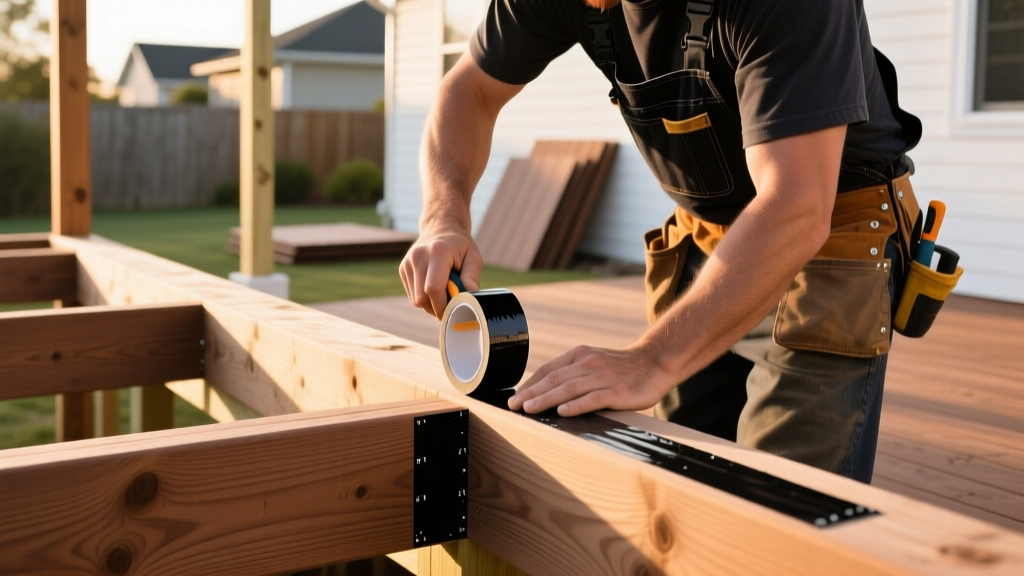
1. Butyl Joist Tape Application
Pressure-treated lumber checks (cracks) as it dries, creating direct pathways for water to pool on top of the joists. This leads to dry rot and premature structural failure. Premium labor includes wrapping the top edge of every joist, beam, and ledger board with a butyl-based waterproofing tape, such as Trex Protect or G-Tape. Unlike asphalt-based tapes that become brittle and peel after a few seasons of UV exposure and temperature fluctuations, butyl tape remains pliable and forms a permanent seal around the fastener penetrations. Applying this tape adds roughly $1.50 to $2.50 per square foot to the labor cost, but it effectively doubles the lifespan of the wooden substructure.
2. Frost-Heave Resistant Footings
According to the American Wood Council's DCA-6 Deck Construction Guide, footings must extend below the local frost line to prevent the ground from freezing, expanding, and lifting the deck posts. Budget laborers often dig shallow holes and dump concrete directly around the wooden post. Premium labor involves digging to the proper depth (often 36 to 48 inches in northern climates), using sonotubes to form a smooth concrete cylinder, and installing a bell-bottom base for added load distribution. Crucially, the wooden post must never touch the concrete; it must be mounted to an elevated standoff bracket (like the Simpson Strong-Tie ZMAX E-Z Base) to prevent capillary moisture wicking, which rots the bottom of the post.
3. Thermal Expansion Management
Composite and PVC decking expand and contract significantly with temperature changes. PVC boards, in particular, can expand up to 1/4 inch per 10 feet of length. If laborers butt the boards tightly together without accounting for the installation temperature, the deck will buckle and warp during summer heatwaves. Expert laborers calculate the exact gap required based on the ambient temperature on the day of installation, ensuring the hidden fastener system (such as Trex Hideaway) is placed precisely to allow for lateral movement without compromising board alignment.
ROI Framework: Upfront Labor vs. Rebuild Costs
Understanding the long-term financial impact requires looking past the initial invoice. Consider a standard 400-square-foot deck build using mid-tier composite materials.
- Tier 1 Labor Scenario ($16/sq. ft.): Initial labor cost is $6,400. By year 12, the joists have rotted due to lack of flashing, and the galvanized nails have rusted and popped. The deck must be entirely rebuilt. Total 25-year cost: $12,800 (two builds) + material replacement.
- Tier 3 Labor Scenario ($32/sq. ft.): Initial labor cost is $12,800. The butyl tape and structural screws keep the framing pristine for 25+ years. At year 25, only the surface boards might need refreshing. Total 25-year cost: $12,800.
The data is clear: paying double for the labor cost to build deck structures initially results in a net-zero or net-positive financial outcome over a 25-year horizon, while entirely eliminating the hassle, mess, and inflation-adjusted costs of a premature rebuild.
Contractor Vetting Checklist for Durability
Do not rely on a contractor's verbal assurance that they 'build things to last.' Use this specific technical checklist during the bidding process to verify their expertise. If they cannot answer these questions definitively, they are not qualified for a Tier 3 build.
- Joist Protection: 'What specific brand of butyl tape do you use on the framing, and does your quote include taping the ledger board and all beam caps?'
- Fastener Specifications: 'Do you use ring-shank nails or structural screws (like Simpson Strong-Tie SDWS) for the framing connections?'
- Post Bases: 'Will the 6x6 posts be embedded in concrete, or will you use an elevated standoff bracket with a 1-inch clearance above the footing?'
- Hidden Fasteners: 'How do you calculate the spacing for hidden fasteners to accommodate thermal expansion for the specific composite brand we are using?'
By rigorously vetting the labor cost to build deck frameworks against these durability benchmarks, you ensure your outdoor living space remains safe, structurally sound, and visually flawless for decades. For further reading on structural safety and maintenance, consult the North American Decking and Railing Association (NADRA) consumer guidelines on deck inspections and code compliance.
Written by
David NakamuraDavid Nakamura is a licensed architect (AIA) and construction technology writer focused on sustainable building methods, mass timber engineering, and high-performance building envelopes. He holds a Master of Architecture from the University of Washington and is a certified Passive House Consultant (CPHC). David spent eight years at the Seattle firm Mithun, where he led the design of three LEED Platinum projects, before founding his own practice specializing in net-zero residential design. He serves on the editorial advisory board of GreenBuilder Magazine and has authored peer-reviewed papers on cross-laminated timber (CLT) connections for the Journal of Structural Engineering. In his spare time, David teaches woodworking at Pratt Fine Arts Center and kayaks the Puget Sound.
More from David Nakamura
View all
Construction Cost
Labor Cost to Build a Deck Per Sq Ft: 2026 Installation Guide
Discover the exact labor cost to build a deck per sq ft in 2026. This installation guide breaks down contractor rates, complexity factors, and hidden fees.
Aug 4, 2026

Construction Cost
How Much Does It Cost to Build a 3 Bedroom House? Financing Guide
Learn exactly how much it costs to build a 3 bedroom house and explore 2026 financing options, construction loan types, and budget frameworks for your build.
Aug 4, 2026

Construction Cost
Cost to Build a Tennis Court: 2026 Guide
How much does it cost to build a tennis court in 2026? Breakdowns for asphalt, concrete, and synthetic surfaces plus fencing and lighting.
Jul 30, 2026