How Maintenance Alters the Approximate Cost to Build a Deck
Discover how long-term maintenance impacts the approximate cost to build a deck, comparing 20-year ownership costs for wood, composite, and aluminum.

The Hidden Variable in Your Deck Budget
When homeowners research the approximate cost to build a deck, online calculators and contractor quotes typically stop at the final installation invoice. However, viewing your deck solely through the lens of upfront material and labor costs leads to severe budget shock down the line. A deck is an exposed exterior structure subjected to UV radiation, freeze-thaw cycles, and moisture intrusion. The true financial impact of your project is defined by its Total Cost of Ownership (TCO), which heavily weights the decades of maintenance required to keep the structure safe and visually appealing.
According to industry data from Angi's deck cost guides, the national average for upfront deck construction ranges from $4,000 to over $15,000 depending on square footage and material. Yet, a pressure-treated wood deck can easily accumulate $3,000 to $5,000 in chemical treatments, sanding, and board replacements over a 20-year lifespan. Conversely, premium capped composites and aluminum decking demand near-zero structural maintenance, effectively flattening the long-term cost curve. This guide deconstructs the maintenance realities of major decking materials to reveal how they alter the approximate cost to build a deck over time.
The Total Cost of Ownership (TCO) Formula
To accurately budget for your outdoor space, apply this framework:
TCO = Upfront Construction Cost + (Annualized Maintenance Cost × Expected Lifespan) + Substructure Replacement Risk
Note: Substructure replacement risk is often ignored. If joist tape is not applied during initial construction, pressure-treated framing can rot by year 15, requiring a $3,000+ structural teardown regardless of the surface material you chose.
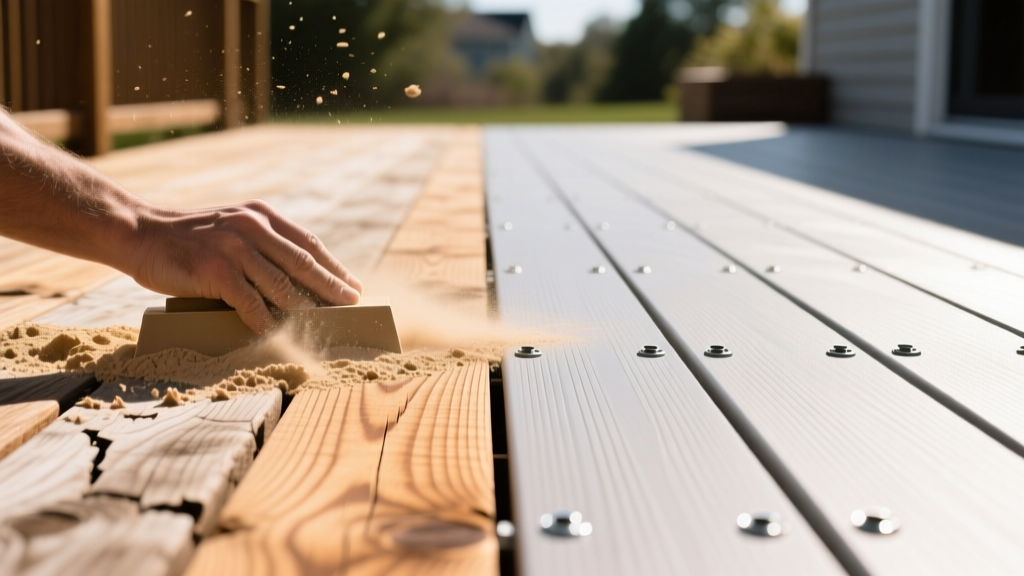
Upfront vs. Long-Term: Material Cost Matrix
The table below illustrates how the approximate cost to build a deck shifts when 20 years of mandatory maintenance is factored into the equation. Costs are based on a standard 200-square-foot deck, including 2026 material pricing and professional application rates where applicable.
| Decking Material | Upfront Cost (per sq. ft.) | 20-Year Maintenance Cost | Estimated 20-Year TCO |
|---|---|---|---|
| Pressure-Treated Pine | $18 - $25 | $14 - $22 / sq. ft. | $32 - $47 / sq. ft. |
| Cedar / Redwood | $28 - $35 | $16 - $25 / sq. ft. | $44 - $60 / sq. ft. |
| Tropical Hardwood (Ipe) | $35 - $50 | $8 - $18 / sq. ft. | $43 - $68 / sq. ft. |
| Capped Composite | $32 - $48 | $1 - $3 / sq. ft. | $33 - $51 / sq. ft. |
| Powder-Coated Aluminum | $45 - $65 | $0 / sq. ft. | $45 - $65 / sq. ft. |
Wood Deck Maintenance: The Annual Grind
Wood remains the most popular choice for keeping the initial approximate cost to build a deck low, but it demands a rigorous, cyclical maintenance schedule. The USDA Forest Products Laboratory notes that unprotected wood exposed to sunlight undergoes photo-degradation, where UV rays break down the lignin that holds wood fibers together, leading to graying, checking, and splintering.
Pressure-Treated Pine and Cedar
To prevent structural decay and aesthetic degradation, softwoods require cleaning and sealing every 18 to 24 months. The type of sealant you choose drastically alters your long-term labor costs:
- Film-Forming Stains (Solid Color Acrylics): These sit on top of the wood like paint. While they provide excellent UV protection, they trap moisture and inevitably peel or flake after 2-3 years. Removing them requires chemical strippers and aggressive sanding, pushing maintenance costs to $4.00+ per square foot per cycle.
- Penetrating Oils (e.g., Defy Extreme, Armstrong Clark): These soak into the wood pores and condition the fibers. They do not peel; they simply fade over time. Reapplication requires only a light wash with a wood brightener (oxalic acid) and a new coat, reducing maintenance costs to roughly $1.50 per square foot.
Tropical Hardwoods (Ipe, Cumaru, Tigerwood)
Dense hardwoods resist rot and insects naturally, but they are not immune to UV graying. If you wish to maintain the rich, dark mahogany tones of Ipe, you must apply a specialized hardwood oil (like Penofin Hardwood Formula) annually. Because hardwoods are so dense, they absorb very little oil, meaning you will spend heavily on premium UV-inhibiting products and labor. Alternatively, you can allow the wood to weather to a silvery gray. This costs $0 in maintenance but requires you to accept a completely different aesthetic and may void certain manufacturer warranties regarding surface checking.
Composite and PVC Decking: The Low-Maintenance Reality
Capped composite decking (such as Trex Transcend or TimberTech Legacy) and cellular PVC (like AZEK) fundamentally alter the approximate cost to build a deck by shifting the financial burden to day one. The polymer cap encapsulates the board, making it impervious to moisture absorption, rot, and insect damage.
Warning: The Power Washing Warranty Trap
A common maintenance error that destroys composite decks is using high-pressure washers. Trex officially warns against using pressure washers exceeding 3,100 PSI. High pressure can etch, gouge, and permanently strip the protective polymer cap off the composite core, instantly voiding the 25-to-50-year fade and stain warranty. Always use a garden hose, a soft-bristle brush, and a mild composite deck cleaner for routine maintenance.
While composites do not require sanding or sealing, they are not entirely maintenance-free. In heavily shaded areas or damp climates, organic matter like pollen, leaves, and tree sap can accumulate and foster surface mold or mildew. Homeowners must commit to sweeping debris weekly and washing the deck with a specialized composite cleaner (or simple dish soap and warm water) twice a year. Over 20 years, this amounts to a few hundred dollars in cleaning supplies and a few hours of manual labor annually—a massive reduction compared to the thousands spent on wood staining.
Aluminum Decking: The Zero-Maintenance Premium
Aluminum decking systems (such as Wahoo Decks or AridDek) represent the highest upfront approximate cost to build a deck, but they offer a true zero-maintenance surface. Extruded aluminum is powder-coated with architectural-grade resins (AAMA 2604 standard) that resist fading, chalking, and scratching. Aluminum will never rot, warp, splinter, or harbor mold.
The only maintenance required for an aluminum deck is ensuring the integrated drainage channels remain clear of debris. If leaves or pine needles clog the gutters built into the interlocking aluminum boards, water can pool and eventually overflow onto the substructure below. A quick pass with a leaf blower twice a year is the only upkeep required, making aluminum the undisputed champion of long-term cost predictability.
The Forgotten Cost: Substructure Maintenance
When calculating the approximate cost to build a deck, homeowners obsess over the surface boards but ignore the joists beneath. Standard pressure-treated SPF (Spruce-Pine-Fir) joists are highly susceptible to moisture trapping, especially where composite or PVC boards are installed tightly together with minimal gaps for airflow. Water pools on top of the joists, accelerating rot.
The Fix: During initial construction, apply a butyl-based joist tape (such as Trex Protect or Grace Vycor Deck Protector) to the top edge of every joist and beam. This adds roughly $0.50 to $0.75 per square foot to your upfront budget but prevents catastrophic substructure failure at year 15. Replacing a rotted substructure beneath a perfectly intact composite surface can cost upwards of $4,000 in labor and materials, entirely destroying the ROI of your premium decking investment.
Decision Framework: Matching Material to Maintenance Tolerance
Use this practical framework to finalize your material choice based on your willingness to perform ongoing maintenance:
- The Weekend Warrior (15+ hours/year available): Choose Pressure-Treated Pine or Cedar. You accept the lowest upfront approximate cost to build a deck in exchange for annual power washing, brightening, and applying penetrating oil stains. You enjoy the natural feel of wood and don't mind the physical labor.
- The Pragmatist (2-4 hours/year available): Choose Capped Composite. You are willing to pay a 30% to 50% premium upfront to eliminate sanding and sealing. You only have time to sweep the deck and wash it with soap and water a few times a year to prevent surface pollen buildup.
- The Absentee / Luxury Owner (0 hours/year available): Choose Aluminum Decking. You are building a deck for a rental property, a vacation home, or simply refuse to spend a single weekend doing yard work. You absorb the highest initial approximate cost to build a deck to guarantee zero structural or aesthetic maintenance for the next 40 years.
Ultimately, the approximate cost to build a deck is merely the down payment on your outdoor living space. By evaluating materials through the lens of 20-year maintenance requirements, you can select a decking system that aligns not just with your current construction budget, but with your long-term financial and lifestyle goals.
Written by
James ThorntonJames Thornton is a construction industry veteran with 25 years of hands-on experience in wood framing, lumber grading, and residential building codes. He started as a framing carpenter in rural Oregon, earned his ICC Residential Building Inspector certification, and eventually became a senior plan reviewer for the City of Portland Bureau of Development Services. James holds a B.S. in Wood Science & Technology from Oregon State University and is a certified lumber grader through the West Coast Lumber Inspection Bureau (WCLIB). He has inspected over 3,000 residential construction sites and authored the city's internal guide on advanced framing techniques (2x6 at 24" O.C.). James lives in Bend, OR, where he builds custom timber-frame cabins and competes in lumberjack sports.
More from James Thornton
View all
Insulation
Best Home Insulation Materials: Complete 2026 Guide
Compare top home insulation materials for 2026. Find R-values, installed costs per square foot, and best uses for fiberglass, spray foam, and mineral wool.
Aug 4, 2026

Sustainable Building
Certify Your Green Building Material for LEED and WELL
Step-by-step guide to certifying a green building material for LEED v5 and WELL v2. Master EPDs, HPDs, and VOC limits for 2026 project specifications.
Aug 4, 2026

Stone & Masonry
Veneer Stacked Stone Panels: Interior Design & Style Showcase
Discover how veneer stacked stone panels transform interiors. Explore modern design profiles, material pairings, and technical installation specs.
Aug 4, 2026