2026 Cost to Build Deck: Installation & Material Breakdown
Discover the true cost to build deck in 2026. This installation guide breaks down material pricing, labor rates, framing, and hidden fastener expenses.

The True Cost Breakdown by Installation Phase
Calculating the accurate cost to build deck requires moving beyond generic square-foot averages. In 2026, national installed costs range from $25 to $65 per square foot, but this variance is driven by specific installation methodologies, structural framing requirements, and fastener selections. According to industry data from Angi's 2026 deck cost guide, labor accounts for 45% to 55% of the total budget, meaning the installation techniques you choose directly dictate your final expenditure.
2026 Baseline Cost Matrix (Installed):
• Pressure-Treated Wood: $25 – $32 per sq. ft.
• Capped Wood Composite: $38 – $48 per sq. ft.
• Advanced PVC Decking: $50 – $65 per sq. ft.
Note: Multi-level decks, complex stair systems, and integrated lighting will push these baselines up by 20% to 35%.
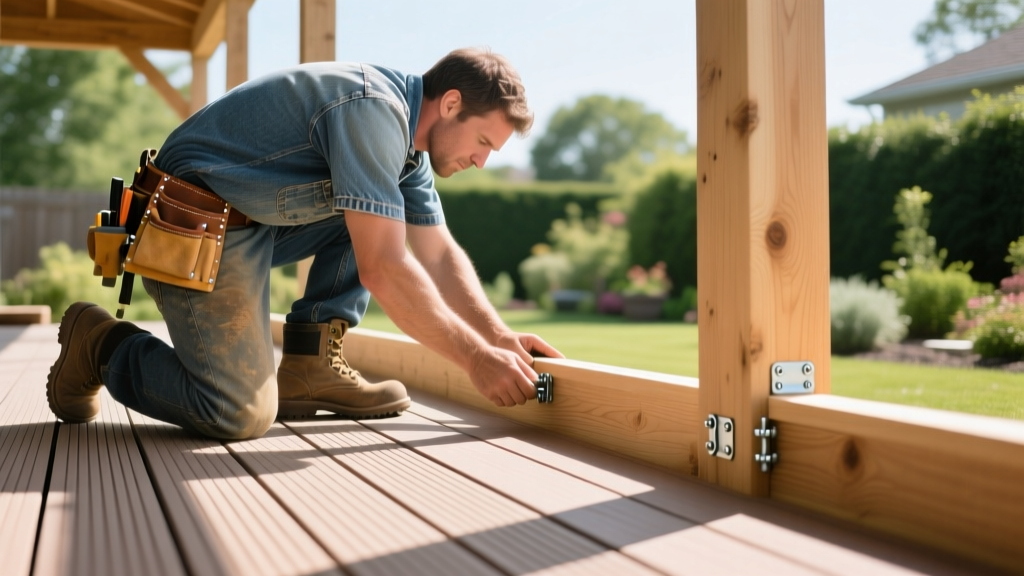
Phase 1: Footings and Framing (The Hidden Costs)
The substructure is where budgets frequently overrun due to unforeseen soil conditions or outdated code compliance. The American Wood Council’s Prescriptive Residential Deck Construction Guide (DCA-6) mandates rigorous load-bearing standards that impact material and labor costs.
Footings: Poured Concrete vs. Helical Piers
Traditional poured concrete footings require digging below the local frost line, setting Sonotubes, and waiting for the concrete to cure. In 2026, labor and excavation for poured concrete average $180 to $250 per footing. Alternatively, helical piers (such as Techno Metal Post systems) are driven into the ground using hydraulic machinery. While the material cost per pier is higher ($220 to $320), they eliminate excavation, curing time, and concrete disposal, often reducing overall phase-one labor costs by 15%.
Framing Lumber and Joist Spacing
Standard framing utilizes #2 grade or better pressure-treated Southern Yellow Pine. However, the decking material you select dictates the joist spacing, which alters lumber costs:
- Wood Decking: Requires 16-inch on-center (OC) joist spacing. Standard framing cost: $6.50 – $8.00 per sq. ft.
- Composite/PVC Decking: Most manufacturers (like Trex and TimberTech) require 12-inch OC joist spacing for diagonal installations or specific heavy-duty PVC lines. This increases framing lumber requirements by roughly 25%, raising the framing cost to $8.50 – $10.50 per sq. ft.
Pressure-treated lumber retains moisture and accelerates corrosion. Failing to apply butyl joist flashing tape (e.g., G-Tape or Trex Protect) over the top edge of every joist and ledger board will void most composite decking warranties. Budget $0.45 to $0.75 per linear foot for joist tape; it is a non-negotiable expense that doubles the lifespan of your substructure.
Phase 2: Decking Material and Fastener Selection
The visible surface represents the largest material line item. When evaluating the cost to build deck surfaces, you must factor in the fastening system. Hidden fasteners cost more upfront but reduce long-term maintenance and prevent surface water intrusion.
| Material Type (2026 Models) | Material Cost / Sq. Ft. | Fastener System & Cost | Install Labor / 100 Sq. Ft. |
|---|---|---|---|
| Pressure-Treated Pine | $4.50 – $7.00 | Face screws (GRK RSS) – $0.80/sq ft | 6 – 8 Hours |
| Capped Composite (Trex Transcend Lineage) | $11.00 – $15.00 | Hidden Clips (Trex Hideaway) – $2.20/sq ft | 8 – 10 Hours |
| Advanced PVC (TimberTech Landmark) | $16.00 – $22.00 | Edge Fasteners (CAMO) – $3.10/sq ft | 7 – 9 Hours |
Expert Insight on Fasteners: If you choose square-edge composite boards to save on material costs, you must use specialized edge fastening tools like the CAMO Edge system. Standard face-screwing into composite or PVC boards traps moisture in the screw divot, leading to localized swelling and mold growth within two seasons.
Phase 3: Stairs, Railings, and Code Compliance
Stairs and railings are the most expensive components on a per-linear-foot basis. A straight 16-foot run of composite decking might cost $800 in materials, while a single 4-step stair stringer system with matching composite treads and risers can easily exceed $1,200 in materials and specialized carpentry labor.
Stair Stringer Installation
Pre-cut pressure-treated stringers cost roughly $25 each, but they rarely align perfectly with custom deck heights and local code requirements for tread depth (minimum 10 inches) and riser height (maximum 7.75 inches). Custom-cutting stringers from 2x12 lumber requires precise calculation of the "rise and run." Carpenters typically charge an additional $150 to $250 per flight of stairs for the layout and cutting labor alone, exclusive of the composite stair tread materials which must be picture-framed for a finished look.
Railing Systems
Railing costs vary wildly based on material and sightline requirements:
- Pressure-Treated Wood Balusters: $25 – $35 per linear foot. High maintenance, requires annual sealing.
- Composite Sleeve Railings: $60 – $85 per linear foot. Features a wood core wrapped in composite. Heavy and requires precise post-sleeve installation.
- Aluminum Frame with Cable Mesh (e.g., Trex Signature): $110 – $160 per linear foot. Offers unobstructed views and near-zero maintenance, but requires specialized tensioning tools during installation.
Labor vs. DIY: Where You Save and Where You Risk Failure
According to Fine Homebuilding’s deck construction archives, the most catastrophic deck failures occur at the ledger board—the horizontal piece of lumber that attaches the deck frame to the house. This single connection point bears the majority of the deck's live and dead loads.
If you are DIYing the build to reduce the cost to build deck, never use standard lag bolts without proper flashing. The 2026 standard requires 1/2-inch hot-dipped galvanized structural screws (like Simpson Strong-Tie SDWS) spaced according to the joist span. Furthermore, you must peel back the house siding to install Z-flashing behind the weather-resistant barrier, and apply self-adhering waterproof membrane over the top edge of the ledger. Skipping this $150 flashing step is the primary cause of residential structural rot and subsequent deck collapse.
When to Hire a Professional
While surface decking and railing assembly are well within the capabilities of an advanced DIYer, site grading, helical pier driving, and complex stair engineering require professional equipment and code knowledge. In 2026, licensed deck contractors charge between $65 and $95 per hour. Hiring a professional for the substructure and ledger attachment, then taking over the composite decking and railing installation yourself, is a hybrid approach that can save 20% on total labor costs while ensuring the structural integrity of the build passes municipal inspection.
Regional Variance and Permitting Costs
Finally, the cost to build deck is heavily influenced by local permitting and soil conditions. In regions with expansive clay soils (like parts of Texas and Colorado), engineers may require deeper footings or specialized helical piers, adding $800 to $1,500 to the foundation budget. Coastal regions require marine-grade stainless steel fasteners and hardware (Simpson Strong-Tie ZMAX or stainless lines) to prevent salt-spray corrosion, which increases hardware costs by 40%. Always factor in $250 to $600 for municipal building permits and mandatory mid-construction footing inspections before finalizing your budget.
Written by
David NakamuraDavid Nakamura is a licensed architect (AIA) and construction technology writer focused on sustainable building methods, mass timber engineering, and high-performance building envelopes. He holds a Master of Architecture from the University of Washington and is a certified Passive House Consultant (CPHC). David spent eight years at the Seattle firm Mithun, where he led the design of three LEED Platinum projects, before founding his own practice specializing in net-zero residential design. He serves on the editorial advisory board of GreenBuilder Magazine and has authored peer-reviewed papers on cross-laminated timber (CLT) connections for the Journal of Structural Engineering. In his spare time, David teaches woodworking at Pratt Fine Arts Center and kayaks the Puget Sound.
More from David Nakamura
View all
Construction Cost
Labor Cost to Build a Deck Per Sq Ft: 2026 Installation Guide
Discover the exact labor cost to build a deck per sq ft in 2026. This installation guide breaks down contractor rates, complexity factors, and hidden fees.
Aug 4, 2026

Construction Cost
How Much Does It Cost to Build a 3 Bedroom House? Financing Guide
Learn exactly how much it costs to build a 3 bedroom house and explore 2026 financing options, construction loan types, and budget frameworks for your build.
Aug 4, 2026

Construction Cost
Cost to Build a Tennis Court: 2026 Guide
How much does it cost to build a tennis court in 2026? Breakdowns for asphalt, concrete, and synthetic surfaces plus fencing and lighting.
Jul 30, 2026