Cost to Build Deck Per Square Foot: 2026 Material Comparison
Compare the 2026 cost to build deck per square foot across wood, composite, PVC, and aluminum. Get exact material and labor pricing breakdowns.
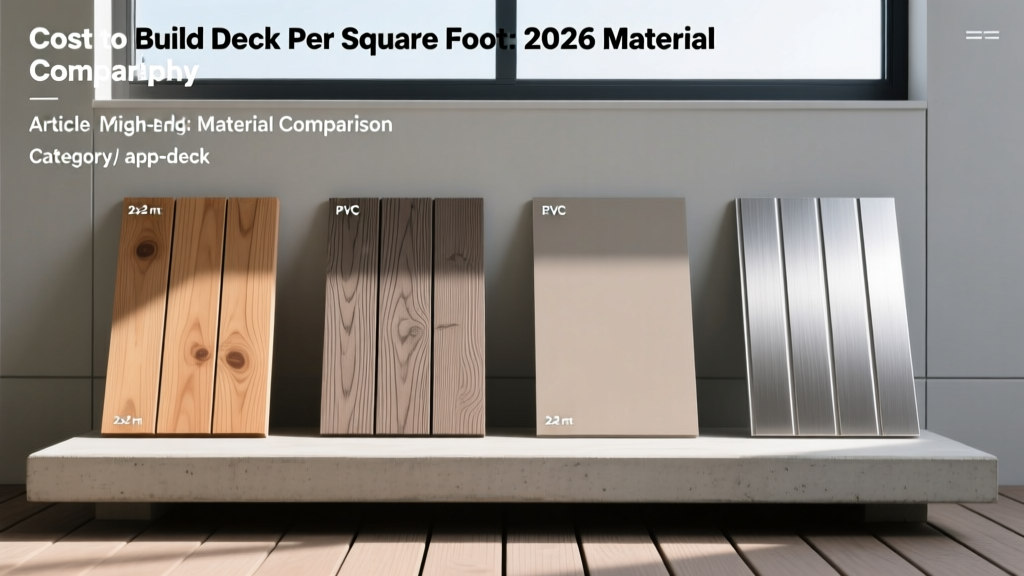
The 2026 Decking Material Cost Matrix
Calculating the true cost to build deck per square foot requires isolating surface materials from substructure framing and regional labor rates. In 2026, supply chain stabilization has normalized lumber prices, but advanced polymer composites and marine-grade aluminum continue to command premium pricing due to manufacturing complexities and raw material costs. The matrix below breaks down the baseline installed costs for a standard 16x20 (320 sq. ft.) ground-level deck, excluding complex stairs, custom railings, or demolition.
| Material Type | Material Cost / SqFt | Labor Cost / SqFt | Total Installed / SqFt | Est. Lifespan |
|---|---|---|---|---|
| Pressure-Treated Pine | $3.50 - $5.00 | $15.00 - $22.00 | $18.50 - $27.00 | 10-15 Years |
| Cedar / Redwood | $6.00 - $9.00 | $18.00 - $25.00 | $24.00 - $34.00 | 15-20 Years |
| Capped Composite | $9.00 - $14.00 | $20.00 - $28.00 | $29.00 - $42.00 | 25-30 Years |
| Advanced PVC | $11.00 - $16.00 | $22.00 - $30.00 | $33.00 - $46.00 | 30-50 Years |
| Extruded Aluminum | $18.00 - $26.00 | $25.00 - $35.00 | $43.00 - $61.00 | 50+ Years |
Material Deep Dive: Beyond the Surface Price
Surface material costs represent only 30% to 45% of the total project budget. To accurately forecast your cost to build deck per square foot, you must understand the installation nuances and hidden requirements of each material class.
Pressure-Treated Wood (The Budget Baseline)
The most common choice remains #2 Southern Yellow Pine treated with CA-C (Copper Azole) or ACQ (Alkaline Copper Quaternary) preservatives. While the upfront material cost is exceptionally low ($3.50–$5.00/sq. ft.), the chemical composition of modern pressure-treated lumber is highly corrosive to standard steel. You must specify hot-dipped galvanized fasteners meeting ASTM A153 standards or stainless steel hardware. Using standard zinc-plated screws will result in severe corrosion and structural failure within three to five years. Furthermore, wood requires a 16-inch on-center (OC) joist spacing and annual sealing, adding roughly $1.50 per square foot in annualized maintenance costs.
Capped Composite (The Market Standard)
Capped composite boards, such as Trex Transcend Lineage or TimberTech Landmark, utilize a wood-flour core encased in a high-density polyethylene (HDPE) or PVC shell. Material costs range from $9.00 to $14.00 per square foot. The critical installation variable for composite is thermal expansion. Depending on the regional temperature delta, a 16-foot composite board can expand or contract up to 1/8 of an inch. Installers must use specialized hidden fastening systems (like the Simpson Strong-Tie DFDO125) that allow for longitudinal movement while maintaining consistent 3/16-inch gapping. Failure to account for this expansion results in buckling during peak summer heat.
Aluminum (The Premium & WUI-Compliant Niche)
Extruded 6061-T6 marine-grade aluminum decking (e.g., Wahoo Decks or Nexan Building Products) costs between $18.00 and $26.00 per square foot for materials alone. While expensive, aluminum offers a unique structural advantage: it can span 24 inches OC compared to the 16 inches OC required for wood and composite. This allows builders to reduce the total linear footage of substructure joists, partially offsetting the premium surface cost. Additionally, aluminum is non-combustible, making it the only code-compliant surface material for decks in strict Wildland-Urban Interface (WUI) zones outlined by FEMA and local fire marshals.
The Substructure: Where Per-Square-Foot Estimates Fail
Warning: The Framing Blindspot
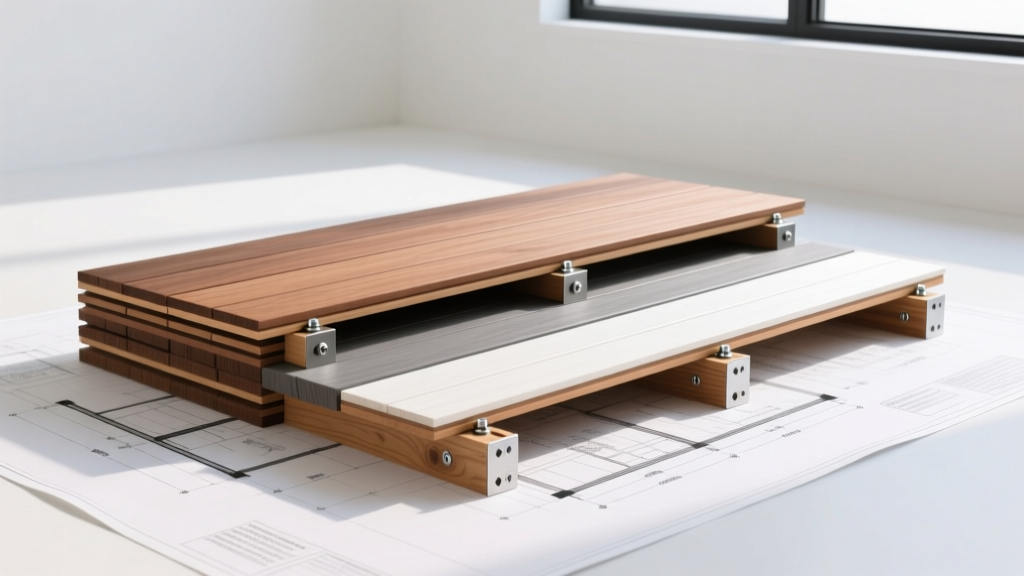
Online calculators frequently quote a 'cost to build deck per square foot' that assumes an existing, code-compliant substructure. If you are building from scratch, the pressure-treated framing, concrete footings, and hardware will add an additional $12.00 to $18.00 per square foot to your total budget. Upgrading to a light-gauge steel framing system (like Trex Elevations) will push substructure costs to $22.00+ per square foot.
To protect your substructure investment, applying a butyl-based joist tape (such as G-Tape or Trex Protect) is mandatory in 2026 for any high-performance build. Asphalt-based tapes degrade under UV exposure and high heat, whereas butyl tape seals around fastener penetrations and prevents moisture intrusion that leads to joist rot. This adds approximately $0.75 to $1.10 per square foot to the framing budget but doubles the lifespan of the substructure.
Foundation choices also drastically alter the per-square-foot metric. Traditional Sonotube concrete footings require extensive excavation and curing time. In contrast, helical piles (e.g., Diamond Helical Piers) can be driven into the ground with hydraulic machinery in a single day, supporting loads up to 10,000 lbs per pier without concrete. While helical piles cost roughly 20% more per footing than poured concrete, the elimination of excavation labor and curing delays often results in a net-zero cost difference for complex or sloped sites.
Regional Labor Multipliers and Site Complexity
Labor rates dictate the final variance in your cost to build deck per square foot. According to data aggregated by Angi's 2026 deck cost analysis, regional multipliers must be applied to baseline estimates:
- High-Cost of Living (HCOL) Regions: Northeast and West Coast markets (e.g., Boston, San Francisco) command labor rates between $35 and $55 per square foot. Union requirements, strict permitting, and high insurance overhead drive these numbers.
- Medium-Cost of Living (MCOL) Regions: Midwest and Mid-Atlantic markets (e.g., Chicago, Raleigh) see labor rates stabilizing between $20 and $30 per square foot.
- Low-Cost of Living (LCOL) Regions: Deep South and rural markets (e.g., Alabama, Arkansas) offer labor rates from $15 to $22 per square foot.
Site complexity acts as a secondary multiplier. A second-story deck requiring scaffolding, structural ledger board flashing (to prevent home envelope water intrusion), and custom stair stringers will increase labor costs by 30% to 50% compared to a simple ground-level floating deck. Stairs are rarely priced by the square foot; instead, expect to pay $250 to $400 per tread for composite-capped stair construction due to the intensive mitering and hidden fastener work required.
10-Year Lifecycle Cost Analysis
Evaluating the cost to build deck per square foot purely on day-one installation expenses leads to poor long-term capital allocation. When analyzing the 10-year lifecycle cost, the gap between wood and composite narrows significantly.
A properly installed capped composite deck requires zero chemical sealing, sanding, or staining. Over a decade, a pressure-treated wood deck will require approximately $4.50 to $6.00 per square foot in cumulative maintenance materials and professional labor, effectively erasing the initial material savings when compared to mid-tier composite options.
— Derived from Fine Homebuilding Decking Guides and long-term material degradation studies.
For homeowners planning to stay in their property for less than seven years, pressure-treated wood with a high-quality oil-based sealer remains the most financially logical choice. For those holding the property for a decade or more, or those building in high-moisture and high-UV environments, capped composite or advanced PVC provides a superior return on investment through eliminated maintenance and extended structural warranties. Aluminum remains reserved for specialized applications, such as WUI compliance, rooftop decks where weight restrictions apply, or zero-maintenance commercial installations.
Written by
Priya KapoorPriya Kapoor is a real estate market analyst and construction economics researcher with expertise in housing affordability, development feasibility, and infrastructure investment. She holds a Master of Regional Planning from Cornell University and previously worked as a senior analyst at CBRE's Investment Properties group, where she modeled returns for $4B in mixed-use development pipelines. Priya now runs an independent research practice advising developers, municipalities, and REITs on construction cost forecasting and market timing. She publishes the quarterly "BuildMat Market Pulse" report tracking material price indices across 12 commodity categories. Based in Austin, TX, Priya serves on the board of Habitat for Humanity Austin and is a marathon runner.
More from Priya Kapoor
View all
Construction Cost
Cost to Build a 1600 Sq Ft Home in 2026: Full Breakdown
Accurate 2026 cost to build a 1600 sq ft home—material, labor, and regional pricing breakdowns included. Plan your budget with real-time estimates.
Aug 11, 2026

Wood & Lumber
Name the Types of Wood for Pressure Treatment and Preservation
Learn how to name the types of wood best suited for pressure treatment. Compare species treatability, chemical retention levels, and 2026 preservation costs.
Aug 4, 2026

Stone & Masonry
Stone Veneer Suppliers Lindenhurst: 2026 Cost Analysis
Analyze 2026 stone veneer costs in Lindenhurst, NY. Compare local supplier pricing, delivery fees, and Suffolk County installation labor rates.
Aug 4, 2026