Your 16 x 16 Deck Materials List: A Long-Term Maintenance Guide
Optimize your 16 x 16 deck materials list for long-term upkeep. Discover exact quantities, seasonal schedules, and repair caches for 256 sq ft decks.

A 16 x 16 deck encompasses exactly 256 square feet of outdoor living space. When contractors draft a 16 x 16 deck materials list, they typically focus exclusively on day-one construction: framing lumber, decking boards, and fasteners. However, a truly comprehensive materials list must account for the structure’s entire lifecycle. Maintenance is not an afterthought; it is a calculated inventory of consumables, replacement parts, and specialized tools required to protect your investment against UV degradation, moisture intrusion, and mechanical wear.
This guide redefines the standard materials list by integrating precise mathematical requirements for a 256-square-foot footprint, bridging the gap between initial construction and decade-long upkeep.
The Day-One Materials List That Dictates Future Maintenance
The maintenance burden of a 16 x 16 deck is determined before the first board is laid. To minimize future upkeep, your initial procurement list must include specific protective materials. For a standard 16x16 footprint framed at 16 inches on-center (OC), you will have 13 joists, each 16 feet long, totaling 208 linear feet of framing.
- Joist Protection Tape: You need exactly 208 linear feet of butyl joist tape (e.g., Trex Protect or DeckWise WiseWrap). Standard rolls are 75 feet. Your materials list must include 3 rolls. This prevents the joist tops from rotting and extends the substructure lifespan to match composite decking.
- Hidden Fastener Systems: A 16x16 deck requires approximately 35 rows of 5.5-inch wide decking boards. With 13 joist intersections per row, you need 455 hidden fastener clips. Always order 500 to account for breakage and future repairs.
- End-Grain Sealer: If your design includes a picture-framed perimeter, the exposed end grains of the mitered border boards will wick moisture 50 times faster than the face grain. Include one gallon of dedicated end-grain sealer, such as AnchorSeal, to apply to all cut ends during installation.
Never rely on standard deck stains or composite cleaners to seal end grains. If end-grain sealer is omitted from your initial 16 x 16 deck materials list, the perimeter boards will inevitably split, cup, and delaminate within the first three years, requiring expensive structural surgery to replace.
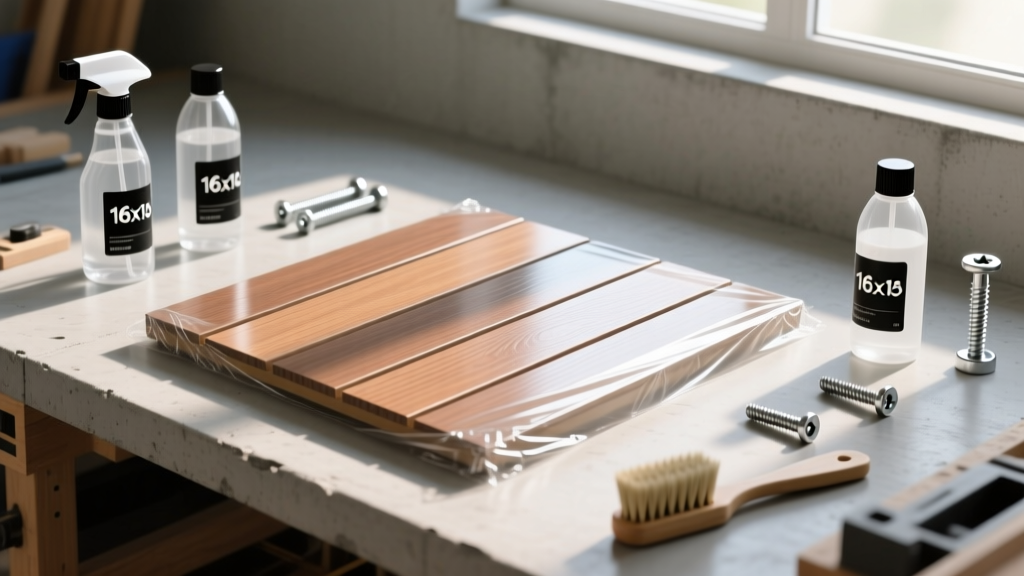
The Annual 16 x 16 Deck Maintenance Materials List
Once the deck is built, the materials list shifts from structural components to chemical consumables and cleaning implements. The quantities below are mathematically calibrated for exactly 256 square feet of surface area.
| Material Category | Specific Product Recommendation | Quantity for 256 Sq Ft | Est. Cost | Frequency |
|---|---|---|---|---|
| Composite Cleaner | Corte-Clean Composite Deck Cleaner | 1 Bottle (Covers 500 sq ft) | $32.00 | Bi-Annual |
| Hardwood UV Sealer | Penofin Hardwood Finish (Ipe/Cumaru) | 1 Gallon (Covers 250-300 sq ft) | $68.00 | Annual |
| Pressure-Treated Stain | Defy Extreme Semi-Transparent | 2 Gallons (Covers 150 sq ft/gal) | $115.00 | Every 2-3 Years |
| Application Tools | Purdy White Dove 3/8" Nap Roller & Pad | 1 Set | $25.00 | Per Application |
The "Emergency Repair" Cache: What to Keep in the Garage
The most overlooked aspect of any deck materials list is the post-construction reserve. Manufacturing color lots for composite and PVC decking change annually, and natural hardwoods vary by batch. If a board cracks or suffers severe staining in year four, you cannot simply buy a matching replacement from a local big-box store. Your initial purchase must include a dedicated emergency cache stored in a climate-controlled garage.
Essential Cache Inventory for a 16x16 Footprint
- 3 to 4 Full-Length Decking Boards: Keep these off the ground and out of direct sunlight to prevent premature UV fading. If a board fails, you will have an exact color and lot match.
- 25 Spare Hidden Fastener Clips: Whether you use Trex Hideaway or TimberTech CONCEALoc systems, plastic and stainless-steel clips can snap during extreme freeze-thaw cycles or impact events. Keep a small ziplock bag of the exact model number used in your build.
- Color-Matched Face Screws: Even if you used hidden fasteners for the field, keep one box of 50 color-matched composite face screws (e.g., Cortex system with matching plugs) for emergency top-down repairs where hidden clips are inaccessible.
- 1 Tube of Structural Epoxy: A marine-grade epoxy like TotalBoat ThickSet is vital for repairing localized joist rot or filling deep gouges in hardwood decking before they expand.
Wood vs. Composite: 10-Year Maintenance Cost Matrix
Understanding the long-term financial impact of your material choices is critical. The table below projects the maintenance material costs for a 256-square-foot deck over a decade, excluding labor.
| Decking Material | Primary Maintenance Consumables | 10-Year Material Cost | Time Investment (Hours/Year) |
|---|---|---|---|
| Pressure-Treated Pine | Cleaner, Brightener, Semi-Transparent Stain | $650 - $850 | 8 - 12 Hours |
| Tropical Hardwood (Ipe) | Hardwood Cleaner, UV Oil Finish | $750 - $950 | 6 - 8 Hours |
| Capped Composite | Specialized Composite Cleaner, Mold Inhibitor | $180 - $250 | 2 - 3 Hours |
Seasonal Workflow for a 256 Sq Ft Footprint
Maintaining a 16 x 16 deck requires a disciplined seasonal approach. Because 256 square feet is a manageable size, these tasks can typically be completed in a single weekend afternoon.
Spring: The Deep Clean
Winter leaves behind organic debris, pollen, and potential mold spores. Mix your composite or wood cleaner according to the manufacturer's dilution ratio. Apply using a pump sprayer to ensure even coverage across the 256 square feet. Allow a 15-minute dwell time—never let the solution dry on the surface—then agitate with a stiff-bristle brush along the board grooves before rinsing with a garden hose. Avoid pressure washers over 1,500 PSI, as they will etch composite shells and fuzz wood grain.
Summer: Inspection and Clearance
Thermal expansion peaks in summer. Walk the perimeter and check the picture-frame miter joints for separation. Ensure that the 1/4-inch expansion gaps between board ends and fixed structures (like the house ledger) have not closed up, which can cause buckling. Clear any vegetation that has grown within 12 inches of the deck surface to promote airflow and reduce moisture retention.
Autumn: Sealing and Winterization
For wood decks, autumn is the optimal time to apply UV sealers, as temperatures are consistently between 50°F and 80°F. Apply the sealer in the direction of the grain, maintaining a wet edge to prevent lap marks. For composite decks, apply a preventative mold-inhibitor spray before the damp autumn leaves begin to fall.
Winter: Snow Management
Never use metal shovels or ice choppers on a 16 x 16 deck, as they will permanently gouge the decking surface. Use a plastic-blade snow pusher and shovel parallel to the board lengths, not across them, to avoid catching the board edges. Use calcium chloride-based ice melt rather than rock salt, which can leave a white, corrosive residue that requires aggressive spring cleaning to remove.
Authoritative Sourcing & Industry Standards
Proper deck maintenance relies on adherence to established material science and manufacturer guidelines. For comprehensive data on wood treatment, decay resistance, and preservative standards, consult the American Wood Protection Association (AWPA). For specific composite care protocols and warranty-compliant cleaning methodologies, refer to the official Trex Care and Cleaning Guidelines. Additionally, the USDA Forest Products Laboratory provides extensive, peer-reviewed research on the long-term weathering and structural degradation of outdoor timber structures.
Written by
Elena RodriguezElena Rodriguez is a civil engineer and technical writer specializing in concrete technology, masonry systems, and ASTM/ACI compliance. She earned her B.S. in Civil Engineering from Texas A&M University and spent a decade at a materials testing laboratory, performing over 2,000 concrete compressive strength tests and masonry prism evaluations. Elena is an ACI-certified Field Testing Technician (Grade I) and a member of ASTM Committee C12 on Natural Building Stone. She currently consults on forensic engineering cases involving concrete failures and moisture intrusion. Based in San Antonio, TX, Elena is a proud member of the Society of Women Engineers (SWE) and coaches her daughter's FIRST Robotics team.
More from Elena Rodriguez
View all
Walls & Panels
Cost Analysis: Light Gauge Steel Framing Advantages and Disadvantages
Evaluate light gauge steel framing advantages and disadvantages through a strict cost analysis lens, comparing material, labor, and lifecycle expenses.
Aug 4, 2026

Walls & Panels
Gypsum Board Types: Exact Specifications, Thickness & Dimensions
Compare standard, Type X, and moisture-resistant gypsum board types. Get exact specifications, thicknesses, dimensions, and ASTM standards for your project.
Aug 4, 2026

Fire Resistance
Best Fire-Resistant Outdoor Decking Materials: 2026 Buyer Guide
Discover the best fire-resistant outdoor decking materials for 2026. Compare Class A PVC, aluminum, and hardwood options for WUI compliance and safety.
Aug 4, 2026