Boat Deck Core Material: Maintenance & Repair Guide
Learn how to inspect, maintain, and repair boat deck core material. Prevent delamination and core rot in marine decks with expert steps and data.
The Mechanics of Core Rot and Delamination
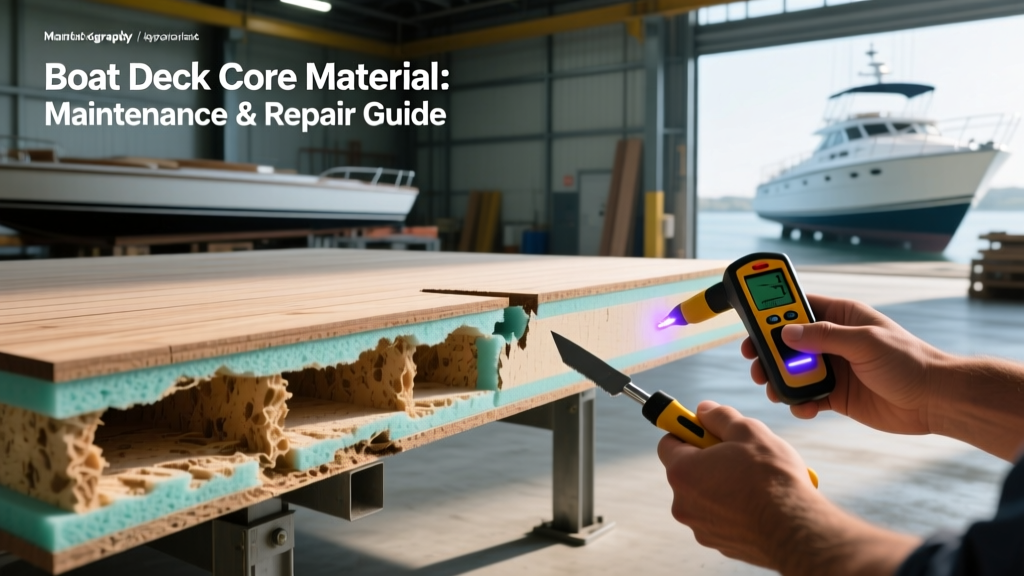
A marine or waterfront deck relies on a composite sandwich structure: two thin, rigid fiberglass skins separated by a lightweight boat deck core material. This design provides immense stiffness-to-weight ratios, but it introduces a critical vulnerability at the hardware penetrations. When water breaches the top skin via poorly bedded cleats, stanchions, or chainplates, it migrates into the core. In organic cores like balsa, this triggers fungal decay (core rot). In closed-cell foams, the water doesn't rot the material itself, but it accumulates in the kerf cuts or debonded cells, leading to freeze-thaw expansion, skin delamination, and catastrophic structural failure.
Identifying Your Boat Deck Core Material
Maintenance protocols and repair resins vary significantly depending on the specific core used in the deck layup. Below is a breakdown of the most common marine core materials, their current market costs, and their specific maintenance vulnerabilities.
| Core Material | Common Brands / Models | Approx. Cost (1/2" 4x8 Sheet) | Water Absorption & Failure Mode |
|---|---|---|---|
| End-Grain Balsa | Generic Marine Balsa | $25 - $35 | High wicking along grain. Fails via fungal rot and freeze-thaw spalling. |
| Cross-Linked PVC Foam | Diab Divinycell H80 | $55 - $75 | Low absorption. Fails via water pooling in scoring/kerf cuts, causing skin debonding. |
| Linear PET Foam | Gurit Corecell A500 | $45 - $65 | High impact resistance. Excellent chemical bond to epoxy; rarely delaminates if sealed. |
| Marine Plywood | BS1088 Okoume/Meranti | $80 - $120 | Wicks laterally through veneers. Heavy; prone to severe delamination when wet. |

Step-by-Step Inspection Protocol
Annual inspection of your boat deck core material is non-negotiable. Do not wait for the deck to feel spongy underfoot; by the time deflection occurs, the core is entirely compromised. Use this three-tier inspection methodology:
- Acoustic Percussion (Tap Test): Use a phenolic hammer or the hard plastic handle of a screwdriver. Tap the deck in a 6-inch grid pattern around all hardware. A crisp, high-pitch "tick" indicates a solid bond. A dull, low-pitch "thud" signifies delamination or crushed core.
- Capacitance Moisture Mapping: Use a non-destructive capacitance meter like the Tramex Skipper Plus. Set the dial to the appropriate scale for fiberglass. Readings below 5% indicate a dry core. Readings between 5% and 15% suggest early moisture ingress. Anything above 15% confirms saturated core material requiring immediate intervention.
- Thermal Imaging: In the early morning or late evening, use an infrared camera (like the FLIR E8-XT). Wet core material retains heat differently than dry foam or balsa, revealing the exact boundary of water migration beneath the gelcoat.
Targeted Maintenance: The Epoxy Potting Method
The vast majority of core rot originates at deck hardware. To maintain the integrity of the boat deck core material, you must isolate the fasteners from the core entirely. According to the repair standards outlined by West System, the "epoxy potting" or "over-drilling" technique is the only permanent preventative maintenance strategy.
Execution Steps for Hardware Bedding
- Over-drill: Remove the hardware. Use a drill bit 1/8-inch larger than the original fastener hole to drill through the top fiberglass skin and into the core, stopping exactly at the bottom skin.
- Route the Core: Use a bent nail or a specialized routing bit in a cordless drill to excavate the core material laterally, creating a 1/4-inch cavity beneath the top skin.
- Seal and Fill: Inject unthickened marine epoxy (e.g., West System 105 Resin with 206 Slow Hardener) to seal the exposed core edges. Once tacky, fill the entire void with epoxy thickened with 406 Colloidal Silica to a peanut-butter consistency.
- Re-drill: After 24 hours of curing at 72°F, re-drill the hole to the exact diameter of the fastener. The bolt now passes through a solid epoxy plug, transferring compression loads directly to the bottom skin and completely waterproofing the core.
Expert Insight: Never use polyester resin for core maintenance or hardware bedding. Polyester shrinks by up to 7% during curing, which pulls it away from the core walls, creating micro-gaps for water ingress. Always use marine-grade epoxy for structural adhesion to modern composite core materials.
Repair Decision Matrix: Consolidate vs. Replace
When inspection reveals moisture, you must decide between resin consolidation and full core replacement. Use the following matrix based on your moisture meter readings and the specific core material.
| Condition / Moisture % | Balsa Core Action | PVC / PET Foam Action |
|---|---|---|
| 5% - 15% (Early Ingress) | Remove hardware, dry via heat lamps, inject thin epoxy consolidant. | Remove hardware, dry, inject epoxy. Foam does not rot, so replacement is rarely needed at this stage. |
| 15% - 25% (Saturated) | Core is likely rotted. Cut top skin, remove wet balsa, replace with new end-grain balsa or PVC foam. | Check for skin delamination. If skin is bonded, dry and inject. If debonded, cut skin and re-bed core. |
| >25% (Structural Deflection) | Full section replacement required. Bottom skin may be compromised by prolonged water exposure. | Full section replacement required. Extract degraded foam and laminate new PET/PVC core. |
Frequently Asked Questions
Can I use marine-grade sealants like 3M 5200 to prevent core rot?
No. Polyurethane adhesives like 3M 5200 are excellent for hull-to-keel joints, but they lack the UV stability and long-term compression resistance required for deck hardware. Furthermore, 5200 bonds so aggressively that removing a cleat bedded in it will often rip the fiberglass skin off the core. Use a marine polyether sealant (like Sikaflex 291 or 3M 4000 UV) for bedding, combined with the epoxy potting method described above for structural support.
How often should I re-bed my deck hardware?
Hardware sealants degrade due to UV exposure, thermal expansion, and deck flexing. Inspect the sealant bead annually. If you observe cracking, peeling, or chalkiness, the sealant has failed. In most marine environments, complete removal, cleaning, and re-bedding of deck hardware should be performed every 7 to 10 years as part of a comprehensive deck maintenance cycle.
Is it safe to use a heat gun to dry out a wet balsa core?
Direct heat from a heat gun will blister the gelcoat and potentially ignite the underlying materials. If you must accelerate drying after removing the core or drilling access holes, use indirect, low-wattage ceramic heat lamps or dehumidifiers enclosed in a tented area over the deck. Maintain the ambient temperature around 110°F to 120°F to evaporate moisture without damaging the resin matrix of the fiberglass skins.
Written by
Sarah WhitfieldSarah Whitfield is a chartered quantity surveyor (MRICS) and construction cost analyst with 15 years of experience in material pricing, procurement strategy, and project budgeting. She earned her degree in Construction Management from the University of Reading (UK) and has worked on projects ranging from $2M custom homes to $180M mixed-use developments across North America and Europe. Sarah currently leads cost estimating for BuildMat Insight, maintaining a proprietary database of 4,000+ material price points updated quarterly. She is a frequent contributor to RSMeans cost data panels and has presented at the International Cost Engineering Council (ICEC) congress. Based in Denver, CO, Sarah is an avid trail runner and volunteer mentor for Women in Construction.
More from Sarah Whitfield
View all
Wood & Lumber
What Are the Different Types of Wood? A Builder's Guide
Compare structural softwoods, finish hardwoods, and engineered lumber. Analyze Janka ratings, MOE values, and 2026 pricing for construction.
Aug 4, 2026

Walls & Panels
Steel Framing vs Wood Framing: Corrosion and Moisture Defense
Compare steel framing vs wood framing for moisture resistance. Learn about galvanized coatings, condensation risks, and corrosion protection strategies.
Jul 21, 2026

Stone & Masonry
How to Cut Stone Veneer: Wet Saw vs Grinder Comparison
Compare the best tools for cutting stone veneer. We review wet saws, angle grinders, and chop saws to help you achieve clean, chip-free cuts.
Jul 21, 2026