Pool Deck Paint Performance Ratings & Specs Guide
Compare pool deck paint performance ratings, DCOF slip standards, mil thickness math, and chemical resistance specs for acrylic, epoxy, and polyurethane.
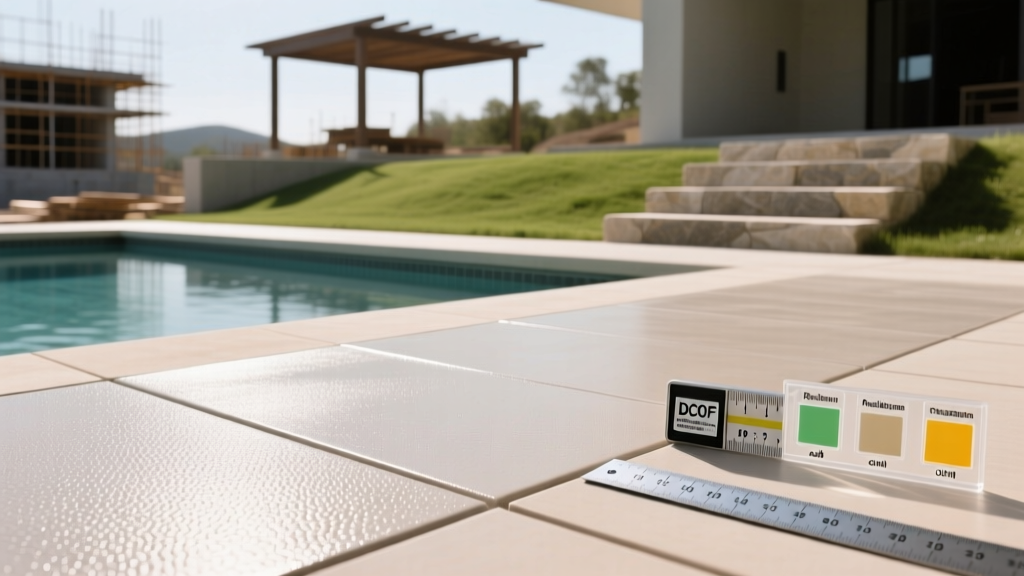
The Critical Metrics: Decoding Pool Deck Paint Specifications
Selecting a coating for a pool deck requires navigating a hostile micro-environment. Unlike standard exterior concrete, pool decks endure constant UV bombardment, thermal shock from freezing nights to scorching days, and relentless chemical exposure from splashed saltwater or chlorinated water. When evaluating pool deck paint, marketing terms like 'weather-resistant' are insufficient. Professional specification requires analyzing Dynamic Coefficient of Friction (DCOF), Dry Mil Thickness (DMT), volume solids, and specific chemical resistance standards.
Never apply standard waterborne acrylics directly over a saltwater pool deck without a specialized silane/siloxane penetrating primer. Saltwater splash zones introduce sodium chloride into the concrete pores. As water evaporates, salt crystallization (subflorescence) creates immense subsurface hydrostatic pressure, causing osmotic blistering and coating delamination within 6 to 8 months.
Coating Chemistry Matrix: Acrylic vs. Polyurethane vs. Epoxy
The baseline performance of any pool deck paint is dictated by its resin chemistry. Below is a technical comparison of the four primary coating systems used in commercial and high-end residential aquatic environments.
| Resin System | UV Stability | Chemical Resistance | Volume Solids | Typical DMT |
|---|---|---|---|---|
| Waterborne Acrylic | Excellent (Non-yellowing) | Poor to Fair (Degrades in high chlorine) | 35% - 45% | 2 - 4 mils |
| Aliphatic Polyurethane | Exceptional | Excellent (Withstands cyanuric acid/salt) | 55% - 75% | 4 - 8 mils |
| Polyaspartic | Exceptional | Exceptional (Rapid cure, high cross-link) | 70% - 95% | 6 - 12 mils |
| Epoxy (Aromatic) | Poor (Chalks/yellows in UV) | Excellent | 80% - 100% | 10 - 20 mils |
1. Acrylic Resins (Water & Solvent-Based)
Acrylics are breathable, allowing moisture vapor transmission (MVT) to escape from the concrete slab. This makes them ideal for older, unsealed concrete decks where hydrostatic pressure is a concern. However, their low volume solids mean they require annual or bi-annual reapplication. They lack the cross-linking density to withstand prolonged exposure to concentrated pool shock (calcium hypochlorite).
2. Aliphatic Polyurethane & Polyaspartic Topcoats
For maximum longevity, two-part aliphatic polyurethanes and polyaspartics are the industry standard. The term 'aliphatic' refers to the carbon chain structure, which is inherently resistant to UV degradation, unlike 'aromatic' epoxies that yellow and chalk when exposed to sunlight. Polyaspartics, a subclass of polyurea, offer the distinct advantage of rapid curing—often allowing foot traffic in 4 to 6 hours, even in temperatures as low as 20°F (-6°C).
3. Epoxy Systems
While 100% solids epoxies provide unmatched adhesion strength (often exceeding 400 psi tensile adhesion to concrete), they are strictly prohibited as a topcoat in direct sunlight due to rapid UV degradation. Epoxies are reserved exclusively as a primer or base coat in multi-layer pool deck systems, always topped with a UV-stable polyurethane or polyaspartic clear coat.
Slip Resistance Standards: The Shift from SCOF to DCOF
Historically, the pool industry relied on the Static Coefficient of Friction (SCOF), measured via the outdated ASTM C1028 standard. SCOF measures the force required to start an object moving. However, human biomechanics dictate that slip-and-fall accidents occur during the dynamic phase of walking (when the heel strikes and slides forward). Consequently, SCOF has been largely abandoned by modern safety organizations.
The current specification standard is the Dynamic Coefficient of Friction (DCOF), measured using a BOT-3000E digital tribometer with a glycerin solution to simulate wet, soapy conditions. According to guidelines referenced by OSHA walking-working surface standards and the ANSI A326.3 standard, a wet DCOF of 0.42 or higher is considered safe for level surfaces.
A standard smooth polyurethane coating typically yields a wet DCOF of 0.35 to 0.40, which is dangerously slick when wet. To achieve a pool-safe DCOF of 0.60 to 0.85, formulators must broadcast anti-slip aggregates into the wet coating. Specify aluminum oxide (Mohs hardness 9) or cross-linked polymer grit at a rate of 1.5 to 2.0 lbs per 100 square feet for optimal traction without creating an abrasive surface that damages bare feet.
Mil Thickness and Coverage Rates: The Math of Durability
Contractors and facility managers frequently miscalculate coverage by confusing Wet Mil Thickness (WMT) with Dry Mil Thickness (DMT). The DMT is the actual protective layer left behind after solvents and water evaporate. The formula is critical for accurate bidding and performance prediction:
DMT = WMT × (% Volume Solids / 100)
Example: If a waterborne acrylic pool paint has 40% volume solids and is applied at a 10-mil wet thickness using a 3/8-inch nap roller, the resulting DMT is only 4 mils. Conversely, a 100% solids polyaspartic applied at 10 mils WMT yields a full 10 mils DMT, providing 2.5 times the physical wear layer.
When reviewing manufacturer technical data sheets (TDS), always base your coverage calculations on the Volume Solids percentage, not the stated 'square feet per gallon' metric, which often assumes an unrealistically thin application rate.
Chemical Resistance and ASTM Testing
Pool environments expose coatings to highly corrosive elements. Sodium hypochlorite (liquid chlorine), muriatic acid (used for pH balancing), and cyanuric acid (chlorine stabilizer) will rapidly degrade inferior resins. When specifying a pool deck paint, require independent laboratory test results for ASTM D1308 (Standard Test Method for Effect of Household Chemicals on Clear and Pigmented Organic Finishes).
A high-performance aliphatic polyurethane should show no softening, blistering, or color shift after a 24-hour spot test with a 15% sodium hypochlorite solution and a 10% muriatic acid solution. For saltwater pools, the coating must also pass a 500-hour salt fog chamber test (ASTM B117) to ensure the resin matrix will not break down from continuous saline aerosol exposure.
Environmental & Curing Specifications
Application parameters dictate the long-term cross-linking of the polymer chains. Ignoring these specifications leads to premature chalking and adhesion failure.
- Surface Temperature vs. Air Temperature: Always measure the concrete surface temperature, not the ambient air. Darker pool decks can be 15°F to 20°F hotter than the air, causing acrylics to 'flash' (dry too quickly) and preventing proper film formation.
- Moisture Vapor Transmission (MVT): Before applying any high-solids epoxy or polyurethane, test the slab for MVT using the ASTM F2170 calcium chloride test. If MVT exceeds 5 lbs per 1,000 sq. ft. per 24 hours, a moisture-mitigating epoxy primer is mandatory to prevent hydrostatic blistering.
- Dew Point Proximity: Never apply pool deck coatings if the surface temperature is within 5°F of the dew point. Condensation forming on the microscopic level during the curing phase will trap water in the film, resulting in a cloudy, white haze (amine blush in epoxies) and compromised adhesion.
Frequently Asked Questions on Pool Deck Coatings
Can I apply a polyurethane topcoat directly over an existing acrylic pool deck paint?
No. Polyurethanes and polyaspartics utilize strong solvents (like MEK or xylene) that will chemically attack and re-emulsify the underlying acrylic, causing a wrinkled, ruined finish. You must either completely remove the acrylic via diamond grinding or apply a compatible water-based epoxy tie-coat as an intermediary barrier.
How do I maintain the slip resistance of a coated pool deck?
Anti-slip aggregates embedded in the coating can become clogged with sunscreen oils, dirt, and calcium scale over time, effectively smoothing the surface and lowering the DCOF. Clean the deck quarterly using a mild, non-acidic detergent and a stiff-bristle broom. Avoid high-pressure washing (over 2,500 PSI) directly on the aggregate, as it can dislodge the polymer grit from the resin matrix.
What is the best coating for a concrete pool deck with existing hairline cracks?
Standard paints will bridge cracks temporarily, but thermal expansion will cause the cracks to telegraph through the coating within one season. For cracked decks, specify an elastomeric polyurethane membrane (often rated for 300% to 400% elongation per ASTM D412) or route out the cracks and fill them with a flexible polyurea joint sealant before applying the primary coating system.