Top Deck Railing Ideas Matched to Your Climate and Lifestyle
Discover scenario-matched deck railing ideas for coastal, wooded, and urban spaces. Compare materials, costs, and building code requirements.
The Scenario-Matching Framework for Deck Railings
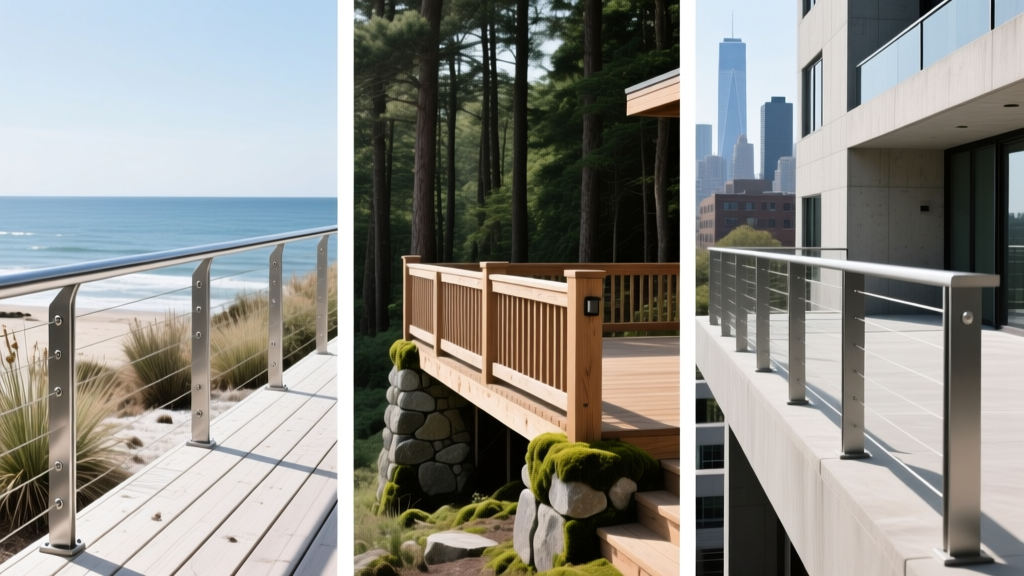
Choosing from the endless array of deck railing ideas requires looking past aesthetics and evaluating environmental stressors, maintenance tolerance, and household dynamics. A railing system that performs flawlessly on a shaded suburban patio will fail prematurely on a salt-battered coastal bluff. The most effective approach to selecting a railing is scenario-matching: aligning the material science of the railing with the specific microclimate and use-case of your outdoor space.
This guide breaks down the optimal railing materials for four distinct environmental and lifestyle scenarios, providing exact specifications, 2026 pricing baselines, and critical installation parameters.
Coastal and High-Moisture Environments (The Salt Test)
Properties within five miles of a saltwater coastline face severe galvanic corrosion and UV degradation. Standard powder-coated steel and basic 304 stainless steel will pit, rust, and bleed onto your decking within 24 months.
Optimal Materials and Specifications
- Marine-Grade Aluminum: Specify extruded aluminum with an AAMA 2604 fluoropolymer powder coating. This standard requires a minimum 1.0 mil film thickness and 3,000 hours of salt-spray resistance, ensuring the finish does not chalk or fade under intense UV exposure.
- 316 Stainless Steel Cable: If utilizing cable railings, 316 (marine-grade) stainless steel is non-negotiable. It contains molybdenum, which drastically increases resistance to chloride pitting compared to standard 304 stainless.
Cost Baseline: $85 to $130 per linear foot (installed) for high-end marine aluminum systems like AGS Aluminum or Fortress.
Wooded and High-Debris Zones (The Maintenance Minimizer)
Decks surrounded by pine trees, oak canopies, or heavy seasonal leaf drop require railings that do not trap organic matter. Wrought iron with intricate scrolls or narrow metal top rails become debris magnets, holding moisture against the material and accelerating decay or requiring weekly cleaning.
Optimal Materials and Specifications
High-density capped composite railings (such as Trex Transcend or TimberTech Reserve) are the superior choice for wooded lots. The wide, flat top caps (typically 4 to 6 inches wide) shed pine needles and leaves efficiently. Furthermore, the polymer cap completely encapsulates the composite core, preventing tannin staining from wet oak leaves.
Materials to Avoid
- Uncapped Wood Balusters: Pine or cedar balusters require annual sealing. In high-debris zones, trapped moisture against the wood grain leads to rapid dry rot and black mildew.
- Horizontal Metal Pickets: These act as shelves for debris, requiring constant brushing to maintain a clean appearance.
Cost Baseline: $55 to $95 per linear foot (installed) for premium capped composite systems.
Urban Rooftops and Unobstructed Viewscapes (The Sightline Priority)
For elevated urban terraces, mountain cabins, or waterfront properties where the view is the primary asset, visual obstruction must be minimized. However, achieving a "frameless" look requires strict adherence to structural engineering and safety codes.
Frameless Glass vs. Tensioned Cable
While tensioned cable railings are popular, they require periodic re-tensioning (usually every 2-3 years) as the cables stretch and thermal expansion occurs. For a true zero-maintenance, unobstructed view, frameless architectural glass is the professional standard.
- Glass Specifications: Require 1/2-inch (12mm) tempered and laminated safety glass. The lamination interlayer (usually PVB or SGP) ensures that if the glass breaks, it adheres to the interlayer rather than shattering onto the deck below.
- Hardware: Base shoes must be structural-grade extruded aluminum, anchored directly into the deck framing (not just the decking boards) using 1/2-inch structural lag bolts.
- Maintenance Reality: Glass requires cleaning. Specify a factory-applied hydrophobic coating (like EnduroShield) to prevent hard water spotting and reduce cleaning frequency by up to 90%.
Cost Baseline: $160 to $280 per linear foot (installed) for structural glass systems.
Family Homes with Pets and Toddlers (The Safety Fortress)
When designing for households with small children or large dogs, the primary constraint is the International Residential Code (IRC) "4-inch sphere rule" (IRC R312.1.2), which dictates that no opening in the railing system can allow a 4-inch sphere to pass through. However, safety extends beyond mere spacing.
The "Ladder Effect" and Horizontal Rails
While horizontal cable or horizontal wood picket railings are visually striking, they create a "ladder effect." Toddlers and pets can easily climb them, leading to catastrophic falls. In fact, several municipalities and the North American Deck and Railing Association (NADRA) strongly advise against horizontal guardrails in residential settings with children, and some local building departments outright ban them.
The Optimal Safety Configuration
Utilize vertical composite or aluminum balusters spaced at exactly 3.5 inches on-center. For added security against pets pushing through, consider aluminum railings with integrated mesh infill panels or solid composite privacy panels that eliminate gaps entirely while providing wind protection.
Cost Baseline: $45 to $75 per linear foot (installed) for vertical aluminum or composite baluster systems.
Scenario-to-Material Decision Matrix
Use the following matrix to quickly align your specific property constraints with the correct material class.
| Primary Scenario | Optimal Material | Material to Avoid | Avg. Cost / Lin. Ft. |
|---|---|---|---|
| Coastal / Salt Air | AAMA 2604 Aluminum, 316 SS Cable | Standard Steel, 304 SS, Wrought Iron | $85 - $130 |
| Wooded / High Debris | Capped Composite (Wide Top Rail) | Intricate Wrought Iron, Uncapped Wood | $55 - $95 |
| Unobstructed Views | 1/2" Tempered Laminated Glass | Thick Wood Pickets, PVC Railings | $160 - $280 |
| Child / Pet Safety | Vertical Aluminum / Mesh Infill | Horizontal Cables, Horizontal Pickets | $45 - $75 |
Critical Code Compliance and Structural Anchoring
Regardless of the aesthetic chosen, the structural integrity of the railing post connection is the most common point of failure in deck inspections. According to the American Wood Council's DCA 6 standard, railing posts must not be attached to the side of the rim joist using only nails or standard lag screws, as this creates a weak cross-grain connection that can snap under lateral load.
The Proper Post Anchoring Method
- Through-Bolting: Use two 1/2-inch hot-dipped galvanized through-bolts with washers, securing the 4x4 post directly to the deck framing and blocking.
- Tension Ties: For ultimate lateral strength, install a structural tension tie (such as a Simpson Strong-Tie DTT2Z) that connects the post to the deck joists, transferring the lateral load deep into the framing.
- Post Sleeves: If using composite post sleeves, ensure the internal structural wood post is properly flashed at the base to prevent water from pooling inside the sleeve, which causes hidden rot.
By prioritizing environmental fit and structural code compliance over fleeting design trends, you ensure your deck railing system provides decades of safe, low-maintenance performance.