Pressure Treated Deck Boards: Matching Grades to Your Project
Discover which pressure treated deck boards fit your project. Match AWPA retention levels, grades, and dimensions to specific outdoor building scenarios.
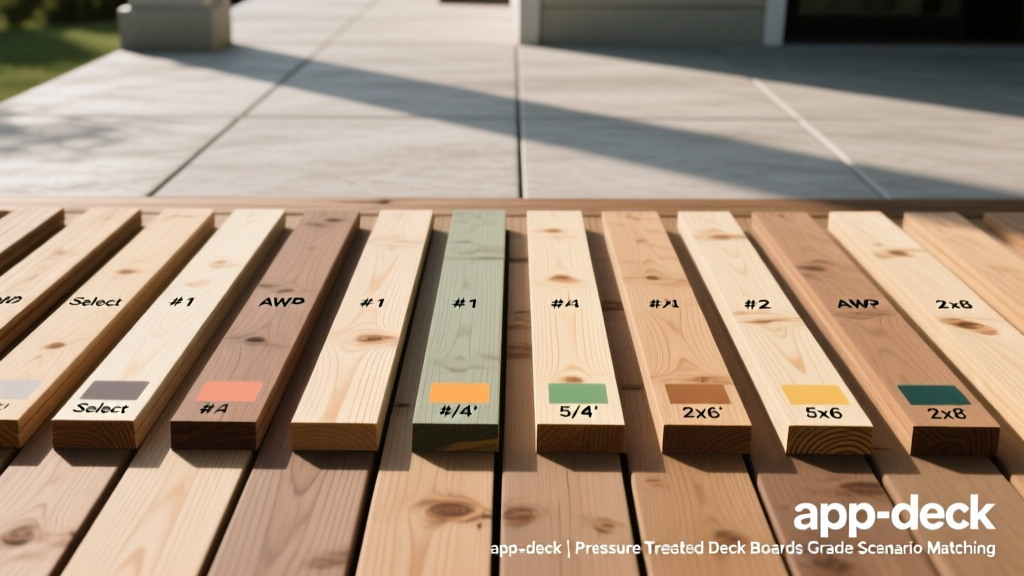
The AWPA Retention Matrix: Decoding the End Tags
Selecting pressure treated deck boards requires matching the lumber’s chemical retention level and grade to its specific structural role and environmental exposure. The American Wood Protection Association (AWPA) categorizes treated wood by 'Use Categories' (UC), which dictate the minimum pounds of preservative per cubic foot (pcf) required to prevent fungal decay and termite damage. Buying standard above-ground lumber for a low-clearance deck is a primary cause of premature joist rot and structural failure.
| AWPA Category | Exposure Scenario | Min. Retention (pcf) | Application Fit |
|---|---|---|---|
| UC3B | Above Ground, Exposed | 0.25 (MCA/CA-C) | Decking boards, railings, balusters, and joists >18 inches from grade. |
| UC4A | Ground Contact | 0.40 (MCA/CA-C) | Deck posts, stair stringers, ledger boards, and joists <18 inches from grade. |
| UC4B | Heavy Duty Ground Contact | 0.60 (MCA/CA-C) | Permanent wood foundations, critical structural posts in high-decay zones, freshwater docks. |
Always inspect the end tag of every board bundle. If the tag indicates UC3B, it is chemically insufficient for any framing member that sits close to the soil or is exposed to constant splash-back from the ground.
Scenario 1: Standard Elevated Decking (Above-Ground Exposure)
For standard elevated decks where framing is well-ventilated and decking is fully exposed to the sun, UC3B Southern Yellow Pine (SYP) is the industry baseline. However, dimensional selection and grade sorting dictate the long-term flatness of the deck surface.
5/4x6 vs. 2x6 Dimensional Lumber
While both are used for decking, 5/4x6 (actual dimensions 1 inch by 5.5 inches) is milled specifically for decking. It features eased (rounded) edges for barefoot comfort and is cut from the outer rings of the log, reducing the likelihood of severe warping. Standard 2x6 lumber (actual 1.5 inches by 5.5 inches) is structural framing lumber. It is heavier, retains more internal moisture, and is far more prone to cupping and checking when laid flat as decking. For the walking surface, 5/4x6 is the superior application fit.
When hand-selecting pressure treated deck boards at the lumber yard, inspect the end grain. If you see the 'pith' (the concentric bullseye center of the tree) anywhere on the board's cross-section, reject it. Boards containing the pith will almost invariably experience radial splitting and severe twisting as they dry. Only select boards with vertical or flat grain lines that do not originate from the board's center.
Scenario 2: Low-Clearance Decks and Ground Contact Framing
Decks built less than 24 inches from the ground trap moisture and restrict airflow, creating a microclimate that accelerates wood decay. According to building science principles documented by the USDA Forest Products Laboratory, wood moisture content in these zones frequently exceeds the 20% threshold required for fungal growth.
Upgrading the Substructure
For low-clearance scenarios, the application fit demands UC4A (Ground Contact) lumber for the entire substructure, including joists and beams, not just the posts. Using UC3B joists in a low-clearance environment typically results in structural rot within 5 to 8 years. Furthermore, if the deck utilizes notched posts resting on concrete footings, the notched section must be UC4A rated, as concrete wicks moisture directly into the wood fibers via capillary action.
Western Species Considerations
If you are building in the Western US, your local yards will likely stock pressure treated Douglas Fir or Hem-Fir. Because these species have dense heartwood that resists chemical penetration, they must be mechanically 'incised' (covered in small, deep puncture marks) to allow the preservative to reach the required depth. Ensure the end tag explicitly states 'Incised' alongside the UC rating; otherwise, the core of the board remains unprotected.
Moisture Content and Installation Gap Spacing
The most common installation error with pressure treated deck boards is improper gap spacing, resulting from a misunderstanding of the wood's moisture content at the time of purchase.
- Wet Treated (Standard Yard Stock): Most UC3B decking sold at big-box retailers is treated and shipped wet, with a moisture content (MC) between 30% and 45%. As this wood dries to the ambient equilibrium moisture content (EMC) of 12-15%, it will shrink significantly across its width. Install wet boards tight (butt joints touching) or with a maximum 1/8-inch gap using a 16d nail as a spacer. If you gap wet boards 3/8-inch apart, you will end up with 1/2-inch gaps after summer, creating a tripping hazard and allowing debris to fall through.
- KDAT (Kiln-Dried After Treatment): Premium suppliers offer KDAT lumber, which is dried back to 19% MC or lower after the chemical treatment process. KDAT boards are lighter, less prone to initial warping, and accept stain immediately. Because they have already undergone their primary shrinkage, you must install KDAT boards with a 3/16-inch to 1/4-inch gap to allow for seasonal expansion during wet winter months.
Fastener and Hardware Compatibility
Modern pressure treated lumber is preserved using Micronized Copper Azole (MCA) or Copper Azole (CA-C). While less corrosive than the older ACQ (Alkaline Copper Quaternary) formulations, the embedded copper and co-biocides will still rapidly corrode standard zinc-plated or electro-galvanized fasteners, leading to black streaking and catastrophic shear failure.
Mandatory Hardware Specifications
For all structural connections, joist hangers, and decking screws, you must specify hardware that meets or exceeds the following corrosion resistance standards:
- Hot-Dipped Galvanized (HDG): Must meet ASTM A153 Class D (for fasteners) or ASTM A653 Class G185 (for connectors like joist hangers). Look for the 'ZMAX' or 'HDG' stamp.
- Polymer-Coated Structural Screws: High-grade epoxy or ceramic-coated screws (e.g., Simpson Strong-Tie Quik Drive or GRK RSS) are rated for MCA/CA-C contact and offer superior pull-out resistance compared to nails.
- Stainless Steel: Type 304 is sufficient for most inland applications. Type 316 is mandatory for coastal environments within 10 miles of saltwater.
2026 Material Cost and Lifespan Projections
Understanding the financial application fit of pressure treated deck boards requires comparing upfront material costs against projected maintenance and lifespan metrics.
| Material Specification | 2026 Avg. Cost (Linear Foot) | Expected Lifespan | Maintenance Requirement |
|---|---|---|---|
| 5/4x6 #2 Grade SYP (UC3B) | $2.85 - $3.40 | 15 - 20 Years | Annual cleaning, sealant every 2-3 years. |
| 5/4x6 #1 Grade / Premium (UC3B) | $4.10 - $5.20 | 20 - 25 Years | Annual cleaning, sealant every 2-3 years. |
| 2x8 #2 Joist Material (UC4A) | $13.50 - $16.00 | 25+ Years (Structural) | None (hidden framing). |
| Composite Decking (Mid-Tier) | $7.50 - $11.00 | 25 - 30 Years | Annual soap and water wash. |
While composite decking commands a 200% to 300% premium over standard pressure treated SYP, PT lumber remains the undisputed choice for structural framing. Even when builders choose PVC or composite for the walking surface, the substructure is almost exclusively built from UC3B and UC4A pressure treated pine due to its unmatched structural load-bearing capacity and cost-efficiency. To maximize the ROI on a PT deck, invest the savings from the decking material into upgrading the substructure to UC4A ground-contact ratings across the entire frame, ensuring the hidden skeleton outlasts the surface boards by decades.