The Essential 8x12 Deck Material List for Annual Maintenance
Procure the exact 8x12 deck material list for annual maintenance. Includes precise quantities, product models, and structural repair specs.

The 96-Square-Foot Maintenance Reality
An 8x12 deck encompasses exactly 96 square feet of primary surface area. While this is a highly efficient footprint for residential construction, maintaining it requires a precise procurement strategy. Overbuying sealants leads to degraded, unusable chemicals sitting in your garage, while underbuying structural repair hardware forces mid-project delays. This guide translates the standard 8x12 deck material list from the construction phase into a targeted maintenance and repair procurement list, calculated specifically for a 96-square-foot footprint with standard 16-inch on-center (OC) joist spacing.
Core 8x12 Deck Material List: Cleaning and Preparation
Proper adhesion of sealants and stains requires the removal of mill glaze, UV-degraded lignin, and embedded mildew. For a 96-square-foot surface, commercial-grade concentrates are vastly more cost-effective than pre-mixed retail solutions.
| Material Category | Specific Product / Model | Qty for 8x12 Deck | Est. Cost (2026) |
|---|---|---|---|
| Wood Cleaner | Messmer's Wood & Deck Cleaner (Part A) | 1 Gallon (Yields 500 sq ft) | $38.00 |
| Wood Brightener | Messmer's Wood Brightener (Part B) | 1 Gallon (Neutralizes Part A) | $42.00 |
| Agitation Tool | 10-inch Tampico Fiber Deck Brush (Medium) | 1 Unit | $24.00 |
| Pump Sprayer | Chapin 2-Gallon Poly Deck Sprayer | 1 Unit | $28.00 |
Never skip the brightener (Part B). Alkaline cleaners (Part A) open the wood pores and raise the pH. If you apply an acidic or neutral sealer over high-pH wood, the sealer will fail to penetrate and will peel within one season. The brightener drops the pH back to ~5.5 and closes the pores slightly, ensuring optimal sealer absorption.
Sealing and Finishing Procurement
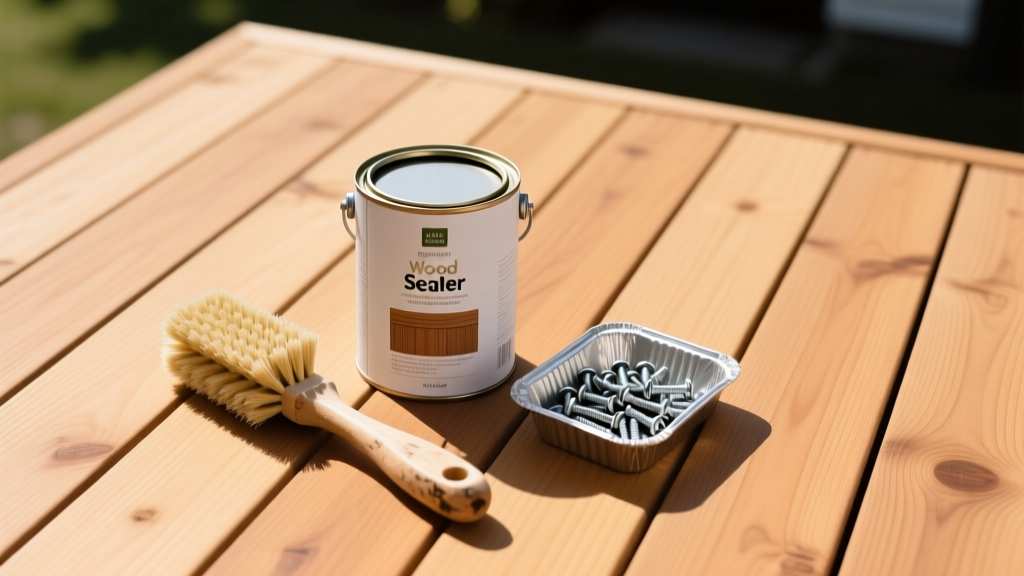
Sealer coverage rates are heavily dependent on wood porosity and application method. For a 96-square-foot deck, you must account for a 10% overlap and waste factor, bringing your target coverage to 106 square feet. Most premium sealers cover 150 to 200 square feet per gallon on smooth, pressure-treated lumber or cedar.
Decision Matrix: Oil vs. Water-Based Sealers for 96 Sq Ft
- Water-Based (e.g., Defy Extreme Wood Stain): Contains zinc nano-particles that act as a physical UV block. Dries in 2-4 hours. Requires 1 gallon for two coats on an 8x12 deck. Best for: High UV exposure areas and quick turnaround times.
- Oil-Based (e.g., Armstrong Clark or Penofin): Penetrates deeper into the wood cellular structure without forming a surface film. Requires 1 gallon for a single heavy coat. Best for: Older, highly porous pressure-treated pine where deep conditioning is required.
Required Finishing Hardware:
- 1x Gallon of chosen sealer (Approx. $55 - $75)
- 1x 4-inch Wooster Pro-Dooz Roller Cover (3/8-inch nap for smooth wood)
- 1x 3-inch Nylon/Polyester Angled Sash Brush (for railings and fascia)
- 1x Pole-mounted roller frame for the main 8x12 field
Structural and Hardware Maintenance List
Maintenance extends beyond the surface boards. The North American Deck and Railing Association (NADRA) emphasizes that structural failures most commonly occur at the ledger board connection and joist hangers. Your 8x12 deck material list must include a structural repair cache to address hidden rot and fastener withdrawal.
| Hardware Component | Specification / Model | Qty Required | Application |
|---|---|---|---|
| Joist Hangers | Simpson Strong-Tie LUS210Z (2x10 ZMAX) | 4 Units | Replacing rusted/crushed hangers |
| Structural Screws | GRK RSS 3-1/8 inch Rugged Structural Screws | 1 Box (50 ct) | Ledger board reinforcement |
| Hidden Fasteners | Camo Edge Fastener Pro Tool + 50ct Marksman | 1 Kit | Replacing warped surface boards |
| Joist Flashing Tape | Trex Protect Butyl Tape (4 in. x 75 ft.) | 1 Roll | Capping exposed joist tops |
According to the American Wood Council's DCA-6 guidelines, ledger boards must be secured with 1/2-inch hot-dipped galvanized lag screws or structural screws. If your 8x12 deck was built using standard zinc-plated lags, they are likely corroding from the inside out. During your annual maintenance, probe the ledger connection with an awl. If you encounter spongy wood or rust flakes, immediately replace the fasteners with GRK RSS structural screws, which do not require pre-drilling and offer superior shear strength.
Execution Protocol: The 48-Hour Maintenance Window
Applying the materials from your 8x12 deck material list requires strict adherence to weather and timing parameters. Do not begin if rain is forecasted within 48 hours or if ambient temperatures will drop below 50°F (10°C) at night.
- Day 1, 08:00 AM (Prep): Sweep the 96 sq ft surface. Mix Messmer's Part A according to label directions. Apply via pump sprayer, agitate immediately with the Tampico brush, and let dwell for 15 minutes. Rinse thoroughly with a garden hose (never use a pressure washer over 800 PSI, as it furs the wood grain).
- Day 1, 11:00 AM (Neutralize): Apply Messmer's Part B brightener. Dwell for 10 minutes and rinse. The wood should look uniformly bright and clean.
- Day 2, 09:00 AM (Moisture Check): Use a pinless wood moisture meter. The internal moisture content of the decking must read below 15% before applying any sealer. If it reads higher, wait an additional 24 hours.
- Day 2, 10:00 AM (Seal): Cut in the perimeter and railings with the 3-inch sash brush. Apply the first coat of sealer to the 8x12 field using the 4-inch roller. Maintain a wet edge to prevent lap marks. Wait 4 hours (for water-based) or 24 hours (for oil-based) before applying the second coat.
Troubleshooting Common 8x12 Deck Failures
Even with meticulous maintenance, specific localized failures require targeted material interventions.
Symptom: Cupping or Bowing of Deck Boards
Cause: Moisture trapped beneath the boards, often due to inadequate clearance or debris accumulation between the board gaps. Standard 5.5-inch boards on an 8x12 deck require a strict 1/4-inch gap for drainage.
Fix: Use a speed square and a pry bar to realign the boards. Secure them using the Camo Edge Fastener tool from your material list, driving screws at a 45-degree angle through the edge of the board into the joist. This pulls the board flat without splitting the surface.
Symptom: Black Staining at Joist Intersections
Cause: Water pooling on top of the 2x8 or 2x10 joists, leading to localized fungal decay. This is highly common in 8x12 decks where the joists run parallel to the house and trap water against the ledger.
Fix: Remove the affected decking boards. Scrub the joist tops with a 10% bleach solution. Once dry, apply the Trex Protect Butyl Tape from your material list over the entire length of the exposed joists. This creates an impermeable barrier that prevents future water intrusion into the end-grain of the joists.
Material Storage and Shelf-Life Management
The materials on this 8x12 deck material list represent a significant investment. Proper storage ensures they remain viable for the next maintenance cycle.
- Sealers and Stains: Store in a climate-controlled environment between 40°F and 90°F. Water-based sealers (like Defy) will permanently coagulate and ruin if they experience a single freeze-thaw cycle. Write the date of opening on the lid; most water-based sealers have a 12-month shelf life once opened.
- Structural Screws and Fasteners: Keep GRK and Camo fasteners in their original sealed packaging with the included desiccant packets. Even ZMAX or ceramic-coated screws will develop surface rust if stored in an unconditioned, humid shed, which can cause staining on cedar or composite decking upon installation.
- Butyl Flashing Tape: Store flat, not on its edge. If stored on its edge in high heat, the butyl adhesive can bleed out of the roll, rendering the tape unusable for joist capping.
Written by
Priya KapoorPriya Kapoor is a real estate market analyst and construction economics researcher with expertise in housing affordability, development feasibility, and infrastructure investment. She holds a Master of Regional Planning from Cornell University and previously worked as a senior analyst at CBRE's Investment Properties group, where she modeled returns for $4B in mixed-use development pipelines. Priya now runs an independent research practice advising developers, municipalities, and REITs on construction cost forecasting and market timing. She publishes the quarterly "BuildMat Market Pulse" report tracking material price indices across 12 commodity categories. Based in Austin, TX, Priya serves on the board of Habitat for Humanity Austin and is a marathon runner.
More from Priya Kapoor
View all
Construction Cost
Cost to Build a 1600 Sq Ft Home in 2026: Full Breakdown
Accurate 2026 cost to build a 1600 sq ft home—material, labor, and regional pricing breakdowns included. Plan your budget with real-time estimates.
Aug 11, 2026

Wood & Lumber
Name the Types of Wood for Pressure Treatment and Preservation
Learn how to name the types of wood best suited for pressure treatment. Compare species treatability, chemical retention levels, and 2026 preservation costs.
Aug 4, 2026

Stone & Masonry
Stone Veneer Suppliers Lindenhurst: 2026 Cost Analysis
Analyze 2026 stone veneer costs in Lindenhurst, NY. Compare local supplier pricing, delivery fees, and Suffolk County installation labor rates.
Aug 4, 2026