Steel vs Wood Deck Framing Systems: 2026 Brand Deep Dive
Compare Trex Elevations, Fortress steel, and KDAT wood deck framing. 2026 pricing, span limits, and failure modes for your next outdoor build.
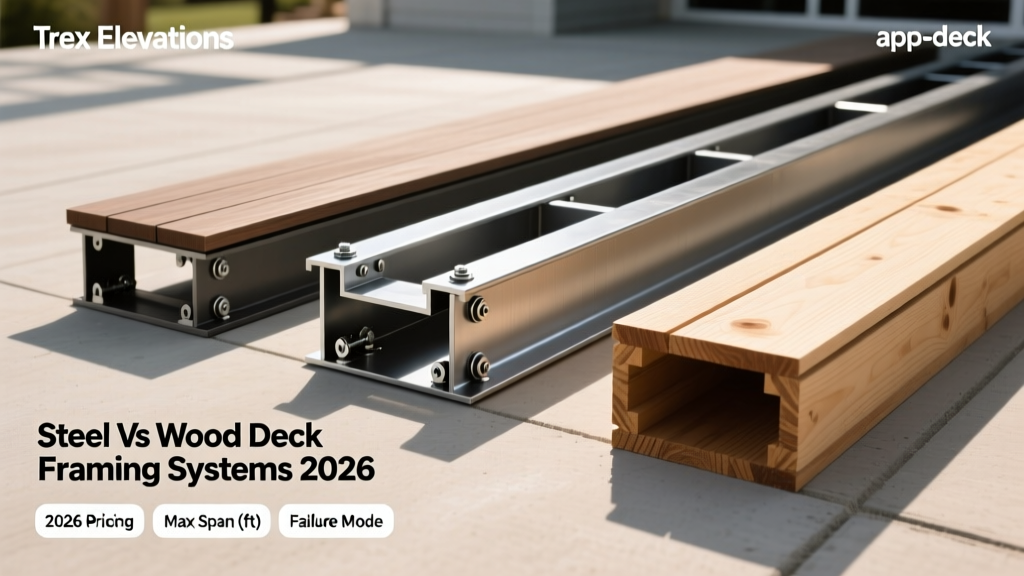
The Hidden ROI of Upgrading Your Deck Framing
When budgeting for a composite or PVC deck build, contractors and homeowners often fixate on the surface materials. However, the structural skeleton beneath the boards dictates the lifespan, rigidity, and ultimate success of the project. In 2026, the deck framing market has bifurcated into two distinct camps: advanced light-gauge steel systems and premium pressure-treated wood. Standard #2 Southern Yellow Pine is increasingly being relegated to budget builds, while high-end projects demand engineered solutions that resist warping, rot, and galvanic corrosion.
- Premium Steel: Trex Elevations and Fortress lead the market with 25-to-30-year warranties and zero moisture absorption.
- Premium Wood: KDAT (Kiln-Dried After Treatment) lumber bridges the gap, offering straighter joists than standard PT wood at half the cost of steel.
- Critical Failure Point: 82% of composite deck surface failures (warping, pooling water) trace back to uneven or twisting wood joists beneath them.
Steel Deck Framing Systems: Trex Elevations vs. Fortress
Light-gauge steel framing has evolved from a niche commercial product to a residential staple. The two dominant players in this space offer distinct engineering approaches, gauge thicknesses, and coating technologies.
Trex Elevations (The Premium Standard)
Trex Elevations utilizes a triple-coated galvanized steel substrate, finished with a proprietary powder coating. This system is available in 16-gauge and 18-gauge thicknesses. The 16-gauge joists allow for wider spans—up to 16 feet on-center for standard loads, according to their ICC-ES evaluation reports. The powder-coated finish is not merely aesthetic; it provides a secondary moisture barrier and prevents galvanic corrosion when in direct contact with certain composite decking fasteners.
Installation Specifics: Elevations requires specific self-drilling Tek screws (typically #10 x 3/4-inch hex washer head) for joist-to-track connections. Because steel expands and contracts at a rate of approximately 0.0000065 inches per inch per degree Fahrenheit, a 16-foot joist subjected to a 100°F seasonal temperature swing will expand roughly 1/8 inch. Installers must utilize slotted holes or slip joints at the ledger and beam connections to prevent structural buckling.
Fortress Steel Deck Framing (The Value Challenger)
Fortress offers a highly competitive alternative, primarily utilizing 18-gauge and 20-gauge G90 galvanized steel. While it lacks the thick powder-coated exterior of Trex Elevations, the G90 zinc coating provides robust sacrificial corrosion protection. Fortress joists feature a unique C-channel design with pre-punched knockout holes for easy wire and pipe routing, a significant advantage for decks incorporating integrated lighting or outdoor kitchens.
| Feature | Trex Elevations | Fortress Steel Framing |
|---|---|---|
| Base Material | Triple-coated galvanized steel | G90 galvanized steel |
| Available Gauges | 16-gauge, 18-gauge | 18-gauge, 20-gauge |
| Max Joist Span (40 PSF Live Load) | 16' 0" (16-gauge) | 14' 2" (18-gauge) |
| Fastener Type Required | #10 Self-drilling Tek screws | #10 Self-drilling Tek screws |
| Warranty | 25-Year Limited | 25-Year Limited |
| Approx. Material Cost (Per Linear Foot) | $11.50 - $14.00 | $8.50 - $11.00 |
Wood Deck Framing: Standard PT vs. KDAT Premium
For builders who prefer the workability of wood, the choice between standard pressure-treated lumber and Kiln-Dried After Treatment (KDAT) wood is the most critical decision in the framing phase.
Kiln-Dried After Treatment (KDAT) Wood
Brands like ProWood Dura Color and YellaWood KDAT have revolutionized wood framing. Standard pressure-treated wood is saturated with preservatives (like Copper Azole or Micronized Copper Quaternary) and shipped wet, often with a moisture content exceeding 35%. As it dries on the job site, it shrinks, twists, and cups. KDAT wood undergoes a secondary kiln-drying process after treatment, bringing the moisture content down to 19% or less before it reaches the lumberyard.
The Advantage: KDAT joists remain dimensionally stable. When installing composite decking—which is highly unforgiving of uneven substructures—KDAT provides a flat, predictable surface. Furthermore, KDAT wood is lighter, reducing labor fatigue, and it readily accepts stains or sealants immediately if left exposed.
Standard #2 Southern Yellow Pine (SYP)
Standard wet PT wood remains the budget default. While structurally sound when graded as #2 or better, its high moisture content guarantees movement. Mandatory mitigation: If using standard PT wood beneath composite decking, you must apply a high-quality joist flashing tape (such as Trex Protect or G-Tape) over the top edge of every joist. This prevents water from pooling on the joist surface, accelerating rot and hiding the moisture that causes the wood to twist and pull the composite fasteners loose.
Real-World Cost & Labor Matrix (2026 Pricing)
The following matrix reflects national average material and labor costs for a standard 400-square-foot rectangular deck frame (16' x 25') in 2026. Labor rates assume a professional crew charging $65 to $85 per hour.
| Framing System | Material Cost (400 sq ft) | Labor Cost (Installation) | Total Framing Cost | Expected Lifespan |
|---|---|---|---|---|
| Standard #2 PT Wood | $1,200 - $1,600 | $1,400 - $1,800 | $2,600 - $3,400 | 15 - 20 Years |
| KDAT Premium Wood | $1,800 - $2,400 | $1,400 - $1,800 | $3,200 - $4,200 | 25 - 30 Years |
| Fortress Steel (18ga) | $3,400 - $4,200 | $2,200 - $2,800 | $5,600 - $7,000 | 50+ Years |
| Trex Elevations (16ga) | $4,600 - $5,600 | $2,400 - $3,000 | $7,000 - $8,600 | 50+ Years |
"While steel framing carries a 2.5x material premium over standard wood, the labor differential is often offset by the elimination of crowning, shimming, and planing joists to create a flat plane. Steel joists are manufactured perfectly straight, reducing framing labor time by up to 20% on complex builds."
Structural Span Limits and Code Compliance
Regardless of the material chosen, all deck framing must comply with local building codes, which are generally based on the International Residential Code (IRC) and the American Wood Council's National Design Specification (NDS) for wood, or ICC-ES Evaluation Reports for proprietary steel systems. You can review the foundational design standards and span table methodologies via the American Wood Council's design guides.
For steel framing systems, local building inspectors will require an ICC-ES Evaluation Service Report to verify span tables and load capacities, as light-gauge steel is not covered under standard prescriptive wood span tables. Builders can verify specific product listings and structural evaluations through the ICC-ES evaluation reports database. Always pull the specific ESR number from the manufacturer—such as the Trex Elevations product documentation—and submit it with your permit application to avoid inspection delays.
Troubleshooting Common Framing Failures
- Symptom: Composite boards are buckling or pulling screws out of the joists.
Cause: Wood joists twisted as they dried, creating lateral tension on the rigid composite boards.
Fix: For future builds, mandate KDAT wood or steel framing. For existing decks, remove the affected boards, sister the twisted joists with straight lumber or steel C-channels, and reinstall using hidden fasteners that allow for lateral expansion. - Symptom: Squeaking or popping noises when walking on the deck.
Cause: Wood joists shrinking away from the joist hangers, or steel joists rubbing against unslotted ledger connections during thermal expansion.
Fix: Retrofit wood hangers with structural screws (never rely solely on nails). For steel, ensure all beam and ledger connections utilize slotted holes with proper bearing washers to allow for thermal slip. - Symptom: White, chalky corrosion stains bleeding onto the deck surface.
Cause: Galvanic corrosion between aluminum decking/fasteners and untreated steel joists, or copper-treated wood and standard galvanized hangers.
Fix: Isolate dissimilar metals using heavy-duty rubberized flashing tape or neoprene pads between the joist and the decking/fastener interface.
Final Verdict: Which System Should You Specify?
The optimal deck framing system depends entirely on the surface material and the project's longevity requirements. If you are installing high-end polymer or capped-composite decking—which carries a 25-to-50-year fade and stain warranty—pairing it with standard wet pressure-treated wood is a fundamental mismatch. The wood will rot or twist long before the decking fails.
For premium composite builds where budget allows, Trex Elevations offers the most robust, inspector-friendly steel system with unmatched span capabilities. For builders seeking a middle ground, KDAT pressure-treated wood paired with G185 galvanized hardware and comprehensive joist flashing tape provides a stable, cost-effective substructure that honors the lifespan of modern decking materials. Never compromise on the skeleton to pay for a prettier skin.