Alu Fence Cost Estimator & Material Calculator 2026
Calculate your 2026 alu fence project costs with our material estimator. Breakdowns for residential grades, gates, labor, and terrain adjustments.
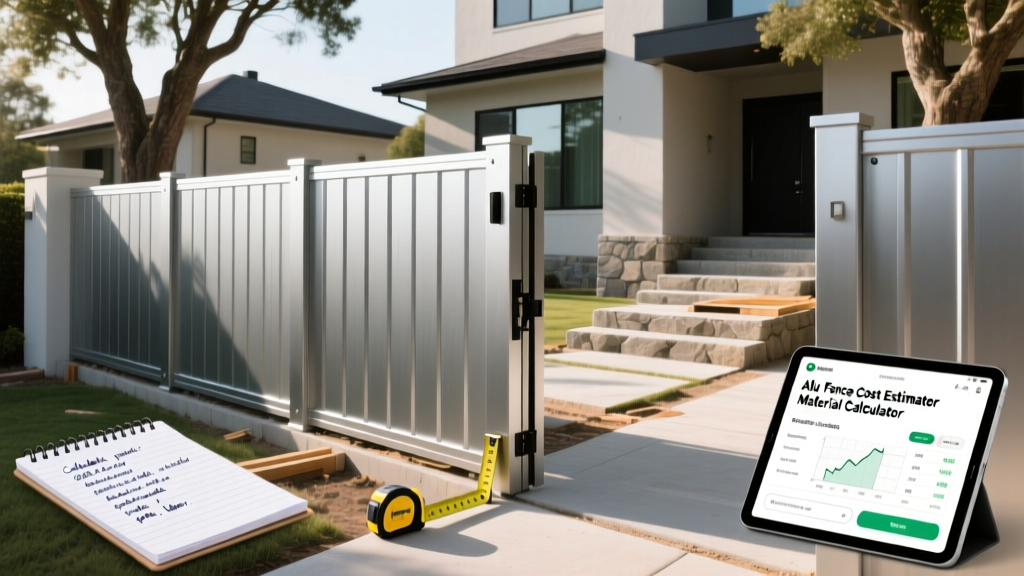
The True Cost of Aluminum Fencing in 2026
Estimating the cost of an alu fence requires moving beyond basic linear-foot averages. Aluminum fencing prices are dictated by extrusion wall thickness, picket dimensions, powder-coating grades, and site-specific terrain challenges. In 2026, the national average for a professionally installed residential aluminum fence ranges from $45 to $75 per linear foot, while commercial and industrial grades push this figure to $95 or more per linear foot. According to industry data tracked by Forbes Home, aluminum remains one of the most cost-effective long-term fencing solutions due to its zero-maintenance lifecycle, despite a higher upfront material cost compared to pressure-treated pine.
2026 Quick Cost Summary
- Residential Grade (0.060" wall): $35 - $45 per linear foot (materials only)
- Commercial Grade (0.080" wall): $45 - $60 per linear foot (materials only)
- Industrial Grade (0.125" wall): $65 - $85 per linear foot (materials only)
- Professional Installation Labor: $15 - $28 per linear foot
- Standard Walk Gate (4 ft): $250 - $450 installed
- Double Drive Gate (10 ft): $800 - $1,400 installed
Alu Fence Material Quantity Calculator Formula
Ordering aluminum fencing requires precise mathematical planning. Unlike wood, which can be cut and pieced together on-site, aluminum panels arrive pre-assembled in fixed 6-foot or 8-foot widths. Miscalculating panel counts results in expensive custom cuts or visible seams. Use the following step-by-step framework to calculate your exact material requirements.
- Calculate Net Linear Footage: Measure the total perimeter of the fence line. Subtract the exact width of all planned gates (e.g., subtract 4 feet for a standard walk gate, 12 feet for a double driveway gate).
- Determine Panel Count: Divide the net linear footage by your chosen panel width (standard is 6 feet). Always round up to the nearest whole number. For example, 145 feet of fencing divided by 6 equals 24.16. You must order 25 panels.
- Calculate Line Posts: You need one line post for every panel, plus one extra to close the run. (Formula: Panels + 1 = Line Posts). In the example above, 25 panels require 26 line posts.
- Calculate Corner and End Posts: Count every 90-degree angle (corner posts) and every point where the fence terminates against a structure or gate (end posts). Gate openings require two heavy-duty gate/end posts per opening to handle the dynamic load of swinging hardware.
- Estimate Concrete Volume: Standard aluminum posts are typically 2.5" x 2.5" or 3" x 3". For a 24-inch deep post hole, you need approximately 1.5 bags (50 lbs each) of fast-setting concrete per post. Multiply your total post count by 1.5 to determine the number of bags required.
Pricing Matrix: Residential vs. Commercial Grades
The term 'alu fence' encompasses vastly different structural capabilities. The primary cost driver is the aluminum alloy extrusion profile. Most architectural fencing uses 6063-T5 alloy, which offers excellent corrosion resistance and a smooth surface finish for powder coating. Understanding the dimensional differences between grades is critical for passing local building codes and HOA requirements.
| Grade Classification | Picket Dimensions | Rail Wall Thickness | 2026 Material Cost / LF | Best Application |
|---|---|---|---|---|
| Residential | 5/8" x 5/8" | 0.060" | $35 - $45 | Pool enclosures, yard perimeters |
| Commercial | 3/4" x 3/4" | 0.080" | $45 - $60 | Schools, parks, commercial lots |
| Industrial | 1" x 1" | 0.125" | $65 - $85 | High-security facilities, heavy industry |
Hidden Cost Variables: Terrain, Gates, and Coatings
Base linear-foot pricing rarely tells the whole story. When running your alu fence estimator, you must factor in the following site-specific variables that can inflate your final budget by 15% to 30%.
1. Terrain Adjustments: Racking vs. Stepping
Aluminum panels are designed to 'rack' (pivot at the rail-to-picket connection) to follow gentle slopes. Standard 6-foot panels can typically rack up to 20 or 30 degrees, accommodating a drop of about 4 to 6 inches over the span of the panel. Racking is included in the base panel cost. However, if your yard features a steep hill requiring a drop of more than 6 inches per panel, you must use the 'stepping' method. Stepping requires custom-cut panels and specialized stair-stepped posts, adding $25 to $45 per panel to your material costs.
2. Powder Coating and Coastal Environments
Standard alu fences are coated with an AAMA 2604 compliant powder coat, which is sufficient for most inland climates. If you are installing a fence within 5 miles of a saltwater coastline, standard coatings will oxidize and chalk within five years. You must upgrade to an AAMA 2605 high-performance fluoropolymer coating. According to Bob Vila's fencing guide, upgrading to marine-grade coatings and stainless steel hardware adds roughly 18% to 22% to the total material cost, but it is strictly necessary to prevent catastrophic galvanic corrosion.
3. Gate Hardware and Automation
Gates are the most expensive single components in an alu fence project. A standard 4-foot walk gate with a gravity latch costs around $300. Upgrading to a self-closing, self-latching mechanism (required by most municipal pool codes) adds $75 to $120. For double driveway gates, adding a low-voltage swing gate automation kit with solar backup will add $1,200 to $2,500 to the project, plus the cost of trenching for electrical if solar is not viable.
Labor vs. DIY: Installation Cost Breakdown
While aluminum fencing is marketed as DIY-friendly, the physical labor of setting posts in concrete is highly demanding. Professional installation typically costs between $15 and $28 per linear foot, depending on regional labor rates and soil conditions.
The DIY Reality Check
Pros: Saves $2,000 - $4,000 on an average 150-foot run. Complete control over post alignment.
Cons: Requires renting a mechanical auger ($85/day). Mixing and pouring 40+ bags of concrete before it sets is physically exhausting for a two-person crew. Mistakes in post plumb cannot be easily corrected once the concrete cures.
Hiring a Professional
Pros: Contractors carry liability insurance and handle utility line locates (811 calls). They possess specialized pneumatic post drivers for rocky soil, bypassing the need for augers and concrete in certain conditions.
Cons: Higher upfront capital requirement. Scheduling delays during peak spring/summer seasons can push installation out by 4 to 8 weeks.
Expert Tips for Ordering and Minimizing Waste
To ensure your alu fence project stays on budget and on schedule, apply these procurement strategies utilized by professional contractors:
"Never order exact-match quantities for aluminum fencing. The rigid nature of pre-assembled panels means that a single bent picket during transit renders the entire 6-foot panel unusable. Always factor in a minimum 5% overage for panels and a 10% overage for loose hardware, brackets, and post caps."
- Verify HOA Specifications Early: Many Homeowner Associations mandate specific picket spacing (usually no more than 4 inches to prevent child entrapment) and restrict decorative finials. Ordering non-compliant materials will result in forced teardowns at your own expense.
- Inspect Upon Delivery: Aluminum is a soft metal. Inspect every panel for micro-abrasions in the powder coating before the delivery truck leaves. Touch-up paint provided by manufacturers rarely matches the factory electrostatic finish perfectly; reject severely scratched panels immediately.
- Use Galvanized or Stainless Mounts: If mounting your alu fence to existing concrete pillars or masonry walls, never use the standard zinc-plated lag screws provided in basic hardware kits. Upgrade to 316-grade stainless steel masonry anchors to prevent rust streaks from bleeding down your pristine fence lines.