Wood and Metal Fence Performance Ratings: Wind Load & Material Specs
Compare wood and metal fence performance ratings, including ASCE 7 wind loads, AWPA wood treatment levels, and steel gauge specifications.
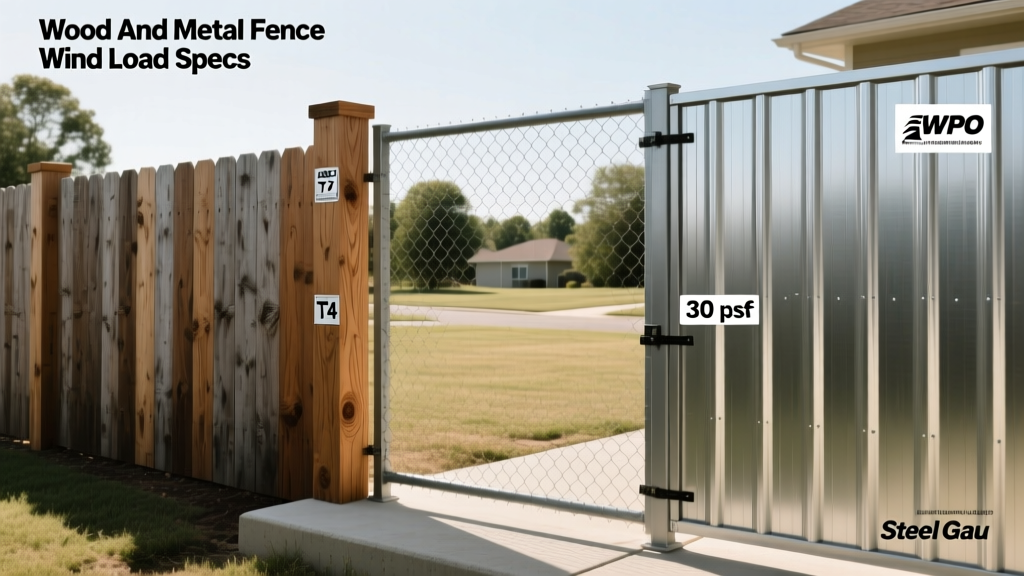
ASCE 7 Wind Load Dynamics: Solid Wood vs. Tubular Metal
When engineering a perimeter barrier, the most critical structural variable is wind load resistance. Under the ASCE 7-22 Minimum Design Loads standard, which governs the 2024–2026 International Building Code (IBC) cycle, fences are classified as 'other structures' and must withstand localized pressure differentials without catastrophic deflection or post shear.
The primary differentiator between a wood and metal fence in wind engineering is porosity. A standard 6-foot solid wood privacy fence acts as a near-impermeable sail (0–5% porosity), generating a drag coefficient ($C_d$) of approximately 1.2 to 1.4. Conversely, a tubular metal fence with 1-inch pickets spaced at 4-inch intervals yields roughly 80% porosity, dropping the effective drag coefficient to 0.3–0.5.
For a 6-foot fence in Exposure C (open terrain) with a basic wind speed of 115 mph, the velocity pressure ($q_z$) at the top of the fence is roughly 34.4 psf. Multiply this by the $C_d$ of a solid wood fence (1.2) and a gust effect factor (0.85), and the design wind load exceeds 35 psf. This translates to over 210 pounds of lateral force per linear foot of fence. A tubular metal fence under the same conditions experiences less than 65 pounds per linear foot, allowing for wider post spacing and shallower concrete footings.
| Fence Type | Porosity | Drag Coeff. ($C_d$) | Design Load (psf) | Max Post Spacing (6' Ht) |
|---|---|---|---|---|
| Solid Wood Privacy | 0–5% | 1.20 | 35.1 psf | 6 feet (requires 36" embed) |
| Wood Shadowbox (Alternating) | 25% | 0.90 | 26.3 psf | 8 feet (requires 30" embed) |
| Tubular Metal (Ornamental) | 75–80% | 0.40 | 11.7 psf | 8–10 feet (requires 24" embed) |
| Chain Link (9-ga fabric) | 85% | 0.35 | 10.2 psf | 10 feet (requires 24" embed) |
Wood Treatment & Decay Resistance Specifications (AWPA U1)
Wood fencing performance is dictated by its ability to resist fungal decay and insect infestation at the ground line. The American Wood Protection Association (AWPA) U1 Standard categorizes preservative retention levels based on Use Categories (UC). Specifying the incorrect UC rating is the leading cause of premature wood fence failure.
Critical Use Categories for Fence Posts
- UC3B (Above Ground, Uncoated): Suitable for horizontal rails and pickets. Requires a minimum retention of 0.05 pcf (pounds per cubic foot) for MCA-C (Micronized Copper Azole with Co-biocide).
- UC4A (Ground Contact, General): The absolute minimum for fence posts set in concrete or soil. Requires 0.15 pcf for MCA-C or 0.15 pcf for CA-C (Copper Azole Type C).
- UC4B (Ground Contact, Heavy Duty): Required for posts in areas with poor drainage, high termite pressure, or critical structural components. Requires 0.21 pcf for MCA-C.
Many big-box retailers sell 'Ground Contact' lumber that only meets UC4A (0.15 pcf). In regions with high Formosan termite activity or continuous soil moisture, UC4A posts can experience structural shear at the ground line within 7–10 years. For commercial or high-wind residential applications, explicitly specify UC4B (0.21 pcf) or utilize steel post anchors to elevate UC3B wood entirely above grade.
Metal Alloy, Gauge, and Coating Standards
Metal fencing performance hinges on substrate yield strength and corrosion protection systems. Marketing materials frequently use nominal 'gauge' numbers, which are legally unstandardized and highly deceptive. Procurement specifications must reference exact decimal thicknesses and ASTM standards.
Steel Substrate Specifications (ASTM A653)
For galvanized steel ornamental or agricultural fencing, the baseline specification should be ASTM A653 Structural Steel (SS) Grade 50, indicating a minimum yield strength of 50,000 psi.
- 16-Gauge (0.0598 inches): Standard for residential tubular pickets. Susceptible to bending under lateral impact loads exceeding 150 lbs.
- 14-Gauge (0.0747 inches): Required for commercial perimeter fencing and gate frames. Provides a 42% increase in moment of inertia over 16-gauge.
- 12-Gauge (0.1046 inches): Mandated for high-security anti-climb mesh and heavy-duty post sleeves.
Corrosion Protection: Zinc and Powder Coatings
Raw steel will oxidize rapidly. High-performance metal fences utilize a dual-coat system:
- Base Layer (Hot-Dip Galvanizing): Specify G90 (0.90 oz/sq ft total zinc weight) for standard environments, or G185 for coastal zones (within 1 mile of saltwater). G185 provides roughly 3.1 mils of zinc coating, yielding an estimated 75+ years to first maintenance in rural environments.
- Top Coat (Powder Coating): Must meet AAMA 2604 specifications for exterior architectural coatings. This requires the polyester powder to withstand 3,000 hours of salt spray testing (ASTM B117) with less than 1/8 inch creep from the scribe, and retain 50% of its original gloss after 5 years of South Florida weathering.
Aluminum Extrusions (ASTM B221)
Aluminum fencing does not rust, making it ideal for coastal applications, but it suffers from lower tensile strength. Specify 6005-T5 or 6061-T6 alloys. 6061-T6 offers a tensile strength of 45,000 psi and a yield of 40,000 psi, making it the mandatory choice for gate frames and high-traffic commercial enclosures where impact resistance is required.
Environmental Degradation & Deflection Matrix
Material selection requires balancing wind porosity, impact resistance, and environmental degradation. The following matrix outlines performance limits based on standardized testing parameters.
| Performance Metric | Pressure-Treated Wood (Southern Yellow Pine) | Galvanized/Powder-Coated Steel | Extruded Aluminum (6061-T6) |
|---|---|---|---|
| Max Allowable Deflection | L/120 (Visual bowing acceptable) | L/240 (Strict structural limit) | L/180 (Moderate flex limit) |
| UV Degradation Resistance | Poor (Requires 250hr re-staining cycle) | Excellent (AAMA 2604 compliant) | Excellent (Anodized or Fluoropolymer) |
| Moisture / Rot Tolerance | Moderate (Dependent on AWPA UC rating) | Poor (If zinc layer is compromised) | Excellent (Immune to biological rot) |
| Impact Resistance (Blunt Force) | High (Absorbs energy via fiber crushing) | Very High (Dents before shearing) | Moderate (Can fracture under sharp impact) |
The Galvanic Corrosion Matrix: Fastener Selection
The most frequent point of failure in mixed-material fencing (e.g., wood panels on metal posts, or metal brackets on treated wood) is galvanic corrosion. Modern wood preservatives (MCA, CA-C, ACQ) are highly alkaline and contain dissolved copper, which acts as a cathode when paired with anodic metals like aluminum or standard zinc.
Never use standard hot-dipped galvanized (HDG) or aluminum fasteners with modern copper-based treated wood. The copper in the wood will strip the zinc from the fastener within 24–36 months, leading to catastrophic bracket failure.
Approved Fastener Specifications
- 304 Stainless Steel (ASTM F593): The minimum requirement for attaching wood pickets to metal rails or using standard MCA-C treated lumber. Provides adequate resistance to the alkaline copper environment.
- 316 Stainless Steel: Mandatory for coastal installations (salt spray) or when using ACQ (Alkaline Copper Quaternary) treated wood, which is significantly more corrosive than MCA.
- Isolation Membranes: When mounting aluminum fence posts to pressure-treated wood base rails, a 40-mil EPDM or PVC isolation pad must be placed between the metals to break the electrolytic bridge.
Footprint and Foundation Specifications
A fence's above-ground performance is irrelevant if the substructure fails. Post embedment depth must be calculated based on the local frost line and the overturning moment generated by the wind load.
For a 6-foot solid wood fence in a region with a 115 mph wind speed, the overturning moment at the base of an 8-foot post (6' above grade, 2' below) exceeds 1,200 ft-lbs. To resist this without relying solely on the passive soil pressure of a narrow hole, specifications must dictate:
- Embedment Depth: Minimum 30 inches (or 12 inches below the local frost line, whichever is deeper).
- Concrete Footing: 3,000 psi compressive strength concrete (ASTM C94), poured to a minimum diameter of 10 inches.
- Gravel Base: 4 inches of compacted 3/4-inch crushed stone beneath the post to facilitate hydrostatic drainage and prevent frost heave uplift.
By strictly adhering to ASCE 7 wind calculations, AWPA wood retention levels, and ASTM metal coating standards, contractors and engineers can eliminate the guesswork from material procurement, ensuring the installed wood and metal fence meets both code requirements and long-term durability expectations.