Best Materials to Build a Fence for Modern Privacy Designs
Discover the best materials to build a fence for modern privacy designs. Compare wood, composite, and metal options with 2026 pricing and structural specs.

The Shift in Fence Design: From Boundary to Architectural Feature
Modern residential and commercial architecture no longer treats perimeter fencing as a mere boundary marker. Today, fences are integrated architectural features that dictate sightlines, manage microclimates, and establish privacy without sacrificing aesthetic continuity. Selecting the right materials to build a fence requires balancing the visual demands of horizontal slats, shadowbox profiles, or industrial corrugated panels against the structural realities of wind loads, soil conditions, and material degradation. In 2026, the most successful privacy fences rely on advanced composite extrusions, sustainably harvested tropical hardwoods, and weathering steels, all supported by hidden structural steel framing.
Decision Matrix: Matching Materials to Build a Fence with Your Design Vision
Before selecting lumber or metal, define the primary architectural function of the fence. The following framework maps specific privacy design styles to their optimal material counterparts based on structural behavior and visual longevity.
| Design Style | Primary Visual Goal | Optimal Material Selection | Structural Requirement |
|---|---|---|---|
| Horizontal Slat | Mid-century modern, elongated sightlines | Ipe Hardwood or Aluminum Extrusions | Hidden steel posts; 316 SS fasteners |
| Board-on-Board / Shadowbox | Traditional privacy, semi-permeable wind flow | Capped Composite or Cellular PVC | Pressure-treated pine or steel framing |
| Corrugated Industrial | Urban privacy, mixed-material contrast | Corten Steel (A606-4) Panels | Welded steel tube framing; gravel drip edge |
| Louvered / Angled Slat | Directional privacy, airflow management | Powder-Coated 6063-T5 Aluminum | Custom welded aluminum brackets |
Horizontal Slat & Louver Designs
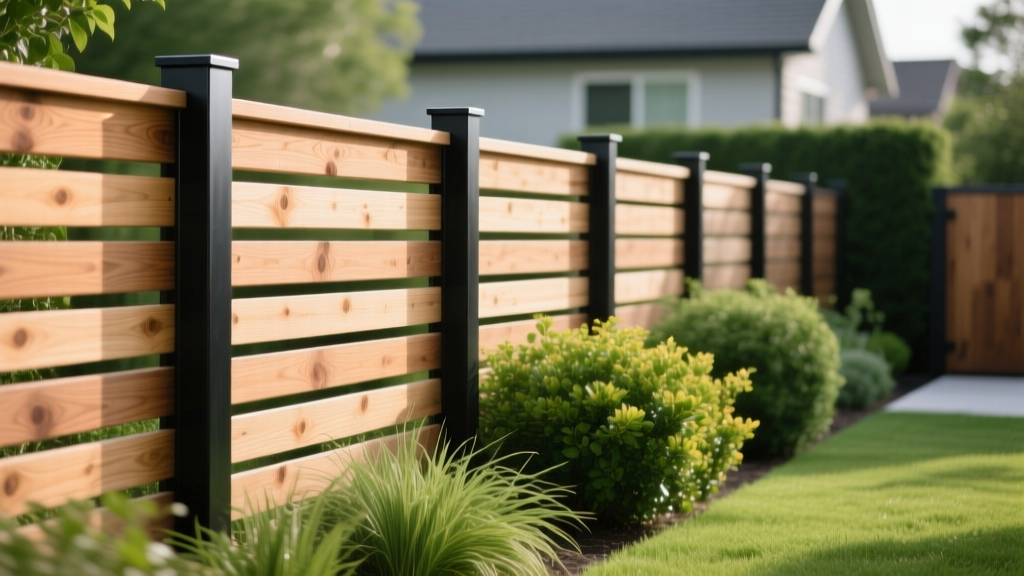
Horizontal fencing creates an illusion of width, making narrow urban lots feel expansive. However, horizontal boards act as ladder rungs and bear immense lateral wind loads compared to vertical pickets. The materials to build a fence in this style must possess high dimensional stability to prevent sagging over 8-foot spans.
Ipe and Tropical Hardwoods
For a premium, natural horizontal design, Ipe (Tabebuia serratifolia) remains the gold standard. With a Janka hardness rating of 3,680 lbf and a density that causes it to sink in water, Ipe resists warping and cupping far better than domestic cedars. According to the USDA Forest Products Laboratory, tropical hardwoods require specific acclimation and fastening protocols. For 1x6 Ipe boards (actual dimensions 3/4" x 5-1/2"), you must use 316-grade stainless steel ring-shank nails or hidden fastener systems like Tiger Claw. Galvanized fasteners will react with the wood's natural tannins, causing unsightly black staining within months. Maintain a strict 3/16" gap between horizontal slats to accommodate seasonal moisture expansion.
Powder-Coated Aluminum Extrusions
For clients who desire the horizontal slat aesthetic without the maintenance of oiling hardwood, 6063-T5 aluminum extrusions are the optimal alternative. Brands like Alumi-Gard offer hollow aluminum boards coated with AAMA 2604 fluoropolymer finishes that resist UV fading and chalking. Because aluminum does not expand or contract with moisture fluctuations, installers can achieve mathematically perfect 1/2" gaps using precision spacer jigs, resulting in a flawless, uniform facade that will never sag or rot.
Board-on-Board & Shadowbox Privacy
Shadowbox and board-on-board designs overlap vertical pickets on alternating sides of the horizontal rails. This creates a fully private barrier that still allows 10-15% airflow, reducing the wind-load coefficient and preventing the fence from acting as a solid sail during severe storms.
Capped Composite Systems
Traditional wood shadowbox fences require face-nailing hundreds of individual pickets, leading to thousands of exposed nail heads that eventually rust and streak. Modern capped composite systems, such as Trex Seclusions, solve this through interlocking 6-inch pickets. The co-extruded polyethylene cap layer resists moisture absorption and UV degradation. The interlocking design means the fence can be installed with hidden fasteners at the rails, leaving a completely smooth, unbroken visual surface on both sides. In 2026, capped composite remains the highest-performing material for zero-maintenance vertical privacy.
Pressure-Treated Southern Yellow Pine
For budget-conscious projects requiring a traditional shadowbox profile, Southern Yellow Pine (SYP) is the standard. However, material selection must be precise. Ensure the lumber is stamped for UC4A (ground contact) or UC4B (heavy-duty ground contact) by the American Wood Protection Association (AWPA). Standard above-ground (UC3B) treated lumber will rot within three years if the bottom edge of the picket rests on damp soil or mulch. To elevate the design, specify "Select Structural" or "Radius Edge" (dog-ear) SYP pickets to avoid the warped, knotted appearance of standard #2 grade pine.
Corrugated Corten steel (ASTM A606-4) provides a stunning rust-patina industrial aesthetic. However, as the protective oxide layer forms during the first 12-18 months, the fence will "bleed" rust-laden water. Never install Corten fencing directly above porous concrete patinos, light-colored stucco, or limestone retaining walls without a dedicated gravel drip trench or sealed flashing system to manage the runoff.
2026 Cost & Lifespan Comparison Data
Understanding the total cost of ownership is critical when evaluating materials to build a fence. The following data reflects 2026 national averages for fully installed privacy fencing (6-foot height), including materials, labor, and concrete footings.
| Material Profile | Design Application | 2026 Installed Cost (per linear ft) | Expected Lifespan | Maintenance Index |
|---|---|---|---|---|
| 1x6 Ipe Hardwood | Horizontal Slat | $65 - $85 | 40+ Years | Annual UV Oil (Optional) |
| 6063-T5 Aluminum | Horizontal / Louvered | $55 - $75 | 50+ Years | Zero |
| Capped Composite | Interlocking Privacy | $50 - $70 | 30-40 Years | Occasional Wash |
| Corten Steel (22ga) | Corrugated Industrial | $70 - $95 | 50+ Years | Zero (Patina Dependent) |
| UC4A Treated Pine | Board-on-Board | $30 - $45 | 15-20 Years | Bi-annual Stain/Seal |
Structural Framing: The Hidden Design Enabler
The most common failure point in high-end fence design is not the face material, but the structural posts. A horizontal Ipe fence generates massive leverage on posts during 60 mph wind events. Traditional 4x4 pressure-treated pine posts are prone to twisting, which will instantly ruin the level sightlines of a horizontal slat design.
To achieve a modern, floating facade, utilize structural steel post systems like PostMaster Plus. These heavy-gauge galvanized steel posts are driven into the ground and set in concrete, engineered to withstand 130 mph wind loads. Once the steel posts are plumb and secured, horizontal wood or composite furring strips are attached to the steel, and the face material is applied over the top, completely hiding the industrial framing behind a seamless architectural exterior.
Expert Sourcing & Installation Standards
When procuring materials to build a fence, reject big-box store "economy" bundles for architectural projects. Tropical hardwoods must be sourced from FSC-certified (Forest Stewardship Council) importers to ensure the wood was kiln-dried to an equilibrium moisture content (EMC) of 12-15% for exterior use. Green or air-dried hardwoods will twist violently once exposed to direct sunlight. For composite and aluminum systems, verify that the manufacturer provides specific engineering stamps for your local municipality's wind-load requirements (typically governed by ASCE 7-22 standards). A fence is only as enduring as its fasteners; always upgrade to 304 or 316 stainless steel screws and structural bolts, as standard zinc-plated hardware will corrode and fail long before the premium face materials degrade.
Written by
Sarah WhitfieldSarah Whitfield is a chartered quantity surveyor (MRICS) and construction cost analyst with 15 years of experience in material pricing, procurement strategy, and project budgeting. She earned her degree in Construction Management from the University of Reading (UK) and has worked on projects ranging from $2M custom homes to $180M mixed-use developments across North America and Europe. Sarah currently leads cost estimating for BuildMat Insight, maintaining a proprietary database of 4,000+ material price points updated quarterly. She is a frequent contributor to RSMeans cost data panels and has presented at the International Cost Engineering Council (ICEC) congress. Based in Denver, CO, Sarah is an avid trail runner and volunteer mentor for Women in Construction.
More from Sarah Whitfield
View all
Wood & Lumber
What Are the Different Types of Wood? A Builder's Guide
Compare structural softwoods, finish hardwoods, and engineered lumber. Analyze Janka ratings, MOE values, and 2026 pricing for construction.
Aug 4, 2026

Walls & Panels
Steel Framing vs Wood Framing: Corrosion and Moisture Defense
Compare steel framing vs wood framing for moisture resistance. Learn about galvanized coatings, condensation risks, and corrosion protection strategies.
Jul 21, 2026

Stone & Masonry
How to Cut Stone Veneer: Wet Saw vs Grinder Comparison
Compare the best tools for cutting stone veneer. We review wet saws, angle grinders, and chop saws to help you achieve clean, chip-free cuts.
Jul 21, 2026