Barb Wire Fence Cost Calculator & Material Estimator 2026
Calculate exact material quantities and 2026 costs for your barb wire fence. Includes post spacing, wire gauge pricing, and terrain adjustments.
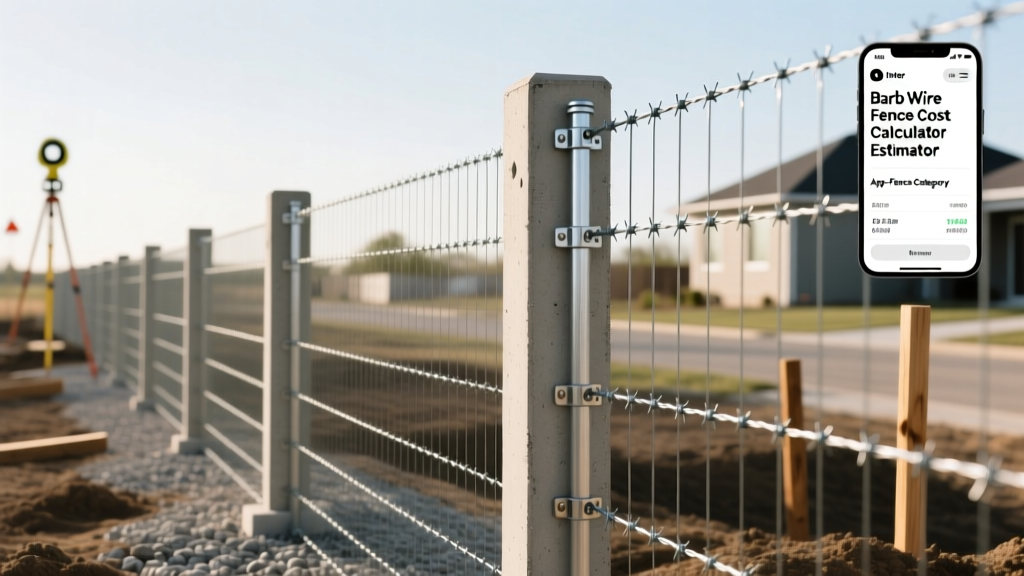
The True Cost of a Barb Wire Fence in 2026
Estimating the cost of a barb wire fence requires moving beyond simple per-foot averages. Agricultural and rural property owners must account for wire gauge, post spacing, terrain variables, and specific bracing hardware. In 2026, the national average for a standard 4-strand barb wire fence ranges from $1.85 to $3.40 per linear foot for materials only, and $3.50 to $6.50 per linear foot when professional installation is included. According to the Iowa State University Extension Ag Decision Maker, material volatility in galvanized steel has stabilized, but labor rates for specialized fence crews continue to climb in remote rural areas.
• Materials Only (Standard 4-Strand): $1.85 – $2.60
• Materials Only (High-Tensile 3-Strand): $1.50 – $2.10
• Professional Installation Labor: $1.65 – $3.90
• Total Installed Cost: $3.50 – $6.50
Material Quantity Calculator: Step-by-Step Breakdown
To accurately price your project, you must calculate the exact quantities of wire, line posts, and corner braces. The following framework uses a standard 1,000-foot linear run with a 4-strand configuration as a baseline.
Step 1: Calculate Linear Footage and Wire Rolls
Barb wire is sold in 80-rod rolls. One rod equals 16.5 feet, meaning a standard roll contains 1,320 linear feet. For a 1,000-foot fence with 4 strands, you need 4,000 total feet of wire. Dividing 4,000 by 1,320 yields 3.03 rolls. Always round up and purchase 4 rolls to account for overlapping at corners, splicing, and tensioning waste.
Step 2: Determine Post Count (Line, Corner, and Brace)
Standard 12.5-gauge barb wire requires line posts spaced every 10 to 12 feet. High-tensile 15.5-gauge wire can stretch to 20-foot spacing, but standard agricultural applications stick to 12 feet to prevent sagging under snow loads or animal pressure. For 1,000 feet at 12-foot spacing, you need 83 line posts. Add 2 extra for contingencies. Corner and end posts require specialized wood H-braces. A basic square enclosure requires 4 corners, each utilizing 1 primary corner post and 2 brace posts, totaling 12 heavy-duty wood posts.
| Material Component | Specification | Quantity (1,000 ft Run) | Est. Unit Cost (2026) |
|---|---|---|---|
| Barb Wire | 12.5-ga, 2-point, 80-rod roll | 4 rolls | $75.00 / roll |
| Steel T-Posts | 6.5 ft, 1.25 lb/ft with anchors | 85 posts | $9.50 / post |
| Corner/Brace Posts | 4x6 or 6x6 Treated Pine, 8 ft | 12 posts | $32.00 / post |
| T-Post Clips | Galvanized steel wire clips | 340 clips | $0.12 / clip |
| Brace Wire & Staples | 9-ga brace wire, 1.5" staples | 1 spool / 1 box | $45.00 total |
Component Pricing Guide and Specifications
Wire Gauge and Coating Selection
Not all barb wire is identical. The USDA Natural Resources Conservation Service (NRCS) outlines specific tension and gauge requirements for livestock containment. Standard 12.5-gauge wire is the industry workhorse, offering high visibility and resistance to stretching. However, if you are fencing large perimeter boundaries where wildlife pressure is high, 15.5-gauge high-tensile wire provides superior break strength (up to 1,000 lbs per strand) and allows for wider post spacing, ultimately reducing your T-post costs by up to 40%. Always specify Class 3 galvanizing (0.80 oz/sq ft zinc coating) for environments with high moisture or salt exposure to prevent premature rusting.
Post and Bracing Hardware
Steel T-posts are graded by weight per foot. A 1.25 lb/ft post is sufficient for standard 4-strand fences in loamy soil. If you are building in sandy soil or areas with high wind loads, upgrade to 1.33 lb/ft or 1.5 lb/ft posts to prevent leaning. For corner bracing, the floating diagonal H-brace is the most reliable configuration. The horizontal brace post should be cut to exactly 8 feet, and the diagonal brace wire must be 9-gauge galvanized wire, twisted tight with a hay wire tightener or gribble to transfer the linear tension into the ground.
Hidden Costs and Terrain Edge Cases
Quantity calculators often fail to account for the physical realities of the land. When budgeting, apply the following multipliers based on your specific terrain:
- Rocky or Caliche Soil: Driving standard T-posts is impossible. You will need to rent a pneumatic rock drill or use a tractor-mounted hydraulic post driver. Expect to add $4.00 to $8.00 per hole for drilling, or use rock-pin anchors which cost roughly $12.00 each.
- Wetlands and Creeks: Standard 6.5-foot posts will heave and rot in saturated soil. You must use 8-foot posts driven 3 feet deep, or set posts in 3000-PSI concrete footers ($18.00 per bag of fast-setting mix). For water crossings, a specialized suspension cable or high-tensile smooth wire drop-gate is required, adding $150 to $300 per crossing.
- Heavy Brush Clearing: Fencing requires a 4-foot clear corridor to stretch wire safely. If your fence line requires chainsaw clearing or skid-steer grubbing, add $1.50 to $3.00 per linear foot for land prep before installation begins.
Tensioning and Long-Term Maintenance
A barb wire fence is only as strong as its tension. Hand-stretching wire with a truck or tractor is an outdated practice that leads to uneven tension and snapped wires. Professional crews use mechanical fence stretchers (come-alongs) or inline tensioning devices like the Gripple Plus #4. These inline tensioners cost about $3.50 each and allow you to re-tension specific strands years later without untying corner knots. Plan to walk the fence line annually to tighten brace wires and replace any T-post clips that have popped off due to frost heave.
"The most common failure point in a barbed wire fence isn't the wire itself, but the corner brace. If the corner post lifts even two inches, the tension across a 1,320-foot run drops to zero, turning a livestock barrier into a dangerous tangled mess. Always set corner posts a minimum of 42 inches deep and tamp the backfill in 6-inch lifts."
Frequently Asked Questions
How many strands of barb wire do I need for cattle?
Four strands is the standard for mature cattle, with the top wire at 40 inches and the bottom wire at 12 to 14 inches off the ground. If you are containing calves or sheep, a 5-strand configuration or a hybrid fence (barb wire on top, woven wire on the bottom) is required to prevent animals from crawling under.
Can I attach barb wire directly to wooden posts?
Yes, but you must use 1.5-inch or 1.75-inch galvanized fencing staples. Never use standard nails or screws, as they will pull out under tension. Drive the staples in at a slight downward angle to prevent the wire from sliding up the post over time, but do not drive them so tight that they pinch the wire and restrict its natural expansion and contraction during temperature changes.