Board on Board Fence Materials: Taxonomy and Selection Guide
Explore the material taxonomy for a board on board fence. Compare wood species, composites, and board dimensions to select the ideal privacy fencing.
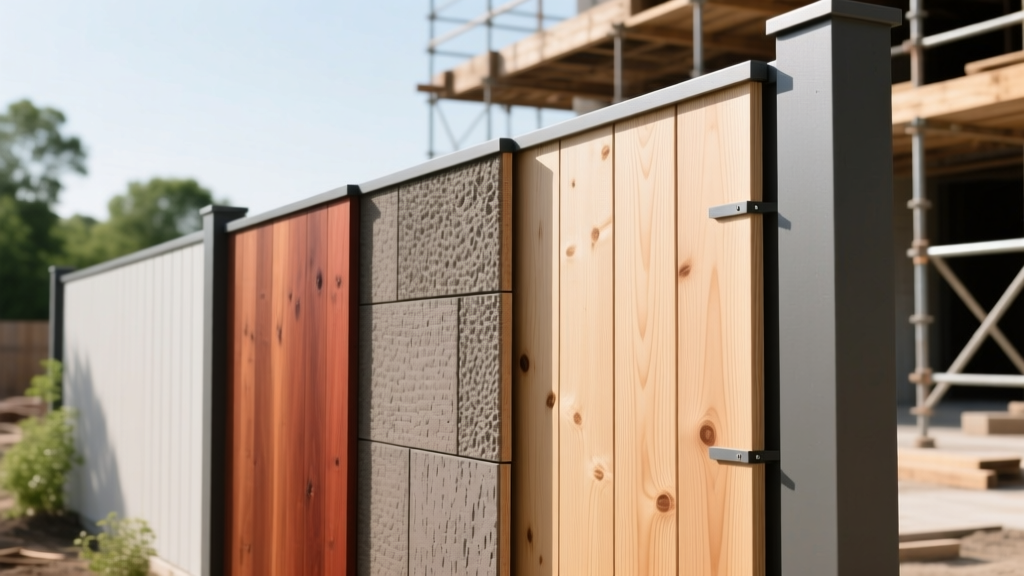
The Structural Reality of Board on Board Fencing
A board on board fence (BoB) is fundamentally different from a standard stockade or shadowbox fence. In a true BoB configuration, vertical pickets are installed on the same side of the horizontal rails with a 1-inch to 1.5-inch overlap, or alternated on both sides with an overlap that completely obscures the gaps. This creates a 100% solid visual barrier. Because there are no gaps for wind to pass through, a BoB fence acts as a solid sail, subjecting the posts, rails, and fasteners to maximum wind shear. Material selection must therefore prioritize dimensional stability, fastener withdrawal resistance, and structural rigidity over mere aesthetics.
Wood Species Taxonomy: Choosing the Right Timber
Wood remains the dominant material for BoB construction due to its strength-to-weight ratio and natural rigidity. However, not all fencing lumber performs equally under the tension of overlapping installations.
Western Red Cedar (Select Tight Knot vs. Clear)
According to the Western Red Cedar Lumber Association (WRCLA), Select Tight Knot (STK) is the optimal grade for BoB fencing. STK boards contain knots smaller than 1.5 inches that are structurally integrated and will not dislodge. While 'Clear' grade cedar is visually pristine, its uniform edge-grain milling makes it highly susceptible to cupping and warping when exposed to uneven sun and moisture. The varied grain structure in STK provides internal tension that keeps the board flat against the rails.
Pressure-Treated Southern Yellow Pine (PT SYP)
For budget-conscious projects, PT SYP is the standard. When selecting PT lumber for a BoB fence, verify the American Wood Protection Association (AWPA) Use Category tags. Posts must be rated UC4A (Ground Contact), while the overlapping boards and horizontal rails should be rated UC3B (Above Ground) or UC4A. Using UC3B boards reduces chemical retention levels, minimizing the severe twisting and checking associated with heavily saturated ground-contact lumber drying out above grade.
Material Comparison Matrix
| Material / Grade | Janka Hardness (lbf) | Shrinkage Coefficient (Radial) | Avg Cost per Lin Ft (2026) | Best Application |
|---|---|---|---|---|
| Western Red Cedar (STK) | 350 | 2.6% | $4.50 - $6.00 | Pacific NW, high-moisture climates |
| PT Southern Yellow Pine | 870 | 5.1% | $2.20 - $3.50 | Southern US, high-budget constraints |
| Capped Wood-Plastic Composite | 1,200+ | < 1.0% | $8.50 - $12.00 | Coastal regions, zero-maintenance mandates |
| Co-Extruded PVC (Hollow) | N/A (Flexural modulus) | Thermal expansion dominant | $6.00 - $9.00 | Suburban residential, HOA compliance |
Synthetic Alternatives: PVC and Capped Composite
Synthetic BoB fences eliminate the rot and insect vulnerabilities of wood, but they introduce distinct engineering challenges regarding thermal expansion and weight.
Hollow-Profile PVC
PVC BoB pickets are typically extruded with internal hollow chambers to reduce weight and material costs. While PVC does not rot, it has a high coefficient of linear thermal expansion. In a BoB configuration where boards overlap and are nailed tightly together, PVC cannot expand and contract freely. If installed without calculating the Z-axis expansion gap, the overlapping seams will buckle during peak summer temperatures. Always follow manufacturer-specified gapping protocols at the top and bottom rails.
Capped Wood-Plastic Composite (WPC)
Composite boards consist of a wood-flour and HDPE core wrapped in a protective polymer cap. They offer superior fade and stain resistance compared to wood. However, solid composite pickets are exceptionally heavy—often weighing 30% to 50% more than dimensional cedar.
Dimensional Math: Calculating Overlap and Yield
Accurate material estimation requires understanding nominal versus actual lumber dimensions and the mathematics of the overlap.
- Nominal 1x6: Actual dimensions are 0.75" thick by 5.5" wide.
- Nominal 1x8: Actual dimensions are 0.75" thick by 7.25" wide.
If you specify a 1-inch overlap using 1x6 boards, each board yields 4.5 inches of face coverage. To cover 100 linear feet of fencing, you need 267 boards (100 ft x 12 in / 4.5 in). If you increase the overlap to 1.5 inches for enhanced privacy and wind deflection, the yield drops to 4 inches per board, requiring 300 boards for the same 100-foot run. This 12% increase in material volume must be factored into the initial procurement budget.
Fastener and Hardware Selection
The overlapping tension in a BoB fence places immense sheer and withdrawal stress on fasteners. Using the wrong nail taxonomy will result in popped boards within the first seasonal moisture cycle.
- Shank Type: Always specify ring-shank or screw-shank nails. The deformations create a mechanical lock in the wood fibers, offering up to 300% greater withdrawal resistance than smooth-shank nails.
- Metallurgy: For cedar or redwood, use 304 or 316 stainless steel. The natural tannic acids in these woods will rapidly corrode hot-dipped galvanized (HDG) steel, causing unsightly black streaks down the face of the overlapping boards.
- Length: For 3/4" thick boards attached to 1.5" thick rails, use 2-1/2" or 3" nails to ensure a minimum 1-inch penetration into the structural rail.
Climate-Driven Selection Matrix
Material selection should be dictated by the local microclimate rather than just upfront cost. Use this decision framework to finalize your BoB material taxonomy:
- High Humidity / Heavy Rainfall (USDA Zones 7-10 Coastal): Select Western Red Cedar or Capped Composite. Avoid PT SYP, as the constant moisture prevents the wood from fully curing, leading to prolonged twisting.
- Arid / High UV (Southwest US): Select Co-Extruded PVC or UV-stabilized Composite. Wood species will rapidly desiccate, causing the overlapping boards to shrink and expose gaps, defeating the purpose of the BoB design.
- High Wind / Hurricane Prone: Avoid solid BoB designs entirely unless engineered with 4x6 posts and steel framing. If BoB is mandated by HOA, use 5/8" thick pickets with a 2-inch overlap to allow slight flex, and secure with structural screws rather than nails.