Chain Link Fence Installation: Gauge, Mesh, and Wind Load Specs
Master chain link fence installation with our technical guide on ASTM fabric specs, pipe schedules, wind load ratings, and concrete footing depths.
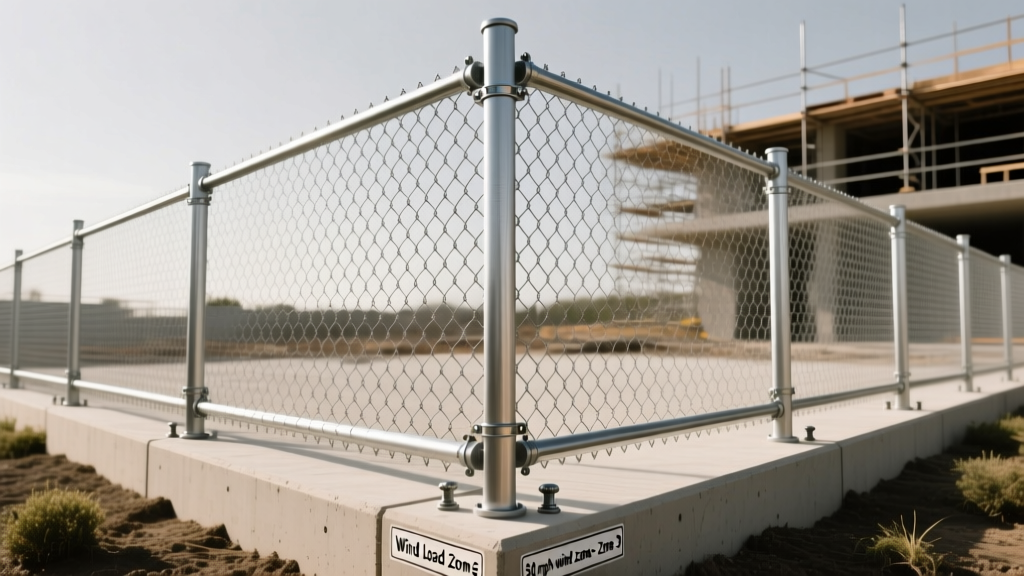
Decoding Chain Link Fabric Specifications (ASTM A392 & A491)
Successful chain link fence installation begins with selecting fabric that meets rigorous performance standards. The industry relies on two primary ASTM specifications: ASTM A392 for zinc-coated steel wire and ASTM A491 for aluminum-coated steel wire. Specifying the correct wire gauge and mesh size dictates the fence's impact resistance, security rating, and overall lifespan.
Wire gauge in chain link fabric is measured using the Birmingham Wire Gauge (BWG) system, where a lower number indicates a thicker, stronger wire. For high-security commercial perimeters, 9-gauge wire (0.148 inches thick) is the mandatory baseline. Standard residential and light commercial applications typically utilize 11.5-gauge (0.120 inches) or 12.5-gauge (0.099 inches) wire. Using 12.5-gauge wire in high-wind zones or areas prone to debris impact frequently results in fabric deformation and structural failure.
Never specify chain link fabric by gauge number alone without verifying the decimal thickness. Some manufacturers use Standard Wire Gauge (SWG) rather than BWG, which results in a thinner wire for the same gauge number. Always require the exact decimal thickness (e.g., 0.148" for 9-gauge) on your material submittals.
Mesh size—the distance between parallel wires—also dictates performance. A 2-inch mesh is required for security applications to prevent toe-holds and climbing, while a standard 2.375-inch mesh is acceptable for boundary demarcation. Furthermore, the zinc coating class heavily influences corrosion resistance. Class 1 coating provides 0.40 oz/sq ft of zinc, while Class 3 provides 0.80 oz/sq ft. In coastal or high-humidity environments, Class 3 zinc or a 15-mil thick PVC vinyl coating is required to prevent red rust within the first five years.
Framework and Pipe Schedule Matrix
The structural framework must withstand both the static tension of the fabric and the dynamic wind loads transferred through the mesh. Framework is typically manufactured from High-Frequency Welded (HFW) Electric Resistance Welded (ERW) pipe with a minimum yield strength of 50,000 PSI. The American Fence Association (AFA Technical Resources) provides strict guidelines on Outside Diameter (OD) and wall thickness based on fence height.
Terminal posts (end, corner, and gate posts) bear the brunt of the fabric tension and must be specified at least two pipe sizes larger than the intermediate line posts. Below is the standard specification matrix for Schedule 40 framework:
| Fence Height | Terminal Post OD | Line Post OD | Top Rail OD |
|---|---|---|---|
| 4 Feet | 2.375" (OD) | 1.660" (OD) | 1.315" (OD) |
| 6 Feet | 2.875" (OD) | 2.375" (OD) | 1.660" (OD) |
| 8 Feet | 3.500" (OD) | 2.875" (OD) | 1.900" (OD) |
| 10+ Feet | 4.000" (OD) Sch 80 | 3.500" (OD) | 2.375" (OD) |
Wind Load Ratings and Tensioning Mechanics
Chain link fabric acts as a semi-permeable sail. According to ASCE 7 minimum design load standards, standard chain link mesh has a porosity factor of roughly 50%, meaning it allows half the wind to pass through. However, if privacy slats are inserted, the fence becomes a solid structure, effectively doubling the wind load on the framework. In regions with basic wind speeds exceeding 115 mph, installing privacy slats on a standard Schedule 40 framework without upgrading to Schedule 80 pipe or reducing post spacing to 8-foot centers will result in catastrophic post leaning or shear failure.
Fabric Tensioning Best Practices
Proper tensioning prevents "bellying" (sagging in the center of the fence) and ensures the fabric transfers wind loads evenly to the framework.
- Tension Bars: Use a 5/16-inch or 3/8-inch galvanized steel tension bar at every terminal post. Never use aluminum tension bars for fences over 6 feet; aluminum lacks the shear strength required to handle high-tension come-along pulling and will bend under load.
- Tension Bands: Space tension bands at 15-inch intervals along the terminal post. A 6-foot fence requires a minimum of 4 tension bands per terminal post.
- Tie Wire: Secure the fabric to the top rail and line posts using 9-gauge aluminum or galvanized steel tie wire. Space ties at 24-inch intervals on the top rail and 12-inch intervals on line posts to prevent the fabric from lifting during uplift wind events.
"The most common failure point in commercial chain link fence installation is not the fabric tearing, but the tension bar slipping through the tension bands because the installer failed to use a come-along to apply the required 1,500 to 2,000 pounds of pulling force before locking the bands."
Soil Conditions and Footing Depth Requirements
The longevity of the framework relies entirely on the concrete footings. Footings must extend a minimum of 12 inches below the local frost line to prevent frost heave, which will push posts upward and ruin the fabric tension. The diameter of the concrete footing should be four times the OD of the post for terminal posts, and three times the OD for line posts.
Concrete mix specifications must be matched to the soil conditions and structural demands:
- Standard Line Posts: 3,000 PSI compressive strength concrete mix is sufficient for intermediate line posts in stable, well-draining soils.
- Terminal and Gate Posts: Require a minimum 4,000 PSI concrete mix due to the high moment forces exerted by fabric tension and gate swing dynamics.
- Expansive Clay Soils: In regions with highly expansive clay, footings must be bell-bottomed (flared at the base) or sleeved with a friction-reducing material to prevent lateral soil pressure from snapping the post below grade.
Cost vs. Performance: Specifying Upgrades
Upgrading specifications during the planning phase of a chain link fence installation yields exponential returns in lifecycle cost reduction. Below is a breakdown of the average material and labor cost premiums for critical performance upgrades in the current market:
| Specification Upgrade | Cost Premium (Per Linear Foot) | Performance Benefit |
|---|---|---|
| 11.5ga to 9ga Fabric | +$2.50 - $4.00 | Increases impact resistance by 40%; deters bolt-cutter attacks. |
| Class 1 to Class 3 Zinc | +$1.15 - $1.80 | Doubles the zinc coating; extends rust-free lifespan by 10-15 years. |
| Schedule 40 to Schedule 80 Pipe | +$5.00 - $8.50 | Increases wall thickness by 50%; mandatory for 10ft+ heights and high wind zones. |
| Standard to V-Ribbed Bottom Rail | +$0.85 - $1.25 | Prevents fabric from lifting off the bottom under animal pressure or wind uplift. |
By strictly adhering to these ASTM standards, framework matrices, and footing requirements, contractors and property owners can ensure their chain link perimeter delivers maximum security and structural resilience without premature degradation.