Wire Mesh Fence Applications: Matching Scenarios to Specs
Match wire mesh fence types to specific scenarios. Compare gauges, coatings, and costs for security, animal containment, and sports perimeters.
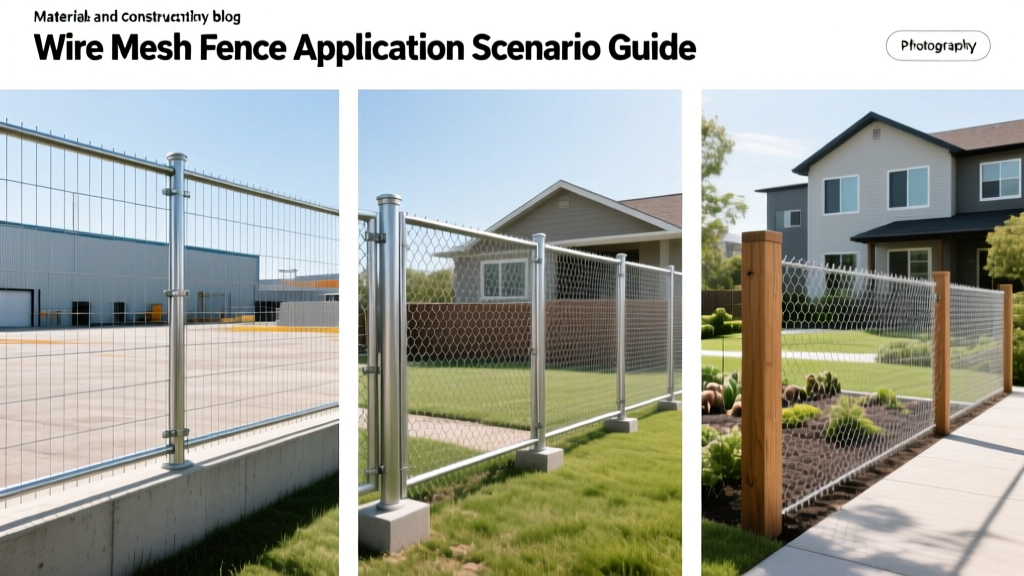
The Core Variables: Gauge, Mesh Size, and Coating
Selecting the correct wire mesh fence requires moving beyond generic product categories and focusing on three engineering variables: wire gauge, mesh aperture, and protective coating. Misjudging any of these leads to premature failure, security breaches, or blown budgets.
Wire gauge operates on an inverse scale. A lower gauge number indicates a thicker, stronger wire. For perimeter fencing, 6-gauge (0.192 inches) is heavy-duty security, 9-gauge (0.148 inches) is standard commercial, and 11.5-gauge (0.120 inches) is light residential. Never specify a fence by 'thickness' without verifying the exact gauge decimal.
Coatings dictate the lifespan of the mesh. Standard Class 1 galvanized wire features a zinc coating of 0.40 oz/ft², suitable for dry inland climates. For coastal, high-humidity, or industrial environments, you must specify Class 3 galvanized (1.20 oz/ft²) per ASTM F669 standards, which provides three times the rust resistance. Vinyl-coated (PVC) mesh adds a layer of UV and impact protection but requires a Class 1 or Class 3 galvanized core to prevent hidden internal corrosion.
Scenario Matrix: Matching Wire Mesh Fence Types to Use Cases
Different applications impose unique mechanical and environmental stresses on a fence line. The matrix below maps specific scenarios to their required technical specifications.
| Application Scenario | Optimal Mesh Type | Required Gauge & Aperture | Key Engineering Requirement |
|---|---|---|---|
| High-Security / Industrial | Anti-Climb Welded Mesh (358 Prison Mesh) | 8-gauge (0.156"), 3" x 0.5" aperture | Aperture too small for finger holds or bolt cutters. |
| Tennis Courts & Sports | Knuckle-Top Chain Link | 9-gauge, 1.75" x 1.75" aperture | Prevents ball trapping; knuckle top prevents player lacerations. |
| Predator-Proof Animal Runs | Welded Wire Hardware Cloth | 14-gauge, 1" x 1" or 1" x 2" aperture | Rigid welds prevent raccoons/coyotes from bending the mesh. |
| Residential Property Lines | Standard Chain Link | 11.5-gauge, 2" x 2" or 2.25" x 2.25" aperture | Cost-effective boundary definition with high visibility. |
| Deer & Wildlife Exclusion | Woven Wire Field Fence | 12.5-gauge, graduated 4" to 8" vertical spacing | Flexible hinges absorb impact without permanent deformation. |
Deep Dive: High-Security & Industrial Perimeters
For commercial facilities requiring strict access control, standard chain link is inadequate. Intruders can easily scale 2-inch mesh using the toe-holds it provides. The Chain Link Fence Manufacturers Institute (CLFMI) recommends transitioning to welded anti-climb mesh (often called 358 mesh) for high-security zones. This mesh features 3-inch by 0.5-inch apertures that eliminate climbing footholds and prevent the insertion of standard bolt cutters. Terminal posts for these systems must be a minimum of 2.875-inch outer diameter (OD) Schedule 40 steel, set in concrete footings at least 36 inches deep to resist vehicular ramming forces.
Deep Dive: Residential Animal Containment & Gardens
When containing poultry or protecting gardens from small predators, chain link fails because smaller animals can slip through 2-inch apertures, and determined predators can dig under it. According to USDA APHIS Wildlife Damage Management guidelines, effective exclusion requires 1-inch welded wire mesh. To prevent digging, the mesh must not just meet the ground; it requires an 'L-footer' apron. Bury 12 inches of the mesh vertically, then bend the remaining 12 inches outward horizontally at a 90-degree angle, pinning it to the soil with landscape staples. This stops animals from digging directly against the fence face.
2026 Installed Cost Breakdown by Application Tier
Pricing for wire mesh fencing is heavily dependent on the framework (posts and rails) rather than just the mesh fabric itself. The following estimates reflect fully installed costs (materials, labor, and concrete) for a standard 6-foot height in 2026.
| Tier / Specification | Mesh Fabric Cost (per sq ft) | Total Installed Cost (per linear ft) | Typical Lifespan |
|---|---|---|---|
| Light Residential (11.5ga, Class 1 Galv) | $0.85 - $1.20 | $18 - $26 | 10 - 15 Years |
| Standard Commercial (9ga, Class 3 Galv) | $1.50 - $2.10 | $28 - $42 | 20 - 25 Years |
| High Security (8ga Anti-Climb, PVC Coated) | $4.50 - $6.80 | $55 - $85 | 30+ Years |
| Sports Court (9ga Knuckle, Color Coated) | $2.20 - $3.00 | $35 - $50 | 20 - 25 Years |
Critical Installation Edge Cases & Failure Modes
Even the highest-grade wire mesh will fail if the structural framework is improperly engineered for the specific site conditions. Watch for these common failure modes:
Adding privacy slats to a standard chain link fence transforms it from a permeable wind filter into a solid sail. A 6-foot chain link fence is typically engineered for 70 mph wind loads with posts spaced at 10-foot intervals. Once privacy slats are inserted, the wind load triples. If you do not reduce the line post spacing to 5-foot intervals and upgrade the post diameter, the fence will lean or collapse during the first major storm.
- Frost Heave on Terminal Posts: In northern climates, concrete footings for gate and corner posts must extend at least 6 inches below the local frost line. If the concrete bell at the bottom of the footing is not wider than the post hole, seasonal freezing will grip the concrete and push the post upward, ruining the gate alignment.
- Tension Wire Sag: A bottom tension wire is mandatory for any wire mesh fence over 4 feet tall. It must be pulled taut using a 3/16-inch steel cable and a turnbuckle. Relying solely on the mesh fabric tied to the bottom rail will result in the mesh bowing upward over time as the metal fatigues and stretches.
- Galvanic Corrosion at Fittings: Never mix metal types. If you are using aluminum line posts to save weight and cost, you must use aluminum fittings and tension bands. Attaching steel fittings to aluminum posts creates a galvanic cell in the presence of rain, causing rapid, severe pitting and structural failure at the connection points.
Decision Flowchart: Selecting Your Exact Specification
Use this step-by-step logic tree to finalize your wire mesh fence specifications before requesting contractor bids:
- Define the Primary Threat/Containment Goal: Are you keeping humans out, animals in, or defining a boundary? (Humans = chain link or anti-climb; Small animals = welded wire; Large animals = woven wire).
- Calculate the Required Aperture: Measure the smallest object or animal head that must be contained or excluded. Select a mesh size at least 20% smaller than that measurement.
- Assess the Environmental Corrosivity: Within 5 miles of saltwater? Specify Class 3 galvanized or heavy PVC coating. Inland/dry? Class 1 galvanized is sufficient.
- Determine the Wind Load Profile: Will the fence feature wind barriers (slats, privacy screens, or heavy vine growth)? If yes, reduce standard 10-foot post spacing to 5-foot or 6-foot spacing and increase line post OD by one nominal size.
- Specify the Framework Coating: Match the framework (posts, rails, fittings) to the mesh coating. Do not pair a PVC-coated mesh with bare galvanized steel posts if aesthetic uniformity and matched lifespans are required.
By rigorously matching the wire mesh fence specifications to the exact mechanical and environmental demands of your site, you eliminate the two most common causes of fencing failure: under-engineering for security and over-engineering for basic boundary definition.