Best Wooden Privacy Fence Brands & Panel Lines Compared (2026)
Compare top wooden privacy fence brands like ProWood, BarretteWood, and Jacksons. Discover pricing, lumber grades, and durability for your 2026 project.
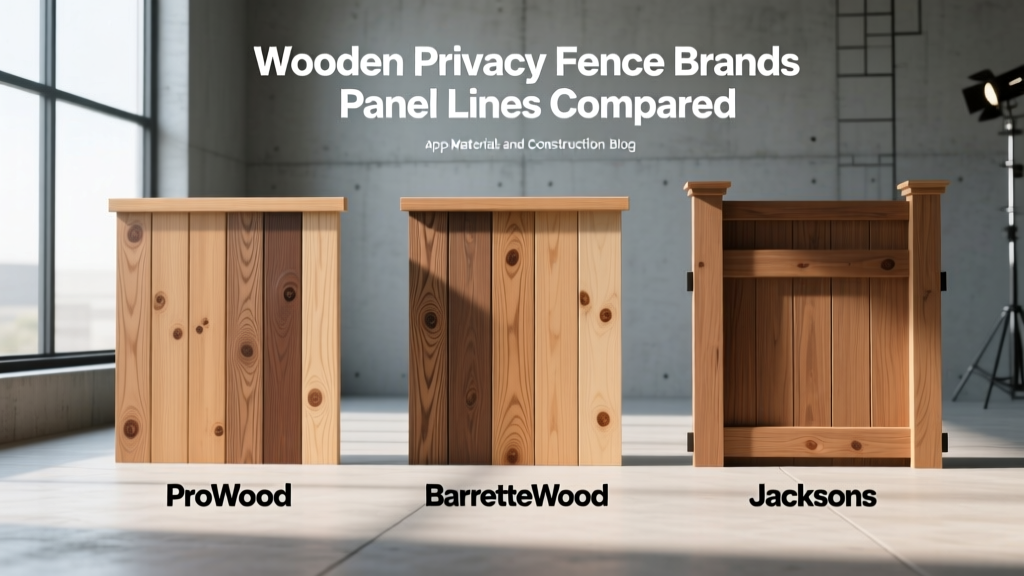
The Landscape of Pre-Assembled Wooden Privacy Fences in 2026
The market for a wooden privacy fence has shifted dramatically toward factory-assembled panels and color-infused pressure-treated lumber, reducing on-site labor while introducing new material science challenges. Homeowners and contractors in 2026 are no longer just choosing between pine and cedar; they are navigating proprietary treatment chemistries, specific lumber grading standards, and rigid panel tolerances. This deep dive analyzes the three dominant pre-assembled wooden privacy fence product lines—ProWood, BarretteWood, and Jacksons Fencing—breaking down their exact specifications, failure modes, and real-world pricing.
Deep Dive: ProWood Dura Color (Master Halco)
Master Halco’s ProWood Dura Color line dominates the pressure-treated segment. Unlike traditional painted fences, Dura Color panels are infused with color pigment during the MCA (Micronized Copper Azole) pressure-treatment process in the retort. This results in a wooden privacy fence that resists rot and insects while offering a uniform, fade-resistant color straight from the factory.
Product Specs & The 'Cut-End' Vulnerability
ProWood Dura Color panels are typically constructed from Southern Yellow Pine. A standard 6-foot by 8-foot stockade panel retails between $55 and $75 in 2026, depending on regional lumber indices. However, contractors frequently encounter a specific failure mode: the pigment penetration is limited to the outer 1/16th of an inch of the wood fibers.
Deep Dive: BarretteWood Cedar & Pine Lines
BarretteWood, widely distributed through major big-box home improvement centers, offers both pressure-treated pine and Western Red Cedar pre-assembled panels. Their most popular configuration for a wooden privacy fence is the 'Shadowbox' (or good-neighbor) panel, which alternates pickets on the front and back of the horizontal rails.
Weight and Backer Rail Structural Limits
A 6x8 BarretteWood Cedar Shadowbox panel contains up to 30 individual pickets and three horizontal backer rails. These panels weigh between 85 and 105 pounds. The structural weak point in the BarretteWood line is the use of spruce or low-grade pine for the horizontal backer rails to keep costs down (panels retail for $110 to $140). When installing on uneven ground, lifting an 85-pound panel by the top rail frequently causes the spruce backer rail to snap at the nail points.
- Pros: Excellent wind deflection (shadowbox design allows 20% air passage, reducing wind load); finished appearance on both sides.
- Cons: Heavy weight requires 3-person installation or mechanical lifts; spruce backer rails are prone to sagging over 5-7 years if spans exceed 7 feet.
Deep Dive: Jacksons Fencing Premium Redwood & Cedar
Jacksons Fencing targets the premium residential market, offering wooden privacy fence panels constructed from Select Tight Knot (STK) Western Red Cedar and clear-grade Redwood. Priced at $160 to $220 per 6x6 or 6x8 panel, this line is designed for high-end architectural landscapes.
The defining feature of the Jacksons product line is the use of stainless steel ring-shank nails driven at precise 45-degree angles into the rails, preventing the 'picket droop' common in cheaper panels. Furthermore, their cedar is kiln-dried to a 12% moisture content before assembly, which virtually eliminates the post-installation shrinkage gaps that plague green (wet) cedar panels from competitors.
Brand Comparison Matrix: Cost, Lifespan, and Specs
| Brand / Line | Wood Species | 2026 Avg. Cost (6x8 Panel) | Treatment / Finish | Expected Lifespan |
|---|---|---|---|---|
| ProWood Dura Color | Southern Yellow Pine | $55 - $75 | MCA + Pigment Infusion | 15 - 20 Years |
| BarretteWood Shadowbox | Western Red Cedar | $110 - $140 | Natural (Untreated) | 12 - 18 Years |
| Jacksons Premium | STK Cedar / Clear Redwood | $160 - $220 | Kiln-Dried, Pre-Stained Opt. | 20 - 25+ Years |
Lumber Grade Secrets: What Brands Don't Tell You
When evaluating cedar or redwood wooden privacy fence panels, understanding lumber grading is critical to avoiding overpayment or premature decay. The Western Red Cedar Lumber Association (WRCLA) sets the standard for grading, yet many retailers obscure these designations on consumer packaging.
Expert Insight: Do not pay the premium for 'Clear' grade cedar for a privacy fence. Clear cedar is graded for architectural siding where zero knots are acceptable. For fencing, Select Tight Knot (STK) is the optimal grade. STK allows for small, structurally sound knots that do not compromise the board's integrity, offering the same rot resistance as Clear grade but at a 30-40% lower cost per panel.
The Moisture Content Trap
According to the USDA Forest Products Laboratory, wood installed at a moisture content above 19% is highly susceptible to fungal colonization and severe dimensional shrinkage. Many big-box store cedar panels are shipped 'green' (wet). When these dry out in the sun, a 5.5-inch picket can shrink to 4.75 inches, creating massive gaps in your privacy fence. Always ask the supplier if the panels are Kiln-Dried (KD) or Green, and plan for a 10% overlap adjustment if installing wet cedar.
Hardware & Fastener Compatibility by Brand
Pairing the wrong fasteners with specific wood treatments is a leading cause of premature fence failure. The chemical reactions between wood preservatives and metal fasteners dictate your hardware budget.
- ProWood (MCA Treated): Micronized Copper Azole is less corrosive than older ACQ treatments, but it still requires minimum G155 hot-dipped galvanized fasteners. For coastal areas, upgrade to 304 Stainless Steel.
- BarretteWood (Cedar): Cedar contains high levels of tannic acid. Using standard galvanized nails will result in black streaking down the pickets within 6 months. You must use 304 or 316 Stainless Steel ring-shank nails or polymer-coated deck screws.
- Jacksons (Redwood): Redwood is highly acidic. Only use top-tier 316 Stainless Steel fasteners to prevent rapid corrosion and wood staining.
Installation Failures to Avoid with Pre-Built Panels
Pre-assembled wooden privacy fence panels demand higher precision in post-setting than stick-built fences. Because the panels are rigid 8-foot rectangles, they cannot accommodate framing errors.
Managing Sloped Terrain
Never attempt to 'rack' (bend) a pre-assembled wooden privacy fence panel to follow a slope. The rigid backer rails will snap, and the pickets will pull loose from the nails. For slopes exceeding a 1-inch drop per foot, you must step the panels (installing them level like stairs) or dismantle the panels and re-assemble them as custom 'rackable' modules, which requires advanced carpentry and voids the manufacturer warranty.
Sourcing and Supply Chain Realities
In 2026, supply chain stabilization has normalized wooden privacy fence inventory, but regional variations persist. ProWood is heavily concentrated in the Eastern and Midwestern US due to Master Halco's treatment facility locations. Jacksons Fencing and premium STK Cedar panels are predominantly sourced and stocked in the Pacific Northwest and California. If you are in the Midwest or South desiring premium cedar, expect to pay a 15-20% freight surcharge for specialized LTL (Less Than Truckload) shipping from regional distributors. Always order 10% more panels than your linear footage dictates to account for end-cuts, gate framing, and transit damage.