Hog Wire Fence Applications: Scenario Matching & Costs
Discover the best applications for a hog wire fence. Learn scenario matching, gauge specs, post spacing, and costs to decide if it fits your property.
The Anatomy of Hog Wire: Woven vs. Welded
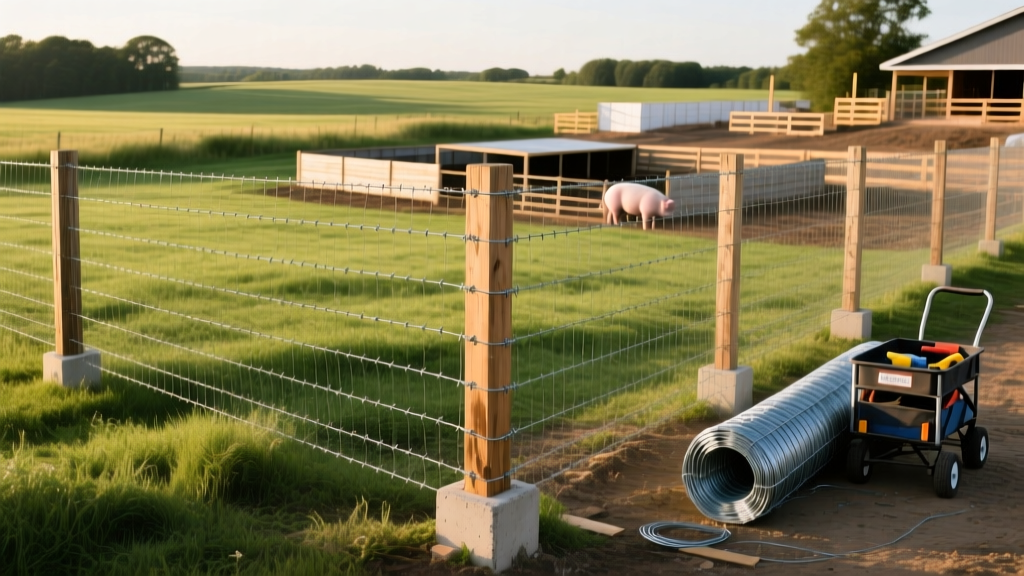
When contractors and homeowners discuss a 'hog wire fence,' they are often conflating two distinctly different agricultural products. To match the material to your specific scenario, you must first identify which variant you are sourcing. True agricultural hog wire is a woven wire mesh featuring graduated spacing—typically 2x4 inch rectangles at the bottom, expanding to 6x6 inch squares at the top. This design prevents small pigs from pushing their snouts through the lower gaps while saving material weight at the top.
However, in modern residential and commercial landscaping, the term is frequently applied to welded wire panels (often sold as cattle or hog panels). These are rigid, 16-foot-long sheets made from heavy 4-gauge steel wire, usually featuring a uniform 4x4 inch or 2x4 inch grid. According to the University of Missouri Extension, selecting the correct mesh geometry and wire gauge is the primary determinant in preventing livestock injury and predator intrusion.
Terminology Check: Which Wire Do You Need?
- Woven Hog Wire (Rolls): 12.5-gauge, flexible, requires tensioning. Best for long agricultural perimeters and uneven terrain.
- Welded Hog Panels (Sheets): 4-gauge, rigid, self-supporting. Best for flat residential gardens, dog runs, and short straight-line enclosures.
Ideal Scenarios: Where Hog Wire Excels
Hog wire is not a universal fencing solution. Its unique geometry and structural rigidity make it the optimal choice for specific, high-stress applications where standard chain link or field fence would fail.
Scenario 1: Urban Garden & Small Orchard Protection
For protecting raised beds and fruit trees from ground-level foragers like rabbits, groundhogs, and neighborhood dogs, welded 2x4 grid hog panels are unmatched. The 2-inch vertical spacing at the bottom of woven hog wire acts as a physical barrier against small mammals, while the 4-gauge thickness of welded panels prevents larger dogs from bending the mesh to gain entry. Unlike chicken wire, which degrades in UV light and tears under minor physical stress, galvanized hog wire maintains structural integrity for 15 to 20 years.
Scenario 2: Canine Containment and Heavy-Duty Dog Runs
Large, active breeds (e.g., German Shepherds, Huskies) routinely destroy lightweight welded wire fencing by jumping against it or chewing the joints. A 50-inch tall, 4-gauge welded hog panel resists impact loads exceeding 200 lbs without permanent deformation. When mounted on steel T-posts driven 24 inches into the ground, the rigidity of the panel eliminates the 'bounce' that encourages dogs to test the fence line.
Scenario 3: Swine Perimeters and Rooting Deterrence
Pigs are notorious for rooting under fence lines. Woven hog wire addresses this through its tight lower mesh, which can be buried 4 to 6 inches into a trench and backfilled with crushed gravel. The USDA Natural Resources Conservation Service recommends burying the lower portion of woven mesh or utilizing a ground-level 'apron' to prevent swine from excavating beneath the perimeter.
Scenario Mismatches: When to Avoid Hog Wire
Equally important to knowing when to use hog wire is recognizing its limitations. Deploying this material in the wrong scenario leads to rapid failure and wasted capital.
- Deer Exclusion: White-tailed deer can easily clear a 6-foot obstacle. Standard hog wire maxes out at 52 inches. For deer, you must transition to 7.5-foot to 8-foot woven deer fencing or high-tensile electric wire.
- Goat and Sheep Enclosures (The Entrapment Risk): While excellent for pigs, 2x4 inch or 4x4 inch grids pose a severe head-entrapment hazard for horned goats and sheep. If an animal pushes its head through a 4x4 square to graze and panics, the rigid wire can cause fatal neck injuries. Use specialized 'no-climb' horse fence with 2x4 inch V-shaped mesh for small ruminants.
- High Snow-Load Regions: Woven hog wire acts as a snow fence. In regions with heavy drifting snow, a 48-inch woven wire fence will catch snow drifts, leading to severe post leaning and wire stretching. In these zones, welded panels with large open grids or high-tensile electric wire are required.
Specification & Application Matrix
| Material Type | Wire Gauge | Grid Geometry | Max Post Spacing | Best Fit Scenario |
|---|---|---|---|---|
| Woven Hog Wire (Roll) | 12.5 ga | Graduated (2x4 to 6x6) | 10 to 12 feet | Long agricultural runs, pigs, uneven ground |
| Welded Hog Panel | 4 ga | Uniform 4x4 inch | 8 feet (standard) | Dog runs, cattle pens, flat terrain |
| Welded Hog Panel | 4 ga | Uniform 2x4 inch | 8 feet | Rabbit exclusion, garden borders, small dogs |
Installation Nuances & Real-World Failure Modes
Proper installation of hog wire requires specific techniques that differ vastly from standard wood or vinyl fencing. Ignoring these nuances is the primary cause of premature fence failure.
1. The Cut-End Rust Vulnerability
Welded hog panels are galvanized after welding (GAW) or galvanized before welding (GBW). When you cut a panel to fit a gate or corner using bolt cutters, you expose the raw steel core at the snip point. In humid or coastal environments, these cut ends will flash-rust within weeks, leading to structural degradation. The Fix: Cut panels using an angle grinder with a cutoff wheel, and immediately coat the exposed nodes with a cold galvanizing compound (e.g., Zinga or Rust-Oleum Cold Galvanizing Spray) to restore the zinc barrier.
2. Tensioning Woven Wire
A common failure mode with woven hog wire is 'belly sag' in the middle of long spans. This occurs when installers pull the wire by hand or use a truck bumper to stretch it. Woven wire requires a uniform tension of 250 to 300 lbs across the entire height. You must use a specialized fence stretcher bar attached to a come-along winch. Pulling without a stretcher bar will snap the lower, thinner wires while leaving the top wires loose.
3. Fastening to T-Posts
Do not use standard zip-ties to secure heavy-duty hog wire to steel T-posts; UV degradation and physical impact will snap them within a year. Use galvanized steel T-post clips (J-clips) driven in with a specialized clip-bender tool, or use heavy-duty UV-rated agricultural zip-ties (minimum 175 lb tensile strength) doubled up at every intersection.
2026 Cost Breakdown: Materials & Labor
Understanding the true linear foot cost requires factoring in the hidden expenses of corner bracing and tensioning hardware. Below is the estimated material cost for a 100-foot linear run in 2026.
| Component | Unit Cost (2026) | Qty for 100ft Run | Total Cost |
|---|---|---|---|
| Welded 4ga Panels (16ft x 50in) | $42.00 | 7 panels | $294.00 |
| 7ft Steel T-Posts (Driven 2ft) | $8.50 | 14 posts | $119.00 |
| Wood Corner/Gate Posts (4x4 PT) | $22.00 | 3 posts | $66.00 |
| Fasteners, Clips, & Concrete | $45.00 (Lot) | 1 | $45.00 |
| Total DIY Material Cost | $524.00 ($5.24/LF) |
Note: Professional installation typically adds $6.00 to $10.00 per linear foot for labor, bringing the total installed cost to approximately $11.24 to $15.24 per linear foot for welded panel systems.
Final Procurement Checklist
Before ordering materials, verify the galvanization class. For agricultural use involving constant moisture or fertilizer exposure, specify Class 3 galvanization (minimum 0.80 oz/sq ft of zinc), which offers up to three times the rust resistance of standard Class 1 hardware store wire. For residential gardens in dry climates, Class 1 or PVC-coated variants provide adequate longevity at a lower initial cost.