2026 Hog Wire Fence Panels Cost Estimator & Material Calculator
Calculate exact costs for hog wire fence panels in 2026. Includes material pricing, post spacing formulas, and hardware quantity estimators per linear foot.
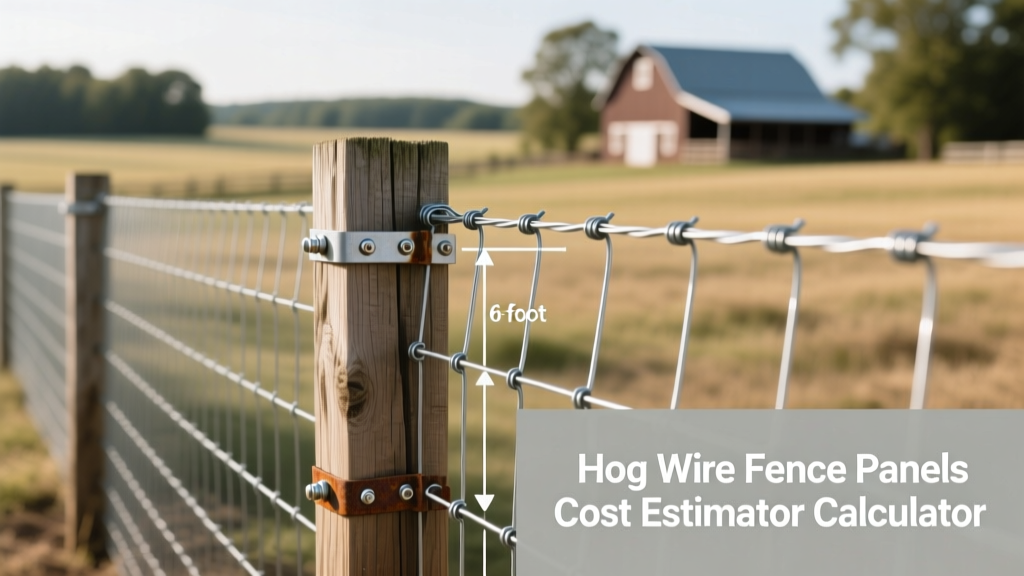
The Anatomy and Economics of Hog Wire Fence Panels
Unlike standard chain link or woven field wire that unrolls from a continuous spool, hog wire fence panels are sold as rigid, pre-welded or tightly-knotted 16-foot sections. This structural rigidity provides superior containment for livestock and a clean, modern aesthetic for residential properties, but it fundamentally changes how you must calculate material quantities and costs. Because panels cannot be easily cut or stretched to fit odd dimensions without compromising structural integrity, precise linear footage math is mandatory to avoid expensive over-ordering or structural gaps.
Standard hog wire panels feature a graduated mesh design: smaller 2x4-inch rectangles at the bottom to contain small animals or deter predators, graduating to larger 4x8-inch rectangles at the top. In 2026, the market is dominated by two primary manufacturing methods: welded wire (such as Master Halco utility panels) and knotted field wire (such as Stay-Tuff Tight-Knot). Both are typically galvanized to Class 3 standards for rust resistance, but their cost and handling profiles differ slightly.
Standard Panel Specifications (2026 Market Baseline)
- Length: 16 feet (192 inches) nominal
- Height: 50 inches or 52 inches (Standard); 34 inches (Pony/Pet height)
- Wire Gauge: 4-gauge (0.207 inches) for heavy livestock/perimeter; 6-gauge (0.162 inches) for light garden/residential use
- Coating: Class 3 Galvanized (standard) or Zinc-Aluminum (premium, 15-20% cost increase)
2026 Material Cost Breakdown: Panels, Posts, and Hardware
Accurate estimation requires breaking the fence down into three cost centers: the panels themselves, the vertical support structure (posts), and the attachment hardware. Prices below reflect Q1 2026 national retail averages from major agricultural and building supply distributors.
| Component | Specification | 2026 Unit Cost | Qty per 100 LF (8ft Spacing) | Line Item Total |
|---|---|---|---|---|
| Hog Wire Panel | 16ft x 52in, 4-Gauge Welded | $42.00 - $48.00 | 7 panels | $294.00 - $336.00 |
| Hog Wire Panel | 16ft x 52in, 6-Gauge Knotted | $28.00 - $34.00 | 7 panels | $196.00 - $238.00 |
| Line Post (Steel) | 6.5 ft T-Post, 1.25 lb/ft | $9.50 - $12.00 | 13 posts | $123.50 - $156.00 |
| Line Post (Wood) | 4x4x8 ft Pressure Treated | $16.00 - $22.00 | 13 posts | $208.00 - $286.00 |
| Corner/End Post | 6x6x8 ft Pressure Treated | $38.00 - $45.00 | 2 posts (min) | $76.00 - $90.00 |
| T-Post Clips | Galvanized Wire Clips | $0.35 each | 52 clips | $18.20 |
| J-Bolts / U-Bolts | 3/8in for Wood Post Mounting | $1.65 each | 52 bolts | $85.80 |
According to fencing guidelines published by Penn State Extension, corner and end posts bear up to 80% of the total tension load in a straight-line fence run. Never substitute 4x4 line posts for 6x6 corner posts when using rigid hog wire panels, as the leverage exerted by the 52-inch panel height will gradually lean undersized wooden posts over a 3-to-5-year period.
The Hog Wire Quantity Calculator: Step-by-Step Formulas
To generate an accurate bill of materials, apply the following formulas to your total measured linear footage. These calculations account for the rigid 16-foot panel constraint and standard overlap requirements.
1. Calculating Panel Quantities
Because hog wire panels are rigid, you cannot simply buy exactly the linear footage you need. You must buy enough 16-foot panels to cover the distance, which often results in minor overages.
- Base Panels: Total Linear Feet ÷ 16 = X. Round UP to the next whole number.
- Overlap/Cut Allowance: Add 1 additional panel for every 150 linear feet to account for gate framing, corner overlaps, or damaged panels during transit.
- Example: For 210 linear feet, 210 ÷ 16 = 13.12. Round up to 14 panels. Add 1 waste panel = 15 panels total.
2. Calculating Post and Hardware Requirements
Post spacing for rigid hog wire is strictly dictated by the 16-foot panel length. While woven wire can be stretched across 12-to-16-foot gaps, rigid panels should be supported every 8 feet to prevent bowing under snow loads or animal pressure.
The 16-Foot vs. 8-Foot Spacing Trap
Many DIY estimators assume that because the panel is 16 feet long, they only need posts at the ends of the panel (16-foot spacing). This is a critical failure point. A 16-foot unsupported span of 4-gauge wire will sag in the center under its own weight over time, and will easily buckle if a 200 lb animal leans against it. Always calculate for an intermediate post at the 8-foot mark of every panel.
- Total Line Posts: (Total Linear Feet ÷ 8) + 1. Subtract the number of corner/gate posts.
- Hardware (T-Posts): 4 clips per panel per post. (Total Panels × 4 clips × Average Posts per Panel).
- Hardware (Wood Posts): 4 J-bolts or U-bolts per panel connection point.
Terrain Adjustments: Stepping vs. Racking Costs
Unlike chain link, which can be 'racked' (biased) to follow the slope of a hill, rigid hog wire fence panels must be 'stepped' on any grade exceeding 5%. Stepping involves installing the panels perfectly level, but at staggered heights, leaving a triangular gap at the bottom of the downhill side of each panel.
When estimating for sloped terrain, factor in the following adjustments:
- Taller Posts: Stepping requires longer posts on the downhill side to maintain the required 50-inch above-ground panel height while accommodating the step-down drop. Upgrade from 6.5ft T-posts to 7ft or 8ft T-posts, adding roughly $3.50 to $6.00 per affected post.
- Gap Fillers: The triangular gaps at the bottom of stepped panels require either custom-cut welded wire mesh or pressure-treated kick-boards to prevent small animals from escaping. Budget an additional $4.00 to $7.00 per linear foot of sloped fencing for gap mitigation materials.
Real-World Scenario: 200 Linear Foot Backyard Enclosure
To demonstrate the calculator in action, here is a precise material and cost estimate for a 200 linear foot residential backyard fence using 4-gauge welded hog wire, wooden corners, and steel T-post line posts spaced at 8 feet.
Material Bill & Cost Projection
- Panels: 200 ÷ 16 = 12.5 (Round to 13). +1 waste = 14 panels @ $45.00 = $630.00
- Corner/End Posts: 4 corners + 1 gate end = 5 (6x6x8 PT posts) @ $42.00 = $210.00
- Line Posts: (200 ÷ 8) + 1 = 26 total spaces. Minus 6 structural posts = 20 (6.5ft T-posts) @ $10.50 = $210.00
- Hardware (T-Post Clips): 20 posts × 4 clips = 80 clips @ $0.35 = $28.00
- Hardware (Wood J-Bolts): 6 wood posts × 4 bolts = 24 bolts @ $1.65 = $39.60
- Gate Kit: 1 steel frame walk-gate (4ft x 52in) with hinges/latch = $185.00
- Concrete: 5 bags Quikrete for corner/gate post footings @ $6.50 = $32.50
Total Material Cost: $1,335.10 (Approx. $6.67 per linear foot for materials).
Professional installation labor for rigid panel fencing typically ranges from $9.00 to $14.00 per linear foot in 2026, depending on soil conditions (e.g., rocky or heavy clay requiring mechanical augers). For this 200 LF project, expect labor quotes between $1,800 and $2,800, bringing the total turnkey project cost to roughly $3,135 to $4,135.
Common Estimation Mistakes to Avoid
When building your final budget, audit your estimate for these frequent errors that cause project delays and cost overruns:
- Ignoring Gate Framing: You cannot hang a raw hog wire panel as a gate; it will instantly sag and deform. You must purchase or weld a square steel tubing frame (typically 1.5x1.5 inch 14-gauge steel) and attach the panel to it using heavy-duty hog rings or self-drilling tek screws. Pre-built hog wire gates cost 4x more than standard chain link gates.
- Underestimating Fastener Corrosion: If you are using Class 3 galvanized panels, do not use standard zinc-plated hardware store screws or bolts. The galvanic reaction between the thick Class 3 zinc coating and thin commercial zinc will cause rapid rust streaking. Specify hot-dipped galvanized (HDG) or stainless steel J-bolts and clips.
- Forgetting the T-Post Driver: Driving 6.5ft steel T-posts into compacted soil requires a heavy-duty manual post driver (a 15lb steel tube with handles). Budget $35 to $50 to purchase or rent this specific tool; a standard sledgehammer will mushroom the tops of the T-posts, making it impossible to attach the top wire clips.
Sourcing and Brand Recommendations
For agricultural and high-tension residential applications, sourcing matters. The USDA Natural Resources Conservation Service (NRCS) recommends adhering to strict wire gauge and coating standards for long-term fence viability. Look for Stay-Tuff (knotted) or Master Halco (welded) brands, which consistently meet ASTM A641 standards for zinc coating weights. Avoid unbranded, imported utility panels from big-box home centers for perimeter fencing; these often utilize inferior 8-gauge or 10-gauge wire disguised as heavy-duty, and feature a thin Class 1 galvanization that will show surface rust within 18 months of installation in humid or coastal climates.