Comparing Fence Types by Durability and True Lifespan
Compare popular fence types by durability and true lifespan. Discover which materials withstand weather, rot, and impact for the best long-term ROI.
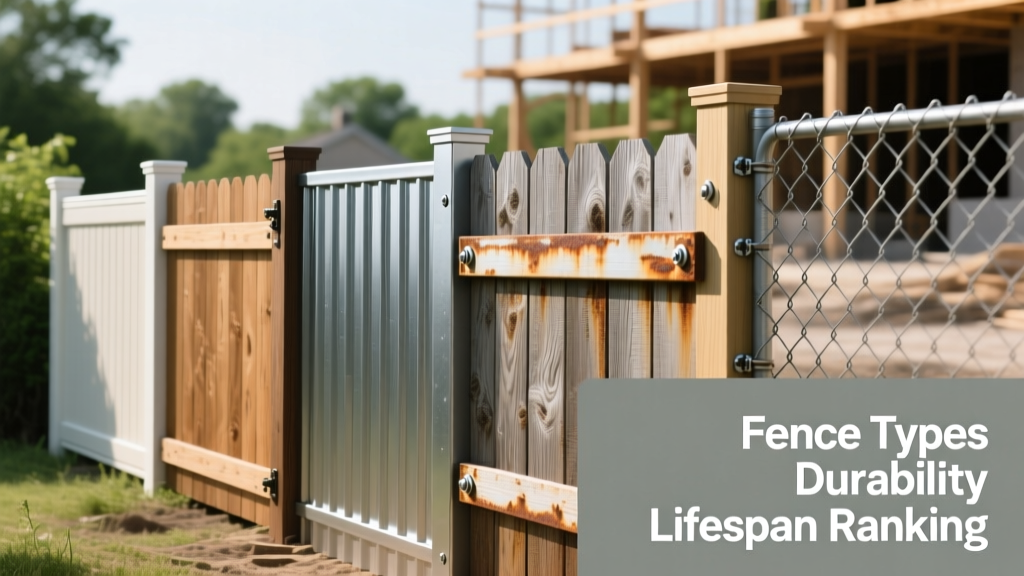
The Lifespan Hierarchy: Fence Types Ranked by Longevity
Most property owners evaluate fence types based strictly on upfront cost per linear foot, ignoring the total cost of ownership. A cheaper material that requires replacement in 12 years ultimately costs more than a premium material that lasts four decades with minimal upkeep. True lifespan is dictated by two distinct metrics: structural failure (when the fence can no longer stand or secure the property) and aesthetic failure (when the material degrades visually beyond acceptable standards).
Below is a durability matrix comparing standard residential and commercial fence types based on current material science and field performance data.
| Fence Material | Expected Structural Lifespan | Aesthetic Failure Point | Primary Failure Vector | Avg. Installed Cost (per ft) |
|---|---|---|---|---|
| Pressure-Treated Pine | 15–20 Years | 3–5 Years (warping/greying) | Ground-line post rot | $18–$28 |
| Western Red Cedar | 20–30 Years | 5–8 Years (UV greying) | Hardware corrosion / sapwood rot | $25–$40 |
| Rigid PVC (Vinyl) | 30–50+ Years | 15–20 Years (chalking) | Impact fracture / UV brittleness | $30–$50 |
| Aluminum (Ornamental) | 50+ Years | N/A (Powder coat holds) | Gate hinge sag / soil shifting | $35–$60 |
| Galvanized Chain Link | 20–30 Years | 10–15 Years (zinc loss/rust) | Fabric stretching / post rust | $12–$22 |
Wood Fences: Species, Treatments, and Rot Vectors
Wood remains a dominant choice for its natural aesthetic, but its durability is entirely dependent on the species and the chemical treatment of the subterranean components. According to research from the USDA Forest Products Laboratory, ground-line decay is the number one killer of wood fences, accounting for over 80% of premature structural failures.
Pressure-Treated Southern Yellow Pine
Not all pressure-treated lumber is equal. For fence posts set in concrete or direct soil contact, you must specify AWPA (American Wood Protection Association) Use Category UC4B (Heavy Ground Contact). Standard UC4A lumber, commonly sold at big-box retailers for above-ground decking, will rot at the soil line within 7 to 10 years. UC4B lumber retains a minimum of 0.25 pcf (pounds per cubic foot) of preservative, effectively doubling the subterranean lifespan.
Western Red Cedar and Redwood
Cedar and redwood rely on natural tannins and extractives in the heartwood for rot resistance. However, modern milling practices often include high percentages of sapwood, which offers zero natural decay resistance. When purchasing cedar fence pickets, inspect the end grains: tight, dark rings indicate heartwood, while pale, wide rings indicate sapwood that will require immediate chemical sealing.
Expert Insight: Never encase a wood fence post entirely in concrete without a drainage slope. Concrete acts as a moisture sponge, trapping water against the wood and accelerating fungal decay. Set posts in compacted crushed gravel (3/4-inch minus) to allow water to drain away from the end grain.
Vinyl and Composite: UV Degradation and Impact Brittleness
Vinyl (PVC) fencing is frequently marketed as 'maintenance-free,' but its true lifespan hinges on the chemical formulation of the extrudate and the physical wall thickness of the profiles. The American Fence Association notes that low-grade vinyl fencing often becomes brittle and shatters upon impact after a decade of UV exposure.
The Titanium Dioxide (TiO2) Factor
To prevent UV degradation and 'chalking' (a white, powdery residue on the surface), high-quality vinyl fencing must contain 8 to 10 parts per hundred resin (phr) of non-chalking Titanium Dioxide (TiO2). Budget manufacturers reduce TiO2 to 4-5 phr to cut costs, resulting in fences that yellow and become brittle within 5 to 7 years. Always request the manufacturer's spec sheet to verify TiO2 concentrations and ensure the product meets ASTM F964 standards for rigid PVC fencing profiles.
Wall Thickness and Wind Load
Hollow vinyl profiles must withstand lateral wind loads. For regions experiencing sustained winds over 40 mph, specify a minimum wall thickness of 0.050 inches for pickets and 0.090 inches for structural rails and posts. Thinner 0.040-inch profiles will deflect, bow, and eventually crack at the routing joints under thermal expansion and wind stress.
Metal Fences: Galvanization, Alloys, and Powder Coating
Metal fencing offers the highest structural longevity but is vulnerable to galvanic corrosion and coating failure. The lifespan of a metal fence is dictated by its protective barrier, not just the base metal.
Ornamental Aluminum vs. Wrought Iron
True wrought iron is rarely manufactured today; most 'iron' fences are actually tubular steel. Steel requires constant maintenance to prevent rust. Extruded aluminum (Alloy 6063-T5) is vastly superior for longevity because it does not rust; it oxidizes, forming a microscopic protective layer. To ensure the color lasts, specify an AAMA 2604 compliant powder coating, which guarantees no chalking or fading for a minimum of 5 years, though field performance often exceeds 25 years. Ensure the powder coat thickness is at least 2.0 mils.
Chain Link: Class 1 vs. Class 3 Galvanization
The lifespan of a chain link fence is entirely dependent on the zinc coating. Standard 'Class 1' galvanizing applies a thin 0.50 oz/sq ft zinc layer that will begin to rust in 10 years. For a 30-year lifespan, you must specify Class 3 galvanization (0.80 oz/sq ft of zinc) or an aluminum-zinc alloy coating (often sold under the trade name Zinc-Alume). Class 3 wire costs roughly 15% more upfront but triples the time before the first sign of red rust appears.
Environmental Stressors and Failure Mode Analysis
A fence type that lasts 40 years in a temperate climate may fail in 12 years in an extreme environment. Match your material to your specific environmental stressors:
- Coastal / Salt Spray Zones: Avoid chain link and untreated steel entirely. Salt accelerates galvanic corrosion by a factor of 5. Use marine-grade aluminum or thick-walled PVC. If using wood, avoid metal fasteners; use hot-dipped galvanized or stainless steel (Type 316) hardware to prevent black streaking and structural pull-out.
- High UV / Arid Climates (Southwest US): Wood will desiccate, split, and warp rapidly without bi-annual sealing. Vinyl must have high TiO2 levels to prevent thermal warping. Dark-colored metal fences can reach surface temperatures of 160°F+, which can degrade inferior powder coatings.
- Freeze-Thaw Cycles (Northern US/Canada): The primary threat is 'frost heave.' If fence posts are not set below the local frost line (often 36 to 48 inches deep), the expanding frozen soil will push the posts upward, ruining the fence's alignment and structural integrity within three winters.
Maximizing ROI: Maintenance Schedules by Material
Even the most durable fence types require baseline maintenance to reach their maximum engineered lifespan. Implement the following schedules to protect your investment:
Wood Maintenance Protocol
- Year 1: Wait 30-60 days after installation for the wood to dry and acclimate, then apply a penetrating oil-based semi-transparent sealer (avoid film-forming polyurethanes that will peel).
- Years 3, 6, 9: Power wash at a low PSI (under 1200) to avoid furrowing the grain, let dry for 48 hours, and reapply sealer.
- Annual: Inspect post bases for soil buildup. Remove dirt and mulch that trap moisture against the bottom rail.
Vinyl & Aluminum Maintenance Protocol
- Bi-Annual: Wash with a mild detergent and a soft-bristle brush to remove organic matter, mildew, and hard water stains that can micro-etch the surface.
- Every 5 Years: Check all gate hinges, latches, and post cap adhesives. Re-tighten set screws and lubricate hinge pins with a dry PTFE spray (avoid wet oils that attract dust and grit).
By prioritizing material science over initial price tags and adhering to strict installation standards like AWPA UC4B and ASTM F964, property owners can select fence types that deliver decades of secure, aesthetically pleasing performance.