How to Choose the Right Fence Wire for Your Property's Specific Needs
Match the right fence wire to your property. Compare gauges, coatings, and mesh sizes for livestock, predators, and security with 2026 cost data.
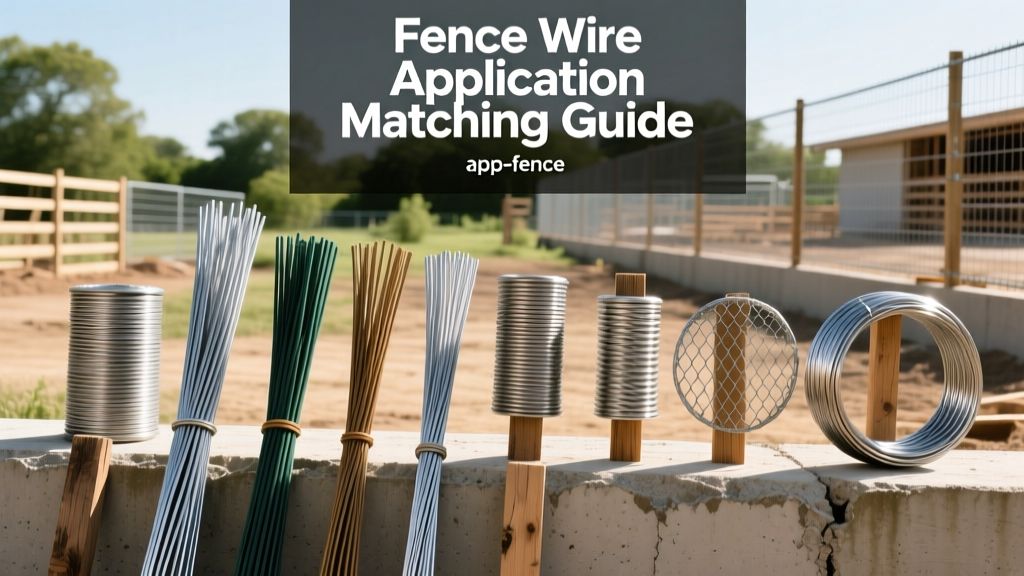
The Application-Fit Framework: Matching Wire to Scenario
Selecting the correct fence wire is not a one-size-fits-all decision. A wire gauge and mesh pattern that perfectly contains cattle will fail catastrophically against poultry predators, while a wire designed for garden pest exclusion will snap under the tension required for a perimeter security boundary. The cost of a mismatched fence is measured in lost livestock, ruined crops, and premature replacement labor. To specify the right material, you must align the wire’s tensile strength, mesh geometry, and protective coating with the specific mechanical and environmental demands of your property.
| Primary Application | Recommended Wire Type | Ideal Gauge & Mesh | Critical Feature Requirement |
|---|---|---|---|
| Cattle & Large Livestock | Woven Field Fence (Hinge-Joint) | 14 to 12.5 ga; 4x4 or 6x6 spacing | High impact flexibility; Class 3 galvanization |
| Horses & Deer Exclusion | High-Tensile Woven (Fixed-Knot) | 12.5 ga; 2x4 or 4x4 spacing | Non-slip knots; smooth top wire to prevent lacerations |
| Poultry & Predator Control | PVC-Coated Welded Wire / Hardware Cloth | 16 to 19 ga; 1x1 or 1/2x1/2 inch mesh | Rigid welds; tight bottom mesh to stop digging/snakes |
| Security & Perimeter | Chain Link or High-Tensile Barbed | 9 to 11 ga (Chain Link); 12.5 ga (Barbed) | Anti-climb mesh; outrigger arms for topping |
Agricultural Containment: Woven vs. High-Tensile Wire
When fencing pastures, the distinction between standard woven field fence and high-tensile wire dictates the longevity and safety of the enclosure. Standard woven fence typically utilizes a hinge-joint knot. This knot allows the horizontal stay wires to flex upon impact, which is excellent for cattle that might push against the fence, as the wire will yield and spring back. However, hinge-joint wire is prone to sagging over time if not installed with precise, uniform tension.
For equine properties or high-pressure deer exclusion, fixed-knot high-tensile wire is mandatory. According to Bekaert’s agricultural fencing specifications, fixed-knot wire uses a solid vertical stay wire wrapped tightly with a continuous piece of wire, locking the intersection in place. This prevents the mesh from sliding or collapsing when a horse leans on it or a deer attempts to push through. High-tensile wire (typically 12.5 gauge) boasts a break strength of over 1,400 pounds per wire, compared to the 800-pound break strength of standard low-carbon 14-gauge field wire.
Never purchase fence wire without verifying the galvanization class. Most big-box home improvement stores stock Class 1 galvanized wire (0.40 oz of zinc per square foot), which will begin to rust in 2 to 5 years in humid climates. For agricultural and perimeter fencing, you must specify Class 3 galvanization (0.80 oz/sq ft) for a 15-to-20-year lifespan. For maximum longevity, seek out Zinc-Aluminum (Zn/Al) coated wires, which offer up to three times the corrosion resistance of standard Class 3 zinc, a standard heavily endorsed by the American Fence Association for coastal or high-moisture environments.
Predator Exclusion & Small Animal Enclosures
Welded wire and hardware cloth are the standards for poultry runs, rabbit hutches, and garden enclosures. Unlike woven wire, welded wire features rigid intersections that resist the biting and pulling forces exerted by predators like raccoons and foxes. However, the welds are the weakest point; if the wire is bent repeatedly, the zinc coating cracks at the weld, leading to rapid localized rusting.
The "Dig-Proof" Apron Technique
A common failure mode in predator fencing is ignoring subterranean breaches. Coyotes and foxes will dig under a fence line rather than attempt to climb it. To counter this, implement an L-footer or "apron" during installation:
- Buried Method: Dig a 12-inch trench along the fence line and bury the bottom 12 inches of 19-gauge, 1/2-inch hardware cloth, backfilling with compacted soil and gravel.
- Surface Apron Method: Attach a 24-inch wide strip of welded wire to the bottom of the main fence, bending it outward at a 90-degree angle so it lays flat on the ground. Cover it with mulch or grass. Predators will dig at the base of the fence, hit the wire apron, and abandon the effort because they do not know to back up two feet to start digging.
2026 Material Cost & Longevity Matrix
Pricing for fence wire fluctuates with global steel markets, but the following ranges reflect current 2026 market averages for standard agricultural and residential rolls. Note that cheaper initial costs often result in higher total cost of ownership due to replacement labor.
| Wire Type & Specification | Roll Dimensions | Est. Cost per Roll (2026) | Cost per Linear Foot | Expected Lifespan |
|---|---|---|---|---|
| 14 ga Hinge-Joint Field Fence (Class 1) | 330 ft x 48 in | $140 - $170 | $0.42 - $0.51 | 3 - 7 Years |
| 12.5 ga Fixed-Knot High-Tensile (Class 3) | 330 ft x 96 in | $310 - $380 | $0.93 - $1.15 | 20 - 30 Years |
| 16 ga PVC-Coated Welded Wire (2x4 mesh) | 100 ft x 48 in | $130 - $160 | $1.30 - $1.60 | 10 - 15 Years |
| 19 ga Galvanized Hardware Cloth (1/2 in) | 50 ft x 36 in | $45 - $65 | $0.90 - $1.30 | 5 - 10 Years |
Critical Installation Failure Modes
Even the highest-grade, Zinc-Aluminum coated high-tensile wire will fail if the structural geometry of the fence is compromised. The USDA Natural Resources Conservation Service frequently highlights improper corner bracing as the primary cause of agricultural fence failure. High-tensile wire is pulled to 150-200 pounds of tension per wire. On a 10-wire fence, that exerts 1,500 to 2,000 pounds of continuous, unrelenting horizontal pull on your corner posts.
How to avoid corner post collapse:
- Do not rely on concrete alone. A 6-inch wooden post set in concrete will eventually lean under high-tensile pressure as the soil shifts.
- Build an H-Brace. Set your main corner post (minimum 8-inch diameter, treated wood or heavy steel) at least 4 feet into the ground. Set a secondary brace post 8 feet away along the fence line. Connect them with a horizontal 4x4 timber brace at the height of the top wire.
- Install a diagonal tension wire. Run a 9-gauge smooth wire from the top of the corner post down to the bottom of the brace post, and tighten it using a tensioner or twister stick. This transfers the horizontal pull of the fence wire into a downward vertical force on the brace post, locking the entire corner assembly into the earth.
By matching the specific gauge, knot type, and coating of your fence wire to the exact biological and mechanical pressures of your property, and supporting it with engineered corner bracing, you transform a recurring maintenance expense into a permanent infrastructure asset.