Garden Fencing Lifespan Analysis: Which Material Lasts Longest?
Compare the lifespan and durability of wood, vinyl, metal, and composite garden fencing. Discover failure modes and maintenance tips to maximize ROI.
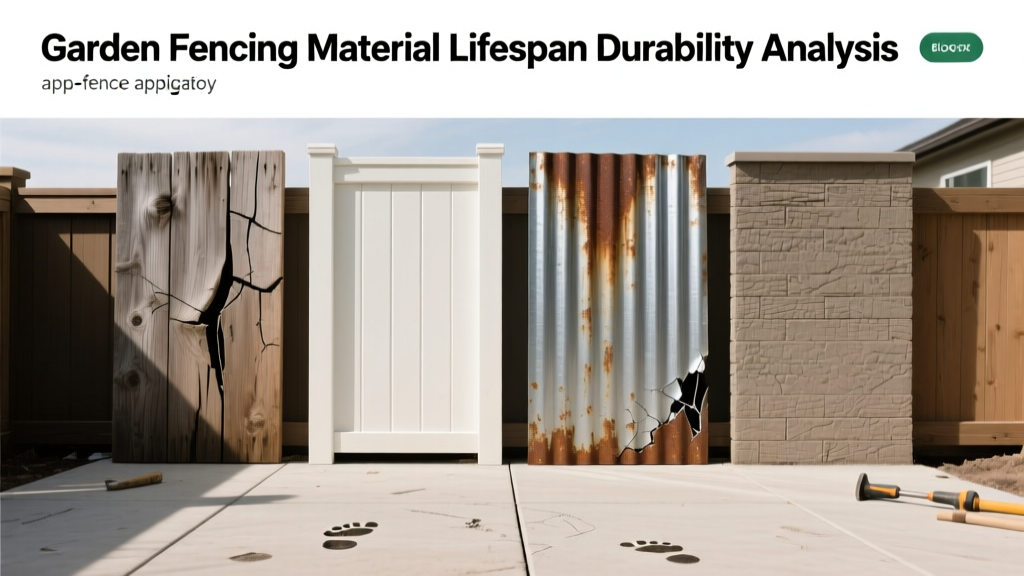
The Reality of Garden Fencing Durability
Garden fencing operates in one of the harshest micro-environments in residential construction. Unlike structural lumber protected by roofs and siding, fence posts are subjected to simultaneous UV degradation, soil-borne fungal attacks, freeze-thaw cycles, and lateral wind loads. When evaluating materials for garden fencing, upfront cost is a secondary metric; the true measure of value is the cost-to-lifespan ratio adjusted for regional climate stressors.
This analysis breaks down the empirical lifespan of primary garden fencing materials, identifying the specific chemical and structural failure modes that dictate when a fence will require replacement.
Baseline Lifespan Matrix
Pressure-Treated Pine: 10–15 years (highly dependent on soil drainage)
Western Red Cedar: 15–20 years (requires above-ground post collars)
Cellular PVC (Vinyl): 25–30+ years (resists moisture, vulnerable to impact in freezing temps)
Powder-Coated Aluminum: 30–50 years (impervious to rot, coating lifespan dictates failure)
Co-Extruded Composite: 20–25 years (high UV resistance, susceptible to thermal expansion)
Material-by-Material Degradation Analysis
Pressure-Treated Pine & Western Red Cedar
Wood remains the most common garden fencing material, but its lifespan is entirely dictated by the preservative retention levels and ground-line moisture management. According to the American Wood Protection Association (AWPA), lumber is classified by Use Categories. The most critical error in garden fencing is installing UC3B (above-ground) treated wood for fence posts. Posts must be rated UC4A (ground contact) or UC4B (heavy ground contact/freshwater) to resist subterranean fungal decay.
Western Red Cedar contains natural tannins and thujaplicins that resist rot, but these compounds deplete over 5 to 7 years when in direct soil contact. Cedar garden fencing achieves its maximum 20-year lifespan only when the posts are hot-dip galvanized steel or pressure-treated UC4A pine, with cedar used exclusively for the above-ground rails and pickets.
Cellular PVC (Vinyl) Fencing
Vinyl garden fencing does not rot, warp, or harbor termites, making its theoretical lifespan nearly indefinite. However, real-world failure occurs via UV-induced photodegradation. Cheaper vinyl profiles lack sufficient titanium dioxide (TiO2) and impact modifiers. Without TiO2, the PVC polymer chains break down under UV exposure, causing the fence to chalk, yellow, and become brittle.
When sourcing vinyl, verify compliance with ASTM F964 standards, which mandate minimum impact resistance and UV stabilizer concentrations. High-quality cellular PVC will maintain structural integrity for 30+ years, though it may require power washing to remove organic mildew in shaded, damp garden zones.
Powder-Coated Aluminum & Galvanized Steel
Aluminum is the premier choice for coastal or high-humidity gardens because it forms a protective aluminum oxide layer when exposed to oxygen, preventing structural rust. The vulnerability lies in the aesthetic finish. Standard baked-on paints will oxidize and peel within a decade. Specify aluminum fencing coated to AAMA 2604 (high-performance organic coatings) or AAMA 2605 (superior performance fluoropolymer) standards to ensure a 30-year color retention warranty.
Galvanized steel offers superior tensile strength for security-focused garden fencing but is highly susceptible to red rust at the cut ends and weld points. If steel is used, it must be hot-dip galvanized after fabrication (ASTM A123), not pre-galvanized, to ensure the zinc coating seals all exposed edges.
Wood-Plastic Composite (WPC)
First-generation composite fencing (uncapped) suffered from severe water absorption, leading to swelling and mold infiltration. Modern garden fencing utilizes co-extruded composite, featuring a dense polyethylene cap over a wood-fiber core. This cap prevents moisture ingress and resists staining from garden fertilizers and soil splatter. The primary failure mode for composite is thermal expansion; in high-heat environments, dark-colored composite rails can bow if installation gaps are not precisely calculated for the local temperature delta.
Environmental Failure Modes: What Actually Kills Fences?
Material quality is irrelevant if the installation ignores local environmental physics. The USDA Forest Products Laboratory notes that moisture and temperature fluctuations are the primary catalysts for structural failure in exterior wood and composite products.
Pouring concrete flush with the soil line creates a "water cup" that traps moisture against the wooden post, accelerating collar rot. Furthermore, in expansive clay soils, a bell-shaped concrete footing acts as an anchor for frost heave, pushing the post upward during winter freezes.
Three Non-Negotiable Installation Protocols
- The Gravel Base: Every post hole must have a 4-to-6-inch base of crushed angular gravel (not rounded pea gravel) tamped at the bottom. This creates a French drain effect, pulling hydrostatic pressure away from the post end grain.
- Sonotube Forms: In frost-prone regions, use cardboard Sonotube forms that extend from below the frost line to 2 inches above grade. This creates a smooth, cylindrical concrete pier that frost cannot grip, neutralizing frost heave.
- Crowning the Concrete: If setting wood directly in concrete, the top of the concrete pour must be sloped away from the post at a minimum 15-degree angle. This "crown" sheds surface runoff away from the vulnerable ground-line transition.
Cost-to-Lifespan Ratio (30-Year ROI Analysis)
Evaluating garden fencing requires amortizing the material and labor costs over a 30-year property horizon. The table below models the true cost of ownership, factoring in mandatory replacements and maintenance.
| Material | Upfront Cost (Per Lin. Ft.) | Expected Lifespan | 30-Year Replacements | Est. 30-Year Total Cost* |
|---|---|---|---|---|
| PT Pine | $25 - $35 | 12 Years | 2 Full Replacements | $85 - $115 |
| Cedar | $40 - $55 | 18 Years | 1 Full Replacement | $90 - $125 |
| Cellular PVC | $50 - $70 | 30+ Years | 0 | $50 - $70 |
| Aluminum | $45 - $65 | 40+ Years | 0 | $45 - $65 |
| Co-Extruded WPC | $60 - $85 | 25 Years | 0 (Minor repairs) | $60 - $85 |
*Costs reflect installed averages and do not account for inflation or localized labor variances. Maintenance costs (staining for wood, washing for PVC) are excluded for simplicity but further widen the gap in favor of synthetic materials.
Expert Verdict: Choosing by Climate Zone
There is no universally perfect garden fencing material; the optimal choice is strictly bound to your regional environmental stressors.
High UV / Arid Desert
Best: Powder-Coated Aluminum or Light-Colored PVC.
Avoid: Dark composite (thermal warping) and untreated cedar (rapid graying and desiccation cracking).
Coastal / Salt Spray
Best: Marine-grade Aluminum or Cellular PVC.
Avoid: Galvanized steel (salt accelerates zinc depletion) and standard iron hardware.
Heavy Clay / Freeze-Thaw
Best: Any panel material, provided posts are set in Sonotube piers below the frost line with gravel bases.
Avoid: Direct-bury concrete bell footings which will heave.
High Termite / Subterranean Pest
Best: Co-Extruded Composite or Aluminum.
Avoid: All wood products, including cedar and PT pine, which eventually lose their chemical barriers.
By prioritizing AWPA wood classifications, ASTM synthetic standards, and hydrostatic post-setting protocols, property owners can eliminate premature garden fencing failures and secure a boundary that outlasts the landscaping it protects.