Wood Privacy Fence Brands: BarretteWood vs Premium Cedar
Compare BarretteWood pre-assembled panels and premium Western Red Cedar for your wood privacy fence. Specs, costs, and failure modes analyzed.
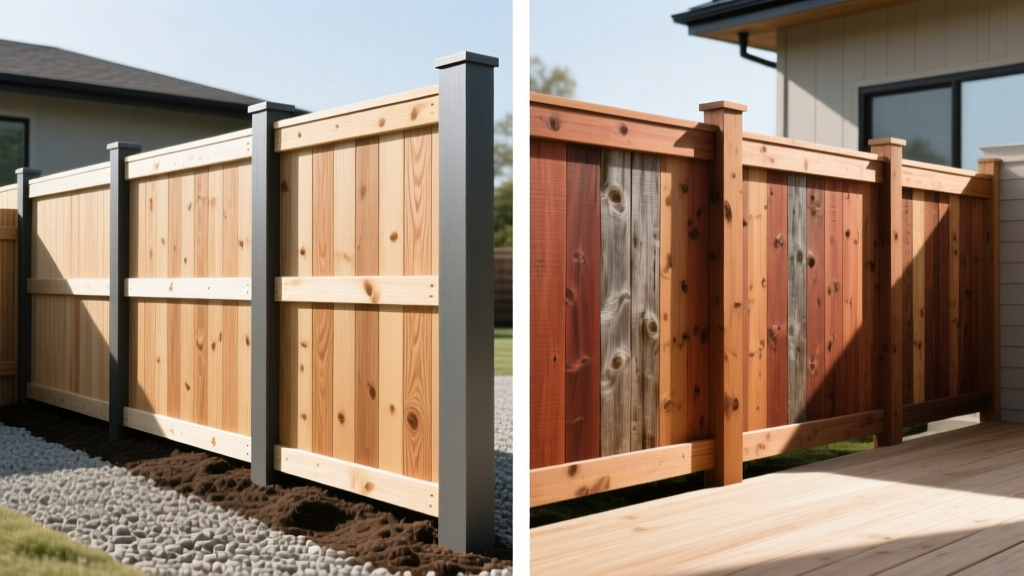
The Pre-Assembled vs. Stick-Built Dilemma
Selecting the right wood privacy fence system requires moving beyond basic aesthetic preferences to evaluate structural engineering, lumber grading, and long-term decay resistance. The market is currently dominated by two distinct procurement strategies: pre-assembled pressure-treated panels (led by brands like BarretteWood and Outdoor Essentials) and custom stick-built systems utilizing premium Western Red Cedar. Each approach dictates a fundamentally different installation methodology, fastener chemistry, and lifecycle cost.
- Choose BarretteWood PT Panels if: You prioritize rapid installation, have a strict initial budget ($14-$18 per linear foot), and accept a 15-to-20-year lifespan with moderate maintenance.
- Choose Stick-Built STK Cedar if: You require a 30-year lifespan, demand minimal warping, have a higher budget ($28-$36 per linear foot), and want to avoid the chemical leaching associated with pressure-treated pine.
Deep Dive: BarretteWood Pre-Assembled Panel Systems
BarretteWood manufactures high-volume, pre-assembled wood privacy fence panels primarily utilizing Southern Yellow Pine (SYP) treated with Micronized Copper Azole (MCA) or Alkaline Copper Quaternary (ACQ). Their flagship 6-ft x 8-ft Dog Ear and Shadowbox panels are ubiquitous in big-box retail and contractor supply yards.
Product Line Specs & Tolerances
The standard BarretteWood Pro-Series panel features 1x6 pickets (actual dimensions: 5/8" thick x 5.5" wide) affixed to 2x3 backer rails. The panels are assembled with galvanized staples or smooth-shank nails in a factory setting. While this ensures uniform spacing, the 5/8" picket thickness is a critical vulnerability. According to the USDA Forest Products Laboratory Wood Handbook, thinner wood sections experience faster moisture equilibration, leading to rapid tangential shrinkage and edge-cupping when exposed to direct UV and seasonal humidity swings.
Known Failure Modes & Edge Cases
- The Shrinkage Gap: Pre-assembled panels are often built when the pine has a moisture content above 19%. As the wood dries in-situ over the first summer, pickets shrink laterally, transforming a "good-neighbor" tight board fence into one with 1/4-inch gaps.
- Fastener Back-Out: Factory-applied smooth-shank staples lack the withdrawal resistance required for SYP, which expands and contracts aggressively. Within 3 to 5 years, staple heads frequently pop, requiring field remediation with stainless steel ring-shank screws.
- Weight and Handling: A fully saturated 6x8 BarretteWood PT panel can exceed 130 lbs. Installation requires a three-person crew or a mechanical panel lifter to prevent racking the backer rails before the concrete footings cure.
Deep Dive: Western Red Cedar (STK Grade) Stick-Built Systems
For custom wood privacy fence builds, Western Red Cedar remains the benchmark for dimensional stability and natural decay resistance. The optimal grade for fencing is Select Tight Knot (STK), which balances structural integrity with visual character, avoiding the prohibitive costs of Architectural Clear grades.
Lumber Grades & Sourcing Specifics
When procuring STK Cedar from suppliers certified by the Western Red Cedar Lumber Association (WRCLA), specify 1x6 boards with a minimum 3/4" actual thickness. Unlike the 5/8" pine pickets, the extra 1/8" of mass significantly increases the board's moment of inertia, resisting the cupping forces caused by differential drying between the bark-facing and heart-facing sides of the board.
Fastener Chemistry and Tannin Bleed
Cedar contains high levels of water-soluble tannic acid. Using standard hot-dipped galvanized (HDG) nails or screws will trigger a chemical reaction, resulting in permanent black streaks running down the fence face. Specification Rule: You must use Type 304 or Type 316 stainless steel fasteners for all cedar applications. Furthermore, utilize 2-inch ring-shank nails or 2.5-inch star-drive (Torx) screws. The ring-shank or threaded shaft provides mechanical locking within the cedar's cellular structure, counteracting the wood's natural tendency to push fasteners out during freeze-thaw cycles.
Material & Lifecycle Cost Matrix
The following table breaks down the true cost of ownership, factoring in material procurement, required fasteners, and expected lifespan before major structural failure.
| Material System | Material Cost (per LF) | Required Fasteners | Cupping Risk | Expected Lifespan |
|---|---|---|---|---|
| BarretteWood PT Pine (Pre-Assembled) | $14.00 - $18.00 | HDG or Polymer-Coated | High (5/8" thickness) | 15 - 20 Years |
| YellaWood PT Pine (Stick-Built) | $18.00 - $24.00 | Polymer-Coated / SS | Medium (3/4" thickness) | 20 - 25 Years |
| Western Red Cedar STK (Stick-Built) | $28.00 - $36.00 | 304/316 Stainless Steel | Low (Natural stability) | 25 - 35 Years |
The Hidden Point of Failure: Post Selection and Setting
The most common cause of wood privacy fence failure is not the pickets, but the subterranean decay of the structural posts. Even premium Cedar and heavily treated PT pine will succumb to fungal rot at the ground-line interface where oxygen, moisture, and soil microbes converge.
"Setting a wood post directly in a concrete collar creates a moisture trap. Concrete is porous and acts as a sponge, holding water against the wood grain. The correct methodology is to use a gravel base for drainage, set the post, and use a specialized steel post anchor, or transition entirely to galvanized steel structural posts."
The PostMaster Steel Post Solution
For high-wind zones and maximum longevity, industry leaders are increasingly pairing wood privacy fence pickets with PostMaster steel posts (manufactured by Master Halco). These heavy-gauge steel posts are driven into the ground or set in concrete, and then completely hidden from the street side by a wood facing board. This hybrid approach eliminates ground-contact rot entirely while maintaining the aesthetic of a 100% wood privacy fence. When using steel posts, the backer rails must be attached using specialized steel-to-wood brackets and self-drilling Tek screws, rather than toe-nailing through the wood.
Final Procurement and Installation Checklist
Before finalizing your material order, verify the following specifications with your supplier or general contractor to ensure the system meets structural and longevity requirements:
- AWPA Compliance: Ensure all pressure-treated pine posts are stamped for UC4B (Ground Contact, Heavy Duty). Standard UC4A (Ground Contact) is insufficient for critical structural fence posts supporting wind loads.
- Picket Thickness: Reject any pre-assembled panels utilizing 1/2" or 5/8" thick pickets. Mandate a minimum 3/4" actual thickness for wind-load resistance and warp mitigation.
- Fastener Audit: Confirm that 304 Stainless Steel ring-shank fasteners are specified for Cedar, and polymer-coated or hot-dipped galvanized fasteners are used for ACQ/MCA treated pine.
- Clearance Protocol: Verify that the installation plan includes a minimum 2-inch gap between the bottom of the pickets and the soil grade. Soil contact will wick moisture into the end-grain of the pickets, bypassing any chemical treatment or natural decay resistance.
- Sealant Timing: If applying a UV-blocking penetrating oil to Cedar or PT pine, wait a minimum of 30 to 60 days post-installation to allow the wood's internal moisture content to drop below 15%, ensuring the sealant penetrates the cellular structure rather than trapping moisture inside.