Best Basement Floor Options for Damp Concrete Slabs
Discover the best basement floor options for damp concrete slabs. Compare luxury vinyl, engineered wood, and tile for moisture-prone spaces.

The Physics of Basement Moisture: Why Standard Flooring Fails
Basements operate under a completely different set of physical rules than above-grade living spaces. Even if a concrete slab appears bone-dry to the touch, it is likely emitting moisture vapor. Concrete is inherently porous, and hydrostatic pressure from the surrounding soil continuously forces groundwater vapor upward through the capillary network of the slab. According to the EPA's Guide to Mold and Moisture, controlling this vapor transmission is the single most critical factor in preventing biological growth and structural degradation in below-grade environments.
When you install an impermeable flooring material directly over an unmitigated slab, you trap this vapor. The resulting condensation creates a microclimate perfectly calibrated for mold spores, ultimately destroying organic flooring materials and adhesives. Selecting the right basement floor options requires matching the material's vapor permeability and dimensional stability to your slab's specific moisture emission rate.
The Moisture Matrix: Testing Your Slab Before Purchasing
Never select basement flooring based on visual inspection alone. You must quantify the moisture vapor emission rate (MVER) using standardized testing protocols before committing to a material.
- ASTM F2170 (In-Situ Relative Humidity Test): The industry gold standard. Involves drilling holes into the concrete (20% depth for slabs drying from one side) and inserting RH probes. Readings above 80% RH indicate high moisture risk requiring a vapor barrier or dimpled subfloor.
- ASTM F1869 (Calcium Chloride Test): Measures surface emissions. A result exceeding 3 to 5 lbs per 1,000 square feet per 24 hours generally voids most flooring manufacturer warranties.
Tier 1: 100% Waterproof Basement Floor Options
These materials are impervious to water and will not harbor mold or degrade when exposed to the high-humidity environment typical of below-grade concrete.
SPC (Stone Polymer Composite) Luxury Vinyl Plank
While WPC (Wood Plastic Composite) vinyl is popular upstairs, SPC is the superior choice for basements. SPC utilizes a dense limestone-polyvinyl chloride core that resists the expansion and contraction caused by the temperature fluctuations common in semi-conditioned basements.
Specification Requirements: Demand a minimum 20-mil (0.5mm) urethane-ceramic wear layer for residential use. Ensure the product features an attached IXPE or cork underlayment to provide a minor thermal break and sound dampening against the hard concrete.
Porcelain Tile (Not Ceramic)
Porcelain is fired at higher temperatures than standard ceramic, resulting in a denser body. Under ASTM C373 standards, true porcelain must exhibit a water absorption rate of 0.5% or less.
Installation Caveat: Concrete slabs inevitably develop shrinkage cracks. If you mortar tile directly to the slab, those cracks will telegraph through and shatter the tile. You must install a crack isolation membrane (such as Schluter-DITRA) between the slab and the thinset. Furthermore, use 100% solids epoxy grout or high-performance urethane grout; standard cementitious grout will absorb basement humidity and stain or mildew over time.
Tier 2: Conditionally Safe Options (Subfloor Required)
If you desire the aesthetic of organic materials, you can install them in a basement, but only if you decouple them from the concrete using a specialized subfloor system.
Engineered Hardwood
Solid hardwood is strictly prohibited below grade due to its tendency to cup and crown when exposed to moisture. Engineered hardwood, with its cross-plywood core, offers superior dimensional stability. However, it must be floated over a dimpled subfloor system that provides an air gap, allowing moisture vapor to dissipate laterally rather than pooling against the wood backing. The Penn State Extension Basement Finishing Guide heavily emphasizes the necessity of maintaining this capillary break when using organic finishes below grade.
Materials to Banish from the Basement
Avoid these materials entirely. The failure rate for these options in below-grade applications approaches 100% within a 5-to-10-year window.
- Solid Hardwood: Will absorb ambient moisture, leading to severe cupping and joint separation.
- MDF-Core Laminate: Medium-density fiberboard acts like a sponge. Once water vapor penetrates the seams, the core swells irreversibly.
- Traditional Broadloom Carpet with Rubber Pad: Traps moisture against the slab, creating an ideal breeding ground for Stachybotrys (black mold). If carpet is desired, use synthetic, breathable carpet tiles that can be lifted and dried.
Comparative Analysis: Cost, Performance, and Installation
| Material | Material Cost (per sq ft) | Moisture Tolerance | Subfloor Required? | Thermal Resistance (R-Value) |
|---|---|---|---|---|
| SPC Luxury Vinyl | $3.50 - $6.50 | 100% Waterproof | No (but recommended for warmth) | ~0.2 (Higher with attached pad) |
| Porcelain Tile | $4.00 - $12.00 | 100% Waterproof | No (Crack membrane required) | ~0.1 (Very cold without radiant heat) |
| Engineered Hardwood | $7.00 - $14.00 | Low (Moisture sensitive) | Yes (Strictly required) | ~1.0 |
| Sheet Vinyl | $1.50 - $4.00 | 100% Waterproof | No | ~0.1 |
The Secret Weapon: Dimpled Subfloor Systems
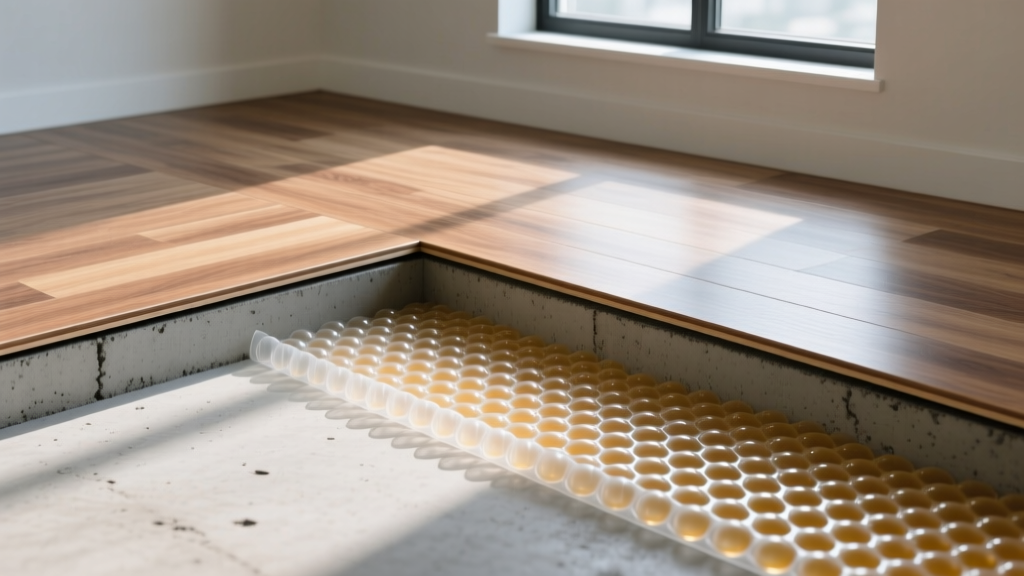
To elevate a cold, damp basement into a comfortable living space, a dimpled subfloor is the most effective investment you can make. These systems consist of a high-density polyethylene (HDPE) dimpled membrane bonded to an OSB or plywood top layer (e.g., DRIcore), or sold as standalone underlayment (e.g., DMX 1-Step).
The Mechanics of the Air Gap: The 5/16-inch dimples create a physical capillary break. As moisture vapor pushes through the concrete, it hits the plastic membrane, condenses, and is allowed to evaporate and move laterally toward the perimeter walls, where it is managed by your basement's HVAC return or dehumidifier. This air gap also raises the floor temperature by an average of 5°F to 7°F, drastically reducing the "cold floor" shock of basement tiles or vinyl.
Cost Breakdown: Adding a Subfloor System
Budget an additional $1.10 to $2.50 per square foot for subfloor materials. While this increases upfront costs, it protects your primary flooring investment and is heavily recommended by the U.S. Department of Energy's Basement Insulation Guidelines to improve the overall thermal envelope of the below-grade space.
Decision Framework: Matching Flooring to Basement Use
Select your basement floor options based on the specific functional demands of the room:
Scenario A: The High-Traffic Entertainment & Bar Area
Optimal Choice: SPC Luxury Vinyl Plank (7-inch wide planks, 22-mil wear layer) installed over DMX 1-Step underlayment.
Why: Spills are inevitable near a wet bar. SPC handles standing water indefinitely, while the dimpled underlayment provides the acoustic dampening necessary for a home theater or loud gathering space.
Scenario B: The Luxury Spa Bathroom or Wet Sauna
Optimal Choice: Large-format Porcelain Tile with a sloped mortar bed and epoxy grout.
Why: Direct, heavy water exposure requires a fully bonded, impermeable surface. Ensure the concrete slab is properly sloped toward floor drains before applying the crack isolation membrane and thinset.
Scenario C: The Home Office or Guest Bedroom
Optimal Choice: Engineered Hardwood (oak or hickory veneer, minimum 4mm wear layer) floated over a DRIcore OSB subfloor.
Why: These spaces demand warmth, acoustic comfort, and high-end aesthetics. The OSB subfloor provides a nailable/floatable surface that elevates the wood away from slab moisture while adding vital R-value to keep the room thermally comfortable.
Written by
Priya KapoorPriya Kapoor is a real estate market analyst and construction economics researcher with expertise in housing affordability, development feasibility, and infrastructure investment. She holds a Master of Regional Planning from Cornell University and previously worked as a senior analyst at CBRE's Investment Properties group, where she modeled returns for $4B in mixed-use development pipelines. Priya now runs an independent research practice advising developers, municipalities, and REITs on construction cost forecasting and market timing. She publishes the quarterly "BuildMat Market Pulse" report tracking material price indices across 12 commodity categories. Based in Austin, TX, Priya serves on the board of Habitat for Humanity Austin and is a marathon runner.
More from Priya Kapoor
View all
Construction Cost
Cost to Build a 1600 Sq Ft Home in 2026: Full Breakdown
Accurate 2026 cost to build a 1600 sq ft home—material, labor, and regional pricing breakdowns included. Plan your budget with real-time estimates.
Aug 11, 2026

Wood & Lumber
Name the Types of Wood for Pressure Treatment and Preservation
Learn how to name the types of wood best suited for pressure treatment. Compare species treatability, chemical retention levels, and 2026 preservation costs.
Aug 4, 2026

Stone & Masonry
Stone Veneer Suppliers Lindenhurst: 2026 Cost Analysis
Analyze 2026 stone veneer costs in Lindenhurst, NY. Compare local supplier pricing, delivery fees, and Suffolk County installation labor rates.
Aug 4, 2026