Best Pool Flooring Options: A Durability & Lifespan Analysis
Compare the top pool flooring options by durability, slip resistance, and heat retention. Find the longest-lasting deck materials for your climate.

The Crucial Metrics of Pool Deck Durability
Selecting pool flooring options requires looking far beyond aesthetic appeal. The poolside environment is one of the most punishing microclimates in residential construction. Materials face constant thermal cycling, aggressive chemical exposure from splashing, hydrostatic pressure, and intense ultraviolet radiation. A material that performs flawlessly in a dry, shaded patio will often delaminate, spall, or fade within three seasons when subjected to a saltwater pool's splash zone.
According to guidelines from the Pool & Hot Tub Alliance (PHTA), the primary cause of premature pool deck failure is not foot traffic, but environmental degradation. To evaluate durability accurately, contractors and homeowners must measure materials against four specific stress vectors: freeze-thaw resilience, slip resistance (DCOF), UV stability, and chemical inertness.
The 'Big Four' Failure Modes in Pool Flooring
- Spalling: Moisture infiltration followed by freezing, which expands and pops the surface layer off (common in non-air-entrained concrete and soft limestone).
- Efflorescence & Joint Erosion: Pool chemicals and water dissolve standard cementitious grout, leading to white salt deposits and destabilized pavers.
- Thermal Shock: Rapid temperature drops (e.g., a cold rainstorm on a 130°F deck) causing rigid materials to crack.
- UV Degradation: Breakdown of topical sealers and composite polymers, resulting in chalking, fading, and loss of slip resistance.
Material-by-Material Durability Breakdown
Tumbled Travertine (Cross-Cut)
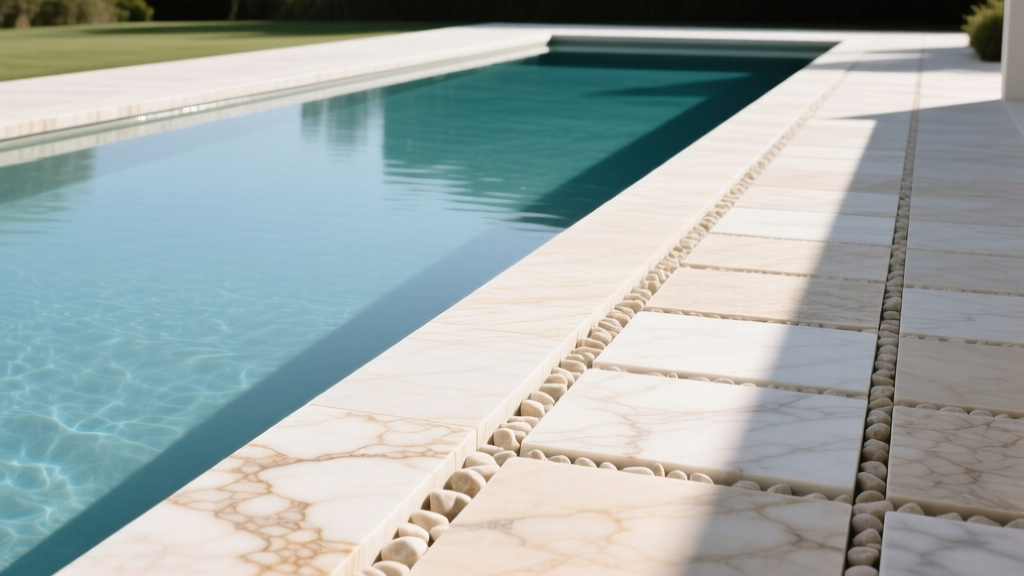
Natural stone remains a premium choice, but not all stone survives the poolside. Travertine, specifically cross-cut and tumbled, is the industry standard for high-end pool decks. Cross-cutting against the vein exposes a denser, more uniform surface that resists pitting. Travertine's natural porous structure actually works to its advantage in wet environments; it absorbs surface water rapidly, reducing puddling and maintaining a cooler surface temperature—often 20°F to 30°F cooler than concrete in direct summer sun.
Durability Caveat: Travertine is calcium carbonate, making it vulnerable to acid washing and aggressive chlorine splashing. The Natural Stone Institute mandates the use of high-quality, breathable impregnating sealers (like siloxane-based formulations) rather than topical acrylics, which trap moisture and cause subsurface spalling. Expect to reseal every 18 to 24 months in high-splash zones.
20mm Gauged Porcelain Pavers
For maximum chemical inertness and structural rigidity, 20mm (3/4-inch) thick porcelain pavers are virtually unmatched. Unlike natural stone, porcelain is fired at over 2,200°F, resulting in a water absorption rate of less than 0.5%. This near-zero porosity makes it completely immune to freeze-thaw spalling and impervious to saltwater corrosion.
Slip Resistance Standards: When evaluating porcelain pool flooring options, you must verify the Dynamic Coefficient of Friction (DCOF). The Tile Council of North America (TCNA) and ANSI A137.1 standards require a minimum DCOF of 0.42 for level interior spaces, but pool decks demand a DCOF of 0.60 or higher. Look for pavers with a textured, structured, or grip finish specifically rated for wet exterior applications. Install using pedestal systems or open-joint sand settings to allow immediate water drainage, eliminating the need for grout that can harbor algae or degrade from pool chemicals.
Stamped and Sealed Concrete
Poured concrete is the most common pool decking material due to its low initial cost, but its long-term durability is entirely dependent on the mix design and sealing regimen. In climates with freezing winters, the concrete mix must be air-entrained (containing 5% to 8% microscopic air bubbles) to provide expansion chambers for freezing water. Without this, surface spalling is guaranteed within three winters.
The Sealer Trap: Most stamped concrete is finished with a topical acrylic or polyurethane sealer to enhance color. In a pool environment, these topical sealers degrade rapidly under UV exposure and become dangerously slippery when wet. Furthermore, they trap hydrostatic vapor from the soil below, leading to blistering and peeling. For superior durability, specify a penetrating silane/siloxane sealer combined with a broadcast application of aluminum oxide or polymer grit for slip resistance. Plan for a complete resealing every 2 to 3 years.
Capped Composite Decking
While wood-plastic composites (like Trex Transcend or TimberTech AZEK) resist rot and splintering, their durability in a pool setting is compromised by heat retention. Darker composite boards can easily exceed 140°F in direct midday sun, making them unusable for barefoot traffic. Furthermore, the expansion and contraction rates of composite materials are significantly higher than stone or concrete. If installed without proper 1/4-inch gapping at the ends and 3/16-inch side gaps, the boards will buckle and warp under thermal stress. Always specify light-colored, capped polymer composites with integrated UV inhibitors for pool surrounds.
Comparative Durability Matrix
| Material | Expected Lifespan | Freeze-Thaw Resilience | Chemical Resistance | Maintenance Frequency |
|---|---|---|---|---|
| Cross-Cut Travertine | 30–50+ Years | Moderate (Requires sealing) | Low (Vulnerable to acids) | High (Seal every 1-2 yrs) |
| 20mm Porcelain Pavers | 50+ Years | Excellent (<0.5% absorption) | Excellent (Inert) | Low (Joint sand top-ups) |
| Air-Entrained Concrete | 20–30 Years | High (If 5-8% air entrained) | Moderate (Sealer dependent) | High (Reseal every 2-3 yrs) |
| Capped Composite | 25–30 Years | Excellent (Unaffected) | High (Non-porous cap) | Low (Wash down only) |
Climate-Specific Failure Points & Mitigation
Durability is not an absolute metric; it is relative to the local climate. A material that lasts 50 years in Southern California may fail in 5 years in Minnesota.
- Freeze-Thaw Zones (Northeast, Midwest): Avoid soft, porous stones like sandstone, limestone, and slate. The water absorption rates of these materials exceed 3%, guaranteeing catastrophic spalling when water freezes and expands by 9%. Stick to 20mm porcelain or properly air-entrained concrete.
- Sunbelt Regions (Southwest, Florida): UV degradation and thermal expansion are the primary threats. Avoid dark-colored concrete and composite decking. Specify light-colored travertine or textured porcelain to mitigate heat absorption and reduce the thermal expansion stresses on the sub-base.
- Coastal & High-Salinity Areas: Salt air accelerates the corrosion of metal fasteners and rebar. If using concrete, ensure the rebar is epoxy-coated or use fiberglass rebar (GFRP). For pavers, use stainless steel edge restraints rather than galvanized steel, which will rust and stain the surrounding deck.
Chemical Resistance: Saltwater vs. Chlorine Pools
The type of pool sanitation system drastically alters the chemical environment of the surrounding deck. Saltwater pools (which use salt chlorine generators) create a highly corrosive splash zone. As the saltwater evaporates on the deck surface, it leaves behind concentrated salt crystals that draw moisture into porous materials, accelerating efflorescence and joint erosion.
"In saltwater pool environments, the mortar and grout joints are often the first point of failure, not the pavers themselves. Standard cementitious sands will dissolve within a few seasons."
To mitigate this, never use standard polymeric sand or cement grout in the splash zone of a saltwater pool. Instead, utilize an epoxy-based paving grout or a high-performance, resin-based jointing compound specifically rated for submerged and high-salinity environments. These materials are completely impervious to salt extraction and will prevent the pavers from shifting over time.
Expert Verdict: Matching Material to Use-Case
There is no single "best" material; there is only the most durable material for your specific parameters. If your priority is absolute zero-maintenance and maximum chemical resistance, 20mm porcelain pavers on a pedestal system are the superior engineering choice. If you require a cooler surface temperature and prefer natural aesthetics in a mild climate, tumbled travertine is optimal, provided you commit to a strict siloxane sealing schedule. Avoid topical sealers on concrete at all costs near the waterline, and always verify the DCOF slip-resistance rating before purchasing any porcelain or tile product for a wet environment.
Written by
Sarah WhitfieldSarah Whitfield is a chartered quantity surveyor (MRICS) and construction cost analyst with 15 years of experience in material pricing, procurement strategy, and project budgeting. She earned her degree in Construction Management from the University of Reading (UK) and has worked on projects ranging from $2M custom homes to $180M mixed-use developments across North America and Europe. Sarah currently leads cost estimating for BuildMat Insight, maintaining a proprietary database of 4,000+ material price points updated quarterly. She is a frequent contributor to RSMeans cost data panels and has presented at the International Cost Engineering Council (ICEC) congress. Based in Denver, CO, Sarah is an avid trail runner and volunteer mentor for Women in Construction.
More from Sarah Whitfield
View all
Wood & Lumber
What Are the Different Types of Wood? A Builder's Guide
Compare structural softwoods, finish hardwoods, and engineered lumber. Analyze Janka ratings, MOE values, and 2026 pricing for construction.
Aug 4, 2026

Walls & Panels
Steel Framing vs Wood Framing: Corrosion and Moisture Defense
Compare steel framing vs wood framing for moisture resistance. Learn about galvanized coatings, condensation risks, and corrosion protection strategies.
Jul 21, 2026

Stone & Masonry
How to Cut Stone Veneer: Wet Saw vs Grinder Comparison
Compare the best tools for cutting stone veneer. We review wet saws, angle grinders, and chop saws to help you achieve clean, chip-free cuts.
Jul 21, 2026