Carpet Adhesive Taxonomy: Selecting the Right Bond for Substrates
Master carpet adhesive selection with our material taxonomy. Compare acrylic, urethane, and pressure-sensitive bonds for concrete and wood substrates.
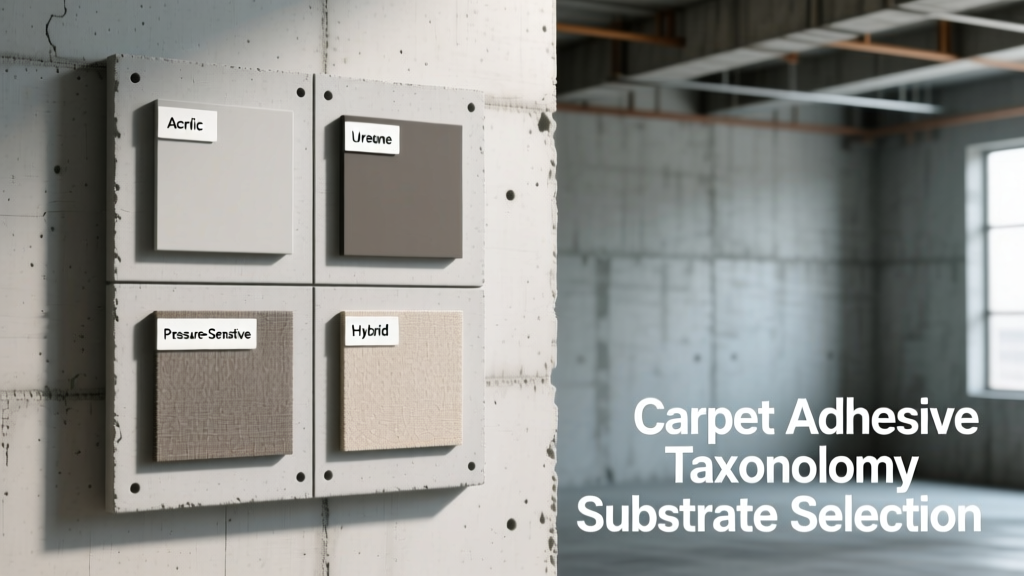
The Chemistry of Carpet Adhesives: A Material Taxonomy
Direct glue-down carpet installation relies entirely on the chemical and mechanical bond between the carpet backing and the substrate. Selecting the incorrect carpet adhesive leads to catastrophic failures, including edge ravel, delamination, and moisture-induced alkaline degradation. To specify the correct product, facility managers and flooring contractors must understand the underlying polymer chemistry of modern adhesives.
The market is dominated by three primary chemical families, each engineered for specific environmental and substrate conditions:
- Water-Based Acrylics: The industry standard for commercial broadloom installations over porous, dry substrates. These adhesives cure through water evaporation and coalescence, forming a flexible, high-tack bond. They are inherently low in volatile organic compounds (VOCs), aligning with strict indoor air quality mandates.
- Moisture-Cured Urethanes (Polyurethane):strong> Engineered for high-stress environments, exterior/semi-exterior applications, or substrates with marginal moisture issues. Urethanes do not rely on water evaporation; instead, they cross-link by reacting with ambient moisture, creating an impermeable, highly durable bond that resists plasticizer migration.
- Pressure-Sensitive (PS) Adhesives: Formulated exclusively for modular carpet tiles. Unlike wet-set adhesives that cure hard, PS adhesives remain permanently tacky. This allows for the localized removal and replacement of damaged tiles without destroying the substrate or adjacent modules.
Substrate Compatibility and Moisture Matrix
Adhesive failure is rarely the fault of the glue itself; it is almost always a substrate preparation or compatibility issue. The following matrix dictates the required adhesive class based on the underlying surface.
| Substrate Type | Required Adhesive Class | Critical Preparation Step |
|---|---|---|
| Fully Cured Concrete (On/Above Grade) | Water-Based Acrylic | Shot-blasting to CSP 2-3; pH and MVER testing |
| Gypsum Underlayment | Acrylic (with primer) | Must seal with manufacturer-approved primer to prevent chemical reaction |
| Existing VCT / Resilient Flooring | Urethane or High-Solids Acrylic | Strip all wax/finish; scarify surface to ensure mechanical tooth |
| Exterior / High-Moisture Concrete | Moisture-Cured Urethane | No moisture mitigation primer required; substrate must be damp-free at time of application |
| Access Flooring / Raised Panels | Pressure-Sensitive (PS) | Clean with isopropyl alcohol to remove factory oils |
Pressure-Sensitive vs. Wet-Set: The Core Decision Framework
The choice between pressure-sensitive and wet-set (direct glue-down) adhesives dictates the lifecycle maintenance of the flooring. This decision must be made during the design phase, not on the job site.
Specifying Pressure-Sensitive (PS) Adhesives
PS adhesives are applied to the substrate and allowed to flash off until they reach a state of high, permanent tack. They do not cure into a rigid film. Use Case: Modular carpet tile over access flooring, data centers, and high-churn office spaces where under-floor cabling requires frequent tile removal. PS adhesives typically yield a spread rate of 35 to 45 square feet per gallon. If a tile is pulled up after five years, the adhesive should remain on the substrate, ready to accept a new tile without re-application.
Specifying Wet-Set (Direct Glue-Down) Adhesives
Wet-set acrylics and urethanes are applied wet, and the carpet is embedded into the adhesive bed. As the water or solvent evaporates, the adhesive cures into a rigid, high-shear-strength bond. Use Case: Broadloom carpet in hospitality, corridors, and heavy rolling-load environments. According to the Carpet and Rug Institute (CRI) 104 Standard, direct glue-down installation is mandatory for commercial broadloom to prevent wrinkling, buckling, and delamination under heavy foot traffic and rolling casters.
Moisture Vapor Emission Rates (MVER) and Adhesive Failure
Water-based acrylic carpet adhesives are highly susceptible to moisture vapor transmission from concrete slabs. When moisture migrates upward, it carries soluble alkalis to the surface. If the pH of the concrete surface exceeds 9.0, the alkaline environment triggers saponification—the adhesive literally turns into soap, resulting in a total loss of bond.
"Never rely on the age of a concrete slab as an indicator of dryness. A five-year-old slab without a proper vapor retarder beneath it will emit more moisture than a 90-day-old slab that was poured over a 15-mil polyethylene barrier. Always test."
Mandatory Testing Protocols:
- ASTM F1869 (Calcium Chloride Test): Maximum allowable MVER for standard acrylic carpet adhesives is 5.0 lbs per 1,000 sq. ft. per 24 hours.
- ASTM F2170 (Relative Humidity Probe): Maximum allowable internal RH is 80%.
- ASTM F710 (pH Testing): Surface pH must be between 7.0 and 9.0.
If a slab fails these parameters, you must apply a two-part epoxy moisture mitigation system (such as Bostik MVP4 or Mapei Primer MF) before applying the carpet adhesive. This adds approximately $1.50 to $2.50 per square foot to the project cost but prevents catastrophic adhesive failure.
Commercial Adhesive Specifications and Pricing
When drafting project specifications, avoid generic "carpet glue" designations. Specify exact product models to ensure performance and warranty compliance. Below are current industry-standard specifications for commercial projects:
- Roberts 3095 Premium Carpet Adhesive: A high-solids, water-based acrylic designed for direct glue-down of broadloom. Features built-in antimicrobial protection (Microban). Estimated Cost: $180 - $210 per 4-gallon pail. Coverage: 135-165 sq. ft. per gallon (depending on trowel).
- Bostik BEST (Urethane): A moisture-cured, one-component urethane adhesive. Ideal for high-moisture areas, ramps, and heavy rolling loads. Contains zero water, eliminating the risk of alkaline hydrolysis. Estimated Cost: $240 - $275 per 4-gallon pail.
- Shaw 9050 Pressure-Sensitive Adhesive: Specifically formulated for Shaw contract carpet tiles. Offers excellent plasticizer resistance and high initial tack. Estimated Cost: $160 - $190 per 4-gallon pail.
Trowel Selection and Spread Rate Calibration
Applying the correct amount of adhesive is critical. Too little adhesive results in poor bonding and edge ravel; too much adhesive leads to prolonged curing times, adhesive bleed-through the carpet backing, and telegraphing of the trowel ridges.
| Carpet Backing Type | Required Trowel Notch | Approximate Spread Rate |
|---|---|---|
| Standard ActionBac / Polypropylene | 1/16" x 1/16" x 1/16" U-Notch | 35 - 45 sq. ft. / gallon |
| High-Density Cushion / Froth Urethane | 1/8" x 1/8" x 1/8" V-Notch | 25 - 30 sq. ft. / gallon |
| Vinyl-Backed Carpet Tile (PS Adhesive) | 3/32" x 3/32" x 3/32" V-Notch | 35 - 40 sq. ft. / gallon |
Pro-Tip on Open Time: Water-based acrylics require an "open time" of 15 to 30 minutes before the carpet is embedded. This allows the water to flash off, increasing the tack. If you lay the carpet into wet adhesive (wet-lay method), the trapped moisture will cause the bond to fail or result in mildew growth beneath the carpet.
Troubleshooting Adhesive Degradation
When carpet installations fail post-occupancy, the root cause usually falls into one of two chemical degradation pathways.
Alkaline Hydrolysis
As mentioned, high pH combined with moisture destroys acrylic polymers. If you observe a white, powdery residue on the concrete after pulling up a failed carpet, the adhesive has saponified. The Fix: There is no topical cure for this. The slab must be mechanically scarified, treated with an epoxy moisture barrier, and re-glued using a urethane adhesive.
Plasticizer Migration
Some carpet backings, particularly older vinyl or PVC-backed tiles, contain high levels of liquid plasticizers to maintain flexibility. Over time, these plasticizers leach out of the backing and migrate into the adhesive layer. If the adhesive is not specifically formulated to be "plasticizer-resistant," the migrating chemicals will break down the polymer chains, turning the adhesive into a sticky, non-cohesive slime. The Fix: Always verify that the Technical Data Sheet (TDS) of your chosen adhesive explicitly states compatibility with PVC/vinyl backings, or upgrade to a 100% solids urethane adhesive which is immune to plasticizer migration.