How Do I Clean a Carpet? The Ultimate Maintenance Playbook
Learn how to clean a carpet with our expert maintenance playbook. Discover exact stain removal steps, formulas, and fiber-specific care tips.
The Fiber Identification Framework: Know Your Material
Before applying any moisture or chemical to your flooring, you must identify the carpet fiber. The question of how to clean a carpet correctly hinges entirely on the material's chemical tolerance. Applying an alkaline cleaner to wool will permanently destroy the keratin structure, while using cold water on a synthetic oil stain will lock it into the fiber.
Synthetic vs. Natural Fiber Tolerances
- Nylon (Polyamide): Accounts for roughly 60% of residential carpets. Highly durable but susceptible to acid dyes. Requires a neutral to slightly alkaline pH (7.0–9.0). High alkalinity (pH > 10) will strip the stain-resist treatment.
- Polyester (PET): Naturally stain-resistant to water-based spills but highly oleophilic (oil-attracting). Requires specialized surfactants to break down body oils and pet sebum. Tolerates pH up to 10.0.
- Olefin (Polypropylene): Common in Berber and loop-pile styles. Virtually impervious to water-based stains and bleach, but acts like a magnet for oils. Requires solvent-based pre-sprays for deep cleaning.
- Wool: A natural protein fiber. Strictly requires a pH between 4.5 and 8.0. Never use optical brighteners, high-alkaline pre-sprays, or water exceeding 120°F, as heat and alkalinity cause the scales on the wool fiber to open, leading to irreversible shrinkage and felting.
If you are unsure of your fiber type, place a single drop of water on an inconspicuous area. If it beads up and sits on the surface, it is likely a synthetic fiber with a hydrophobic stain guard. If it absorbs rapidly, it may be wool or a worn synthetic lacking fluorochemical protection.
Routine Maintenance: The 80/20 Soil Prevention Rule
According to the Carpet and Rug Institute (CRI), up to 80% of the soil in a carpet is dry, insoluble particulate matter (sand, silica, tracked-in dirt). If this abrasive grit is not removed via vacuuming, foot traffic grinds it against the fibers, causing microscopic lacerations that permanently dull the carpet's appearance.
Vacuuming Frequency and Equipment Specs
Not all vacuums are engineered for deep soil extraction. Look for machines carrying the CRI Seal of Approval, which certifies that the vacuum meets strict standards for soil removal, dust containment (HEPA filtration), and surface appearance retention.
| Traffic Profile | Vacuum Frequency | Passes per Area | Beater Bar Requirement |
|---|---|---|---|
| Light (Guest rooms) | 1x Weekly | 2-3 slow passes | Optional |
| Moderate (Living areas) | 2-3x Weekly | 4-5 slow passes | Required (Adjustable height) |
| Heavy (Entries, hallways) | Daily | 5-7 slow passes | Required (High agitation) |
| Pets / Allergies | Daily | 7+ multi-directional | Required (Sealed HEPA system) |
Spot Cleaning Playbook: Exact Formulas for Top Stains
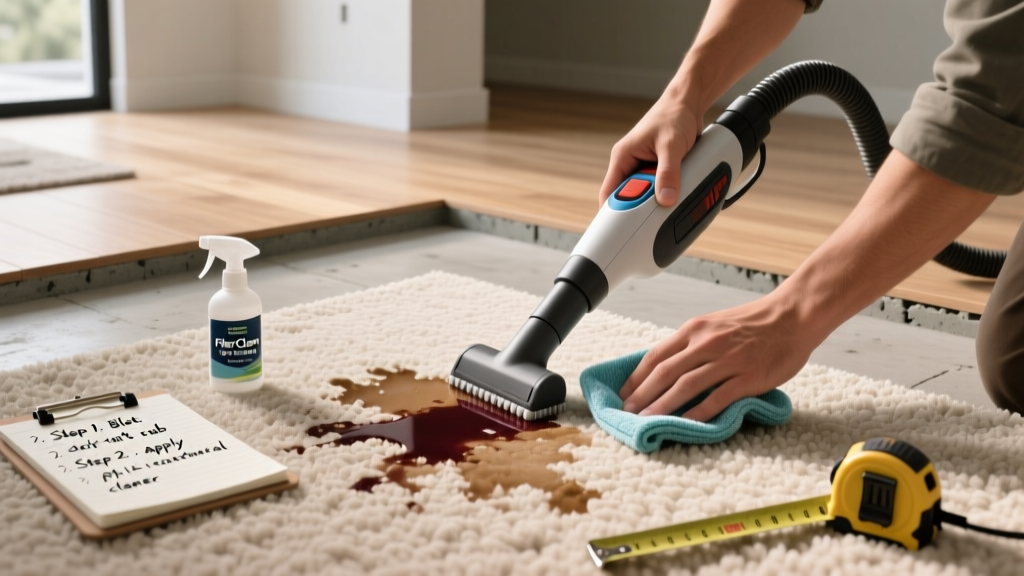
When a spill occurs, time is the enemy. The golden rule of spot cleaning is to blot, never rub. Rubbing generates friction heat and distorts the yarn twist, causing permanent fuzzing and bloom. Use a clean, white, absorbent microfiber towel to apply downward pressure, utilizing capillary action to draw the spill out of the backing.
The Master Stain Matrix
| Stain Category | Common Culprits | Chemical Solution | Dwell Time & Action |
|---|---|---|---|
| Protein | Blood, vomit, dairy, egg | Cold water + Enzyme cleaner (e.g., Nature's Miracle) | 10 mins. Never use hot water, which coagulates protein. |
| Tannin | Coffee, tea, red wine, berries | 1 part white vinegar to 2 parts warm water | 5 mins. Blot. Rinse with plain water to prevent browning. |
| Oily / Grease | Butter, makeup, motor oil, crayon | Isopropyl alcohol (70%) or Citrus Solvent | Apply to towel first, blot onto stain. Volatile; ventilate room. |
| Synthetic Dye | Food coloring, ink, Kool-Aid | Red Zone Reducer (Sodium hydrosulfite based) | Requires heat activation (steam iron over damp towel). Pro only. |
| General Soil | Mud, tracking, unknown spills | 1/4 tsp clear, non-bleach dish soap + 1 cup warm water | 5 mins. Must be rinsed with plain water to remove soap residue. |
Deep Cleaning: Hot Water Extraction vs. Encapsulation
The Environmental Protection Agency (EPA) notes that carpets act as massive air filters, trapping volatile organic compounds (VOCs), allergens, and particulate matter. Over time, these filters reach capacity. Deep cleaning is required every 12 to 18 months to restore indoor air quality and fiber resilience.
Hot Water Extraction (HWE)
Often mislabeled as 'steam cleaning,' HWE is the gold standard for residential synthetic and wool carpets. The process involves injecting a pressurized cleaning solution (150°F–200°F for synthetics, max 120°F for wool) into the pile, followed by immediate, high-vacuum extraction.
- Truckmount Units: Generate 400–500 PSI of water pressure and massive vacuum lift (over 10,000 cubic feet per minute). They extract up to 95% of the moisture, leaving carpets dry in 4–6 hours.
- Portable / Rental Units: Typically operate at 30–60 PSI with weak vacuum recovery. These machines often leave behind excessive moisture and sticky surfactant residue, leading to rapid re-soiling and potential subfloor damage.
If a carpet remains wet for more than 24 hours, you risk delamination (the separation of the primary and secondary backings), jute rot, and microbial growth (mold/mildew). Always use an acid rinse (pH 3.0–4.0) after an alkaline pre-spray to neutralize the carpet and strip away sticky residues.
Very Low Moisture (VLM) Encapsulation
For commercial spaces or low-pile synthetics, encapsulation is highly effective. A specialized polymer solution is agitated into the carpet using a counter-rotating brush machine. As the solution dries (usually within 30 minutes), the polymers crystallize, trapping soil particles. The crystallized soil is then easily vacuumed away during the next routine maintenance cycle. This method uses less than a gallon of water per 1,000 square feet.
Preventing Wicking and Residue Buildup
The most common failure in DIY carpet cleaning is the 'phantom stain'—a spot that disappears when wet but reappears a few days after drying. This phenomenon is called wicking.
The Physics of Wicking
When a spill penetrates past the face yarn and into the carpet backing or pad, surface cleaning only removes the top portion of the stain. As the carpet dries, capillary action draws the remaining moisture and soil from the backing up to the tips of the fibers, depositing the soil on the surface.
The Weighted Towel Protocol
To prevent wicking after treating a deep spill or performing a spot extraction:
- Extract as much moisture as possible using a wet vac or dry absorbent towels.
- Apply a light mist of an acid rinse or plain water to the area to dilute any remaining backing soil.
- Extract again.
- Place a half-inch layer of dry, white paper towels or a clean microfiber cloth over the spot.
- Place a heavy, flat object (like a textbook or a brick wrapped in a plastic bag) on top of the towel.
- Leave it for 12–24 hours. The weight forces the backing against the towel, and the capillary action transfers the hidden moisture and soil into the towel instead of the carpet tips.
Post-Cleaning Grooming and Drying
Cleaning is only half the process; resetting the fiber is the other. After any deep wet cleaning, the carpet pile will be crushed and twisted in random directions. Using a carpet rake (such as a Grandi Groomer) immediately after cleaning stands the fibers upright. This serves three critical functions:
- Accelerates Drying: Separating the fibers allows ambient air to reach the backing, cutting drying time by up to 40%.
- Prevents Matting: Resets the yarn twist before the fibers dry in a crushed position.
- Eliminates Wand Marks: Erases the overlapping lines left by the extraction wand, leaving a uniform, professional finish.
Ensure the HVAC system is running, and deploy axial air movers (fans) pointing across the surface of the carpet to create a high-velocity boundary layer of air, which rapidly evaporates residual moisture. Under optimal conditions (72°F, 40% humidity, active airflow), a properly extracted carpet should be dry to the touch within 4 to 6 hours.