Best Carpet Cutter Tools & Blade Taxonomy for 2026
Master carpet cutter selection with our 2026 tool taxonomy. Match hook, straight, and serrated blades to specific carpet fibers and backings.
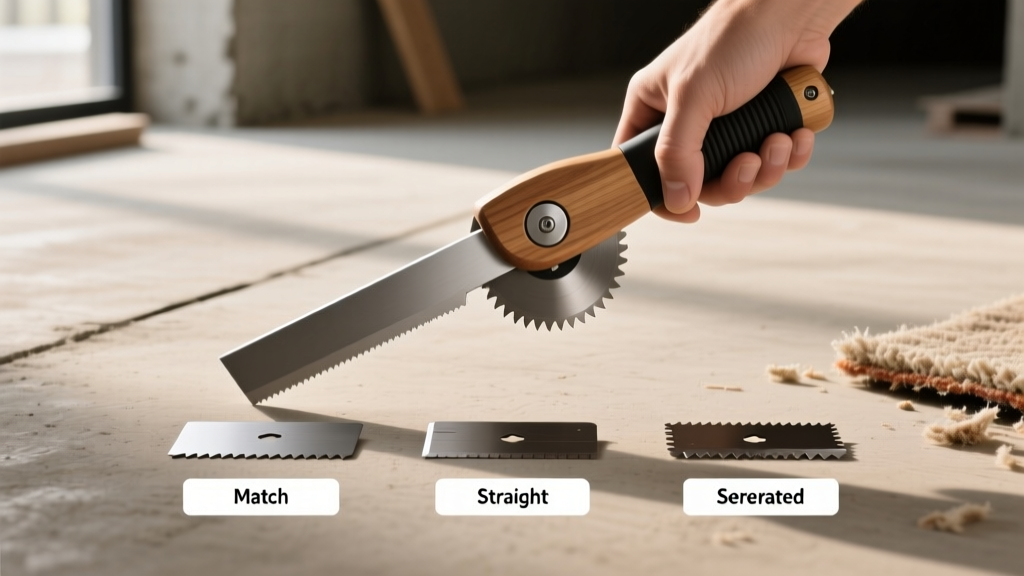
The Core Taxonomy of Carpet Cutting Tools
Selecting the correct carpet cutter requires understanding the intersection of tool mechanics and material science. A carpet cutter is not a single universal implement; it is a category of specialized instruments designed to sever complex composite materials—face fibers, primary backing, latex adhesive, and secondary backing—without causing delamination or fraying. For flooring contractors and advanced DIYers in 2026, mastering this taxonomy is the difference between a seamless installation and thousands of dollars in ruined material.
Hand Utility Knives (The Workhorses)
The standard retractable and fixed-blade utility knives remain the primary tools for rough cuts and field trimming. Modern pro-grade models feature integrated blade storage, magnetic blade retainers, and ergonomic over-mold grips designed to reduce carpal strain during high-volume commercial installs. Fixed-blade models offer superior rigidity for cutting through dense, high-latex commercial backings, while retractable models prioritize safety on active job sites.
Wall Trimmers and Offset Cutters
Wall trimmers, such as the industry-standard offset carpet trimmers, feature a specialized guide wheel or flat plate that rides along the baseboard or tack strip. This geometry forces the blade into the exact corner where the floor meets the wall, allowing installers to trim the carpet to within 1/16th of an inch of the drywall. These tools almost exclusively utilize straight or slightly concave blades to prevent the blade tip from gouging the subfloor or drywall.
Power Carpet Cutters
For large-scale commercial projects involving thick, high-density broadloom, manual cutting introduces severe fatigue and inconsistency. Oscillating and rotary power carpet cutters utilize motorized blades to slice through heavy polypropylene and jute backings with zero physical drag. These tools are strictly categorized for professional use, requiring specialized training to manage the torque and prevent over-cutting the underlying padding or subfloor.
Blade Metallurgy and Edge Geometry
The cutter handle is only half the equation; the blade dictates the cut quality. Blade selection must be matched to the specific carpet fiber and backing composition.
- High-Carbon Steel (HCS): The default for most residential and commercial installations. HCS blades take a razor-sharp edge and maintain it well against abrasive synthetic fibers like nylon. However, they are prone to oxidation if left in humid environments.
- Stainless Steel (SS): Less common and slightly softer than HCS, but essential when cutting carpets with high-moisture backings or when working in marine and RV applications where rust contamination is unacceptable.
- Hook Blades: The curved edge catches the secondary backing and slices through the latex layer via a pulling motion. This is the mandatory geometry for back-cutting tufted carpets to avoid severing the face yarns.
- Straight Blades: Used for top-down cutting, trimming edges, and precise wall-line cuts. They rely on a pushing or slicing motion and are ideal for softer fibers and woven constructions.
- Serrated Blades: Featuring a micro-toothed edge, these are engineered specifically for natural fibers like wool and dense jute backings. The serrations act like a saw, gripping and cutting fibrous materials that would otherwise fold or bind against a smooth straight blade.
Material Matching Matrix: Fiber, Backing, and Blade
The Carpet and Rug Institute emphasizes that installation failures often stem from improper tool-to-material matching. Use the following decision matrix to select your carpet cutter setup based on the specific material taxonomy.
| Carpet Material & Construction | Primary Backing Type | Recommended Blade Geometry | Optimal Tool Type | Cutting Technique & Frequency |
|---|---|---|---|---|
| Nylon 6,6 (Cut Pile) | Synthetic Polypropylene | Hook Blade (HCS) | Heavy-Duty Fixed Utility | Back-cut along tuft rows. Change blade every 30 linear feet. |
| Wool (Loop Pile / Berber) | Woven Jute | Serrated or Ultra-Sharp Straight | Wall Trimmer / Utility | Back-cut carefully to avoid snipping loops. Change blade every 10 feet. |
| Polyester (Cut Pile) | Felt or Synthetic | Straight Blade (HCS) | Standard Retractable Utility | Top-down or back-cut. Standard blade life (40+ feet). |
| Polypropylene / Olefin | High-Latex Synthetic | Hook Blade (Stainless or HCS) | Fixed Utility / Power Cutter | Low-friction back-cut to prevent melting the latex backing. |
| Commercial Broadloom (High Density) | PVC or Heavy Latex | Heavy-Duty Hook | Power Cutter or Fixed Knife | Requires high downward force; score and snap method recommended. |
Pro-Level Selection Framework: Top Models for 2026
When investing in a carpet cutter, durability and blade-change ergonomics are the primary ROI drivers. The following models represent the current professional standard.
Roberts 10-805 Heavy-Duty Carpet Knife
The Roberts 10-805 remains the undisputed workhorse for back-cutting broadloom. Its die-cast aluminum body withstands the extreme lateral torque required to pull a hook blade through dense commercial latex backings. The integrated thumb screw allows for rapid blade changes without requiring a secondary tool, a critical time-saver on large commercial bids.
Crain 414 Cushion-Back Carpet Trimmer
For precision wall-line trimming, the Crain 414 is unmatched. Its offset blade holder and adjustable guide wheel allow the installer to trim the carpet perfectly flush against the tack strip without damaging the drywall. The 15-degree ergonomic grip angle significantly reduces wrist extension, mitigating the risk of repetitive strain injuries during long perimeter cuts.
Roberts 10-250 Power Carpet Cutter
For high-volume contractors installing thick, high-density commercial goods, the Roberts 10-250 oscillating power cutter eliminates manual fatigue. It slices through heavy PVC and jute backings cleanly, leaving a factory-straight edge that is essential for heat-tape seaming. While the initial investment is high, the reduction in labor hours and material waste yields a positive ROI within the first 2,000 square feet of installation.
Edge Cases and Failure Modes in Carpet Cutting
Even with the correct tool, specific failure modes can compromise the installation. Recognizing these edge cases is a hallmark of master-level expertise.
When cutting from the back, applying excessive downward pressure with a hook blade can sever the primary backing from the secondary backing, especially in older or poorly manufactured tufted carpets. This delamination creates a weak point that will eventually unravel at the seam. Always use a sharp blade and rely on the slicing motion of the hook rather than brute downward force.
Fraying and Loop Snipping in Berber
Loop-pile carpets (Berber) are notoriously unforgiving. If a dull blade or an incorrect hook geometry catches a face-fiber loop during a back-cut, it will pull and snip the loop, creating a visible run or bald spot on the face of the carpet. Rule: Never use a hook blade on the face side of a Berber carpet, and always use a freshly snapped serrated or straight blade when trimming the edges from the top.
Blade Binding in Thick Padding
When trimming carpet that is already laid over a thick, high-density urethane pad (such as an 8lb rebond), the blade can bind in the foam, causing the cut line to wander. To prevent this, use a straight blade and employ a 'score and snap' technique, or lift the carpet edge slightly off the pad using a specialized lifting tool before making the final trimming pass.
Ergonomic and Safety Protocols
Flooring installation is a high-risk trade for musculoskeletal disorders. According to guidelines on hand and power tools published by OSHA, repetitive gripping and forceful wrist deviation are primary catalysts for carpal tunnel syndrome and tendonitis.
To mitigate these risks when operating a carpet cutter:
- Maintain Neutral Wrist Posture: Select tools with offset or contoured grips that allow your wrist to remain straight while the blade engages the floor.
- Rotate Tools: Alternate between a standard utility knife for field cuts and a wall trimmer for perimeter cuts to vary the muscle groups engaged.
- Implement Strict Blade Changing Schedules: A dull blade requires up to 40% more physical force to pull through latex backing. Changing your blade every 30 linear feet is not just about cut quality; it is a critical ergonomic intervention.
- Use Retractable Models for Transit: Always retract the blade or use a hard sheath when moving between rooms to prevent severe lacerations from tripping or falling on an exposed fixed blade.
By treating the carpet cutter not as a simple knife, but as a highly specialized material-processing tool, installers can dramatically reduce waste, accelerate project timelines, and deliver flawless, long-lasting flooring installations.