AC Ratings and Specs for Laminate Flooring Floors Decoded
Decode AC ratings, core density, and moisture specs for laminate flooring floors. Learn exact EN 13329 standards to choose the right product.
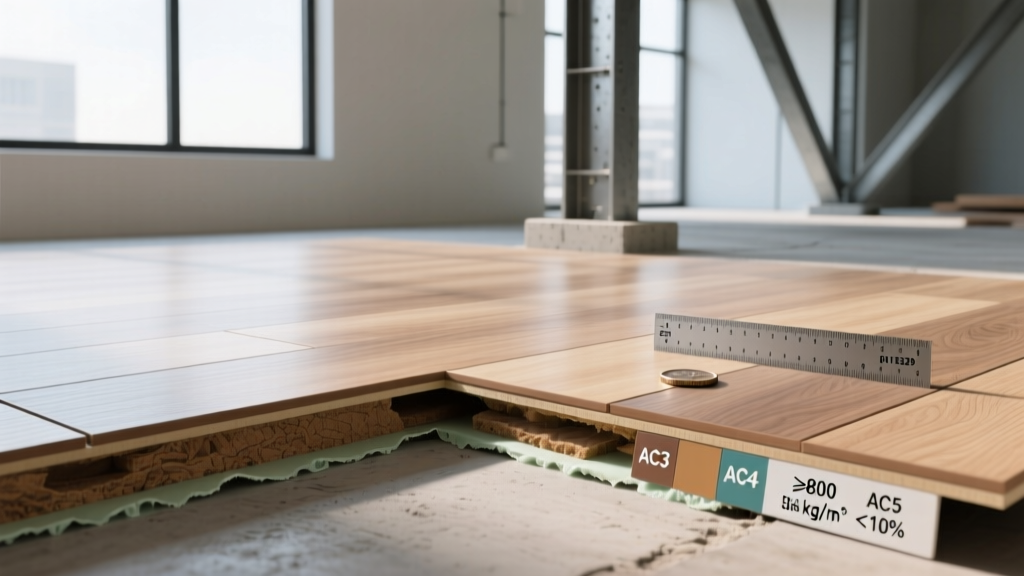
The Technical Anatomy of Laminate Flooring Floors
Selecting the right laminate flooring floors requires moving beyond aesthetic preferences to evaluate structural performance ratings. Unlike solid hardwood, laminate is an engineered composite. Its durability is dictated by four distinct layers: the melamine backing (stabilizing layer), the high-density fiberboard (HDF) core, the decorative photographic paper, and the aluminum oxide (Al2O3) wear layer. Understanding how these layers interact under standardized testing protocols is critical for preventing premature failure, joint separation, and moisture damage.
- Minimum Residential Core Density: 800 kg/m³ (HDF)
- Standard Thickness Swelling (EN 13329): ≤ 18% after 24h immersion
- Premium Water-Resistant Swelling: ≤ 5% with hydrophobic edge sealing
- Formaldehyde Emission Standard: CARB Phase 2 (< 0.09 ppm)
Decoding the AC Rating System
The Abrasion Class (AC) rating, established by the European Producers of Laminate Flooring (EPLF), is the definitive metric for surface wear resistance. The rating is determined by the Taber abrasion test, which measures how many revolutions of abrasive sandpaper are required to wear through the aluminum oxide layer to the decorative paper beneath. When comparing laminate flooring floors, the AC rating must align with the specific traffic load of the installation environment.
| AC Rating | Use Class | Taber Test Revs | Ideal Application |
|---|---|---|---|
| AC1 | Class 21 | ≥ 900 | Bedrooms, closets (barefoot/slipper traffic) |
| AC2 | Class 22 | ≥ 1,500 | Living rooms, dining rooms |
| AC3 | Class 23/31 | ≥ 2,500 | Kitchens, hallways, small home offices |
| AC4 | Class 32 | ≥ 4,000 | Boutiques, cafes, heavy-use households |
| AC5 | Class 33 | ≥ 6,500 | Department stores, public lobbies |
| AC6 | Class 34 | ≥ 8,500 | Industrial spaces, extreme abuse zones |
Beyond AC Ratings: Critical Core Density & Thickness Specs
While the AC rating protects the surface, the structural integrity of laminate flooring floors relies entirely on the core board. Manufacturers use either Medium-Density Fiberboard (MDF) or High-Density Fiberboard (HDF). For any flooring application, MDF (typically 600–700 kg/m³) is insufficient; it lacks the tensile strength to support mechanical locking systems under dynamic loads.
HDF Core Density Requirements
Specify HDF cores with a minimum density of 800 kg/m³. Premium European and North American manufacturers often compress cores to 850–950 kg/m³. This higher density achieves two critical outcomes:
- Joint Integrity: A 900 kg/m³ core allows the milled tongue-and-groove locking mechanisms (such as Uniclic or Välinge 5G) to withstand up to 400 N/mm² of tensile stress without fracturing.
- Subfloor Telegraphing Prevention: Denser cores resist bending over minor subfloor imperfections, preventing the 'spongy' feel and eventual joint separation that plagues low-density boards.
Thickness Tolerances and Impact Resistance
Total board thickness ranges from 6mm to 14mm, with 8mm and 12mm being the industry standards. However, thickness alone does not dictate impact resistance. The impact resistance is measured via the EN 13329 large ball drop test. A 12mm board with an 800 kg/m³ core will reliably pass the >20 Newton impact requirement, whereas a 12mm board with a 650 kg/m³ core may fracture under the same force. Always verify the density specification alongside the thickness.
Moisture Resistance Specifications: Decoding the Marketing
The terms 'waterproof' and 'water-resistant' are heavily marketed, but only standardized testing reveals the actual performance of laminate flooring floors in moisture-prone environments. The governing standard for moisture evaluation is the EN 13329 Thickness Swelling (TS) test, which measures the percentage of board expansion after 24 hours of complete water immersion.
Expert Warning: Standard laminate flooring floors have a TS rate of 12% to 18%. If a manufacturer claims a product is 'waterproof' but cannot provide a third-party TS test result of ≤ 8%, the core will inevitably swell and destroy the locking joints upon prolonged water exposure.
As of 2026, true water-resistant laminate achieves a TS rate of ≤ 5%. This is accomplished not just through resin-treated HDF cores, but via hydrophobic edge-sealing technologies. Look for specifications that explicitly mention polyurethane or paraffin wax edge coatings applied during the milling process, which prevent water ingress at the most vulnerable point: the plank seams.
Verifying Emissions and Indoor Air Quality
The HDF core is bound using urea-formaldehyde or melamine-urea-formaldehyde resins. Off-gassing is a primary health concern in enclosed spaces. To ensure safe indoor air quality, require laminate flooring floors that carry independent certifications rather than relying solely on manufacturer claims.
- CARB Phase 2 / EPA TSCA Title VI: The baseline legal requirement in North America, limiting formaldehyde emissions to < 0.09 ppm for HDF.
- FloorScore: Administered by SCS Global Services, this certification tests for a broader spectrum of Volatile Organic Compounds (VOCs) and ensures compliance with strict indoor air quality criteria.
- NALFA Certification: The North American Laminate Flooring Association provides a rigorous third-party testing seal that verifies surface wear, moisture resistance, and structural integrity against ANSI/NALFA LF-01 standards.
Decision Matrix: Matching Specs to Room Environments
Use the following matrix to specify the exact performance ratings required for different installation zones. Over-specifying wastes budget, while under-specifying guarantees premature replacement.
| Environment | Min. AC Rating | Core Density | Moisture Spec (TS) | Recommended Thickness |
|---|---|---|---|---|
| Master Bedroom | AC2 / AC3 | ≥ 800 kg/m³ | ≤ 18% (Standard) | 8mm |
| Kitchen / Mudroom | AC4 | ≥ 850 kg/m³ | ≤ 8% (Hydrophobic edges) | 10mm - 12mm |
| Commercial Retail | AC5 | ≥ 900 kg/m³ | ≤ 8% (Sealed joints) | 12mm+ |
| Below-Grade Basement | AC3 / AC4 | ≥ 850 kg/m³ | ≤ 5% (Full PU edge seal) | 12mm (with 6mil vapor barrier) |
Final Specification Checklist for Procurement
Before approving a purchase order for laminate flooring floors, verify the technical data sheet (TDS) includes the following explicit data points:
- AC Rating & Class: Must state both (e.g., AC4 / Class 32).
- Core Type & Density: Must specify HDF and exact kg/m³.
- Thickness Swelling (TS): Must cite the EN 13329 percentage.
- Locking System Patent: Identify the licensed mechanism (e.g., Välinge 5G, Uniclic) to ensure replacement board compatibility.
- Third-Party Certifications: Require proof of FloorScore and NALFA/EPLF compliance.
By mandating these exact specifications, you eliminate the risk of installing substandard composite boards that fail under real-world environmental and mechanical stressors.