Terrazzo Floor Lifespan: Durability Analysis & Maintenance Costs
Analyze the lifespan, durability, and lifecycle costs of cementitious versus epoxy terrazzo floors, including failure modes and maintenance specs.
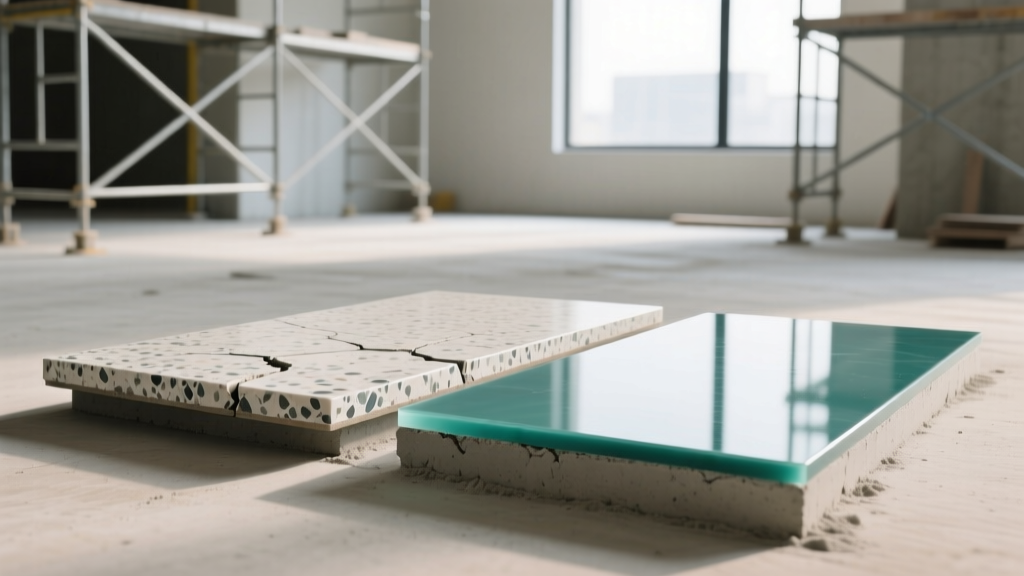
The Core Anatomy of Terrazzo Durability
When architects and facility managers specify a terrazzo floor, the primary value proposition extends far beyond its monolithic aesthetic; it is a lifecycle investment. A properly installed cementitious terrazzo system routinely exceeds 75 to 100 years of service life, frequently outlasting the structural integrity of the building itself. However, this exceptional longevity is not inherent to the material alone—it is the result of precise assembly engineering, binder chemistry, and aggregate selection.
At a structural level, traditional sand-cushion cementitious terrazzo is a multi-layer composite. It begins with the structural concrete slab, followed by a vapor barrier, a 1-inch sand layer, a cleavage membrane (usually asphalt-saturated felt), and a wire mesh reinforcement. This isolation assembly is critical: it decouples the terrazzo topping from the concrete slab's natural shrinkage and deflection, preventing telegraphed cracking. The topping itself consists of a Portland cement binder mixed with carefully graded marble, quartz, or glass aggregates, poured to a thickness of 1/2-inch to 3/4-inch and ground down to expose the aggregate matrix.
Standard cementitious terrazzo achieves a compressive strength of approximately 5,000 to 7,000 PSI after 28 days of curing, making it highly resistant to point-load indentation from heavy commercial equipment or rolling loads.
Lifespan Comparison Matrix: System Types
Not all terrazzo systems share the same lifecycle profile. The choice between cementitious, epoxy, and tile formats dictates the floor's ultimate lifespan, moisture tolerance, and restoration potential. The National Terrazzo and Mosaic Association (NTMA) categorizes these systems based on their binder chemistry and underbed assembly.
| System Type | Thickness | Expected Lifespan | Moisture Tolerance | Installed Cost (per sq.ft.) |
|---|---|---|---|---|
| Sand-Cushion Cementitious | 1/2" - 3/4" | 75 - 100+ Years | High | $18.00 - $28.00 |
| Bonded Cementitious | 1/2" | 50 - 75 Years | Moderate | $14.00 - $22.00 |
| Epoxy Terrazzo | 1/4" - 3/8" | 30 - 50 Years | Very Low (Prone to Failure) | $12.00 - $24.00 |
| Precast Terrazzo Tile | 3/8" - 1/2" | 20 - 40 Years | High | $9.00 - $16.00 |
Real-World Failure Modes and Edge Cases
Despite its durability, terrazzo is not immune to failure. Most catastrophic failures occur not from surface wear, but from subsurface environmental conditions or installation errors.
Epoxy Delamination and Saponification
Epoxy terrazzo is highly valued for its thin profile, rapid curing time, and vibrant color options. However, it is completely impermeable. If applied over a concrete slab with excessive Moisture Vapor Transmission (MVT), the hydrostatic pressure will break the chemical bond at the substrate interface. Furthermore, alkaline moisture reacting with the epoxy resin causes saponification—a chemical breakdown that turns the adhesive layer into a soapy substance, leading to massive delamination. According to ASTM F2170 testing standards, relative humidity (RH) in the concrete slab must not exceed 75% to 80% before epoxy application. If a slab fails this test, a cementitious system or a specialized moisture-mitigation primer is mandatory.
When specifying metal divider strips in cementitious terrazzo, avoid mixing metals. Using aluminum strips in conjunction with zinc or brass in the presence of moisture can trigger galvanic corrosion, causing the aluminum to oxidize, expand, and spall the surrounding terrazzo matrix.
Aggregate Pop-Outs and Differential Wear
The Mohs hardness scale dictates how well a terrazzo floor will wear over decades of foot traffic. Traditional marble aggregates rank at 3 to 4 on the Mohs scale. If a designer specifies recycled glass (Mohs 5.5 to 6.5) or quartz (Mohs 7) in a soft cementitious binder, the binder will wear away faster than the aggregate. This differential wear leaves hard glass or quartz shards protruding above the surface, eventually leading to "pop-outs" where the aggregate is plucked from the matrix by rolling loads. For high-traffic commercial zones utilizing glass aggregates, an epoxy or polyacrylate binder is required to match the aggregate's structural integrity.
Decade-by-Decade Maintenance & Restoration Costs
The General Services Administration (GSA) notes that historic terrazzo floors can be fully restored to their original luster, a feat impossible with vinyl or laminate. However, improper maintenance accelerates degradation.
- Daily/Weekly (Years 1-10): Requires only dust mopping and damp mopping with a strictly neutral pH cleaner (pH 7.0). Acidic cleaners (pH below 6) will etch the calcium carbonate in marble aggregates, leaving permanent dull spots. Annual cost: $0.15 - $0.30 per sq.ft.
- Mid-Lifecycle Burnishing (Years 10-25): High-speed burnishing with a diamond-impregnated pad maintains the polish without removing material. This closes micro-pores and reduces staining. Annual cost: $0.40 - $0.80 per sq.ft.
- Full Restoration (Years 40+): If the floor becomes heavily scratched, etched, or stained, diamond grinding is required. Contractors use a sequence of metal-bonded diamonds (from 40-grit to remove lippage, up to 3000-grit resin diamonds for polishing), followed by an impregnating sealer. Cost: $4.50 - $8.50 per sq.ft. This process removes less than 1/16-inch of material, meaning a 1/2-inch terrazzo floor can be fully restored 5 to 8 times over its century-long lifespan.
Decision Framework: Specification Guidelines
Use this framework to determine the optimal terrazzo system for your specific environmental and budgetary constraints.
Specify Sand-Cushion Cementitious Terrazzo When:
- The project is a ground-level commercial space, airport terminal, or hospital where a 75+ year lifecycle is required.
- The concrete subfloor is new and has not fully cured or dried to epoxy standards.
- The design incorporates heavy, localized point loads (e.g., heavy machinery, dense shelving units).
Specify Epoxy Terrazzo When:
- The project is a multi-story renovation where floor height buildup and weight are strictly limited (epoxy is 1/4" thick and significantly lighter).
- The design requires intricate, highly detailed patterns with tight divider strip spacing and vibrant, non-traditional colors.
- The concrete slab has been verified via ASTM F2170 to have an RH below 75%.
Specify Terrazzo Tile When:
- The budget cannot accommodate the $15+ per sq.ft. installed cost of poured-in-place systems.
- The area is a residential interior or low-traffic boutique retail space where grout lines and modular sizing are aesthetically acceptable.
"The true cost of terrazzo is never measured at the point of installation. When you amortize a $22 per square foot cementitious terrazzo floor over an 80-year lifespan, the annualized cost drops to pennies, easily undercutting the third or fourth replacement cycle of commercial carpet or luxury vinyl tile." — Commercial Flooring Lifecycle Analysis Report