Carpet Replacement Cost Guide: Scenario Matching by Room
Discover accurate carpet replacement cost breakdowns by room and scenario. Match the right carpet fiber, pad, and budget to your specific home needs.
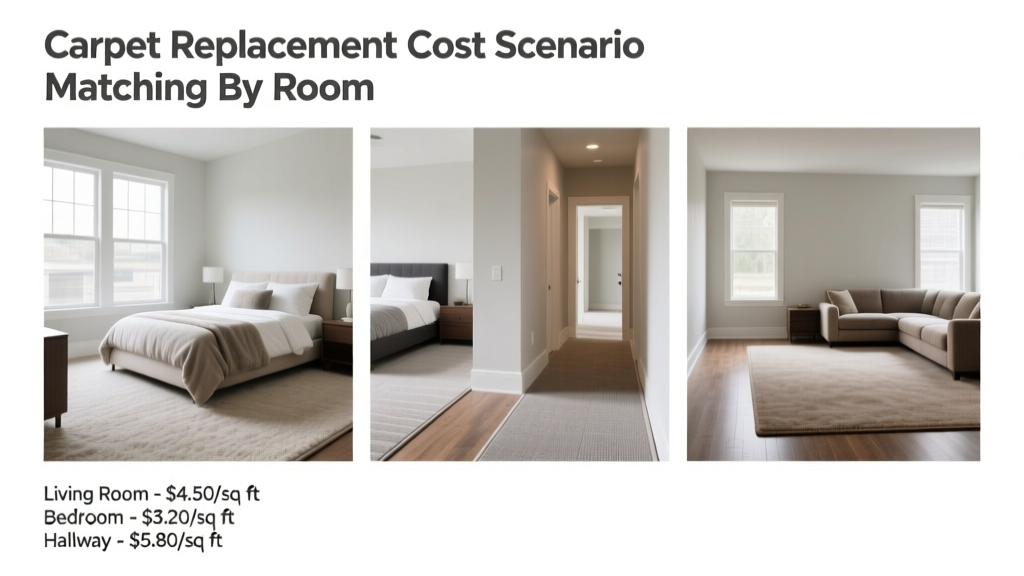
The Core Variables Driving Carpet Replacement Cost
Calculating an accurate carpet replacement cost requires moving beyond simple square-footage averages. The final price is dictated by the intersection of material face weight, pad density, subfloor condition, and room-specific labor requirements. In the current market, fully installed carpet replacement ranges from $3.50 to $11.00 per square foot, but applying a blanket average to your project will lead to budget shortfalls or overpayment.
To achieve the best application fit, you must deconstruct the cost into its three primary components:
- Carpet Material: $1.00 to $5.50 per square foot. Budget options (30 oz. polyester) sit at the lower end, while premium 60 oz. solution-dyed nylon or wool blends command the higher tier.
- Carpet Padding: $0.50 to $1.50 per square foot. The critical metric here is density, not thickness. An 8-pound rebond polyurethane pad outperforms a thicker 4-pound foam pad in high-traffic scenarios.
- Labor and Installation: $1.00 to $2.50 per square foot. This fluctuates based on room complexity, stair counts, and the need for furniture relocation.
Scenario Matching: Cost Breakdown by Room Application
Matching the right carpet specification to the room's functional demands is the most effective way to optimize your carpet replacement cost. Over-specifying a guest bedroom wastes capital, while under-specifying a family room guarantees premature matting and early replacement.
| Room Scenario | Traffic Profile | Optimal Fiber & Weight | Pad Specification | Estimated Installed Cost (per sq. ft.) |
|---|---|---|---|---|
| Master Bedroom | Low / Barefoot | PET Polyester, 45-55 oz. | 1/2", 6lb Rebond | $4.50 - $6.50 |
| Family / Living Room | High / Multi-directional | Triexta or Nylon 6,6, 55-65 oz. | 7/16", 8lb Rebond | $6.50 - $9.00 |
| Basement (Below Grade) | Variable / Moisture Risk | Solution-Dyed Nylon, 40-50 oz. | Synthetic / Rubber | $5.50 - $8.00 |
| Home Office (Rolling Chairs) | Concentrated / Shear | Low-Pile Nylon, 40 oz. | 1/4", 8-10lb Firm | $5.00 - $7.50 |
| Stairs & Hallways | Extreme / Edge Wear | Tightly Twisted Nylon, 50+ oz. | 1/4" to 3/8", 8lb | $8.00 - $12.00 (Labor heavy) |
High-Traffic vs. Low-Traffic: Fiber & Pad Selection Framework
The longevity of your carpet is determined by how well the fiber and pad resist compression and abrasion. According to the Carpet and Rug Institute (CRI), selecting the correct pad is just as critical as the carpet itself for maintaining warranty compliance and texture retention.
Fiber Performance Matrix
- Nylon 6,6: The gold standard for resilience. It recovers from compression better than any synthetic. Look for brands like Shaw Anso nylon. Best for hallways and stairs. Expect to pay $3.00 - $5.00/sq ft for the material alone.
- Triexta (PTT): Popularized by Mohawk SmartStrand, Triexta offers exceptional stain resistance built into the fiber core, not just as a topical coating. Ideal for homes with pets and young children. Material cost: $2.50 - $4.50/sq ft.
- PET Polyester: Offers brilliant color clarity and excellent stain resistance but lacks the structural memory of nylon. It will mat down in high-traffic lanes within 3 to 5 years. Strictly limit this to bedrooms or low-use guest rooms. Material cost: $1.00 - $2.50/sq ft.
Hidden Costs: Removal, Subfloor Prep, and Transitions
When budgeting for carpet replacement, the line-item costs often omit the necessary preparatory work. Failing to account for these variables is the primary cause of budget overruns.
Old Material Removal and Disposal
Tearing out and hauling away existing carpet and pad typically costs $1.00 to $1.50 per square foot. If your existing carpet is glued down (common in commercial spaces or older basement installations), scraping the adhesive can add $0.50 to $1.00 per square foot to the labor cost.
Subfloor Remediation
Carpet is unforgiving of subfloor imperfections; dips and humps will telegraph through the material and cause premature wear on the backing.
- Minor Squeaks: Securing loose OSB or plywood to joists with 2-inch deck screws ($50 - $100 per room).
- Leveling Compound: For concrete slabs with dips greater than 1/8 inch over 10 feet, applying a cementitious self-leveler (like Henry 565 FloorPro) costs $1.50 to $3.00 per square foot.
- Tack Strip Replacement: If the existing wood tack strips are water-damaged or stripped, replacement costs $3.00 to $5.00 per linear foot.
Decision Flowchart: When to Replace vs. Restore
Before committing to a full carpet replacement cost, evaluate the existing floor against these specific failure modes. Data from industry cost guides suggests that targeted restoration can save thousands if the underlying structure is intact.
- Assess the Padding: Pull up a corner of the carpet in the highest traffic area. If the pad is crumbling, holds a persistent odor, or shows dark moisture stains, replacement is mandatory. Cleaning will not fix a degraded pad.
- Check for Delamination: Grab the carpet face and pull it horizontally. If the primary backing separates from the secondary backing (a condition known as delamination), the carpet is structurally failed and must be replaced. This is common in areas exposed to repeated pet urine or improper wet cleaning.
- Evaluate Surface Stains: If the carpet is solution-dyed nylon or polyester and the stains are localized, professional hot water extraction ($0.25 - $0.50 per sq ft) or replacing a specific plank/section with a remnant is highly cost-effective.
- Analyze Matting and Crushing: If the pile in the traffic lanes is permanently crushed flat and lacks spring-back when vacuumed, the fibers have lost their structural memory. No chemical treatment will restore this; full replacement is the only application-fit solution.
"The most expensive carpet replacement is the one you have to do twice in five years because you compromised on pad density to save fifty dollars on the initial install. Match the pad density to the foot-traffic reality of the room."
Final Budgeting Strategy
To lock in an accurate carpet replacement cost, obtain three itemized quotes that separate material, pad, labor, and prep work. Require the contractor to specify the exact pad weight (e.g., 8 lb rebond) and carpet face weight (e.g., 55 oz nylon) in the contract. This prevents the common bait-and-switch where installers substitute premium showroom samples with lower-grade builder stock during the actual installation.