Carpet for Stairs: Critical Performance Specs & Ratings
Discover the exact performance specifications, density ratings, and fiber types required for carpet for stairs to prevent matting and ensure safety.
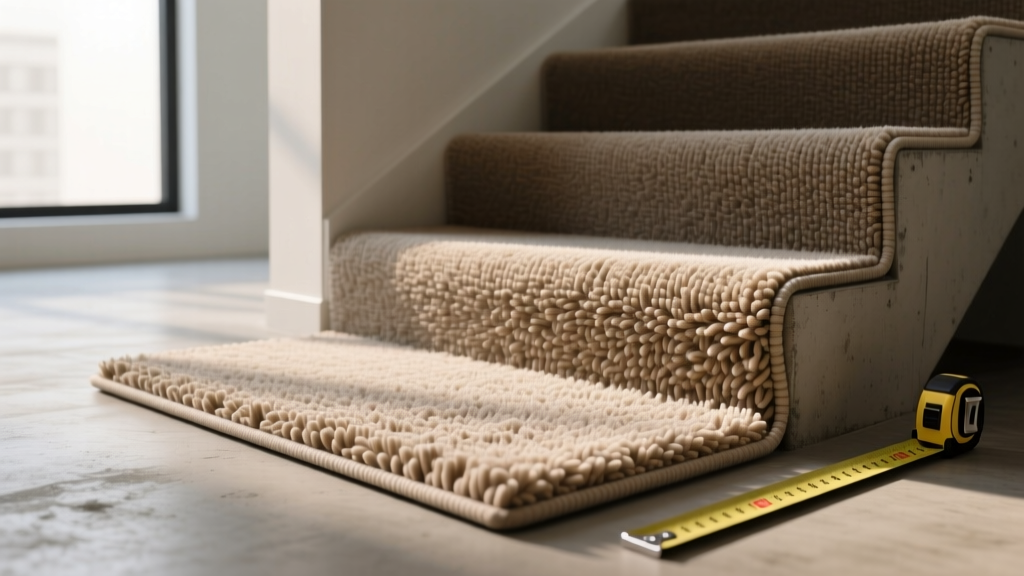
The Physics of Stair Traffic: Why Standard Carpet Fails
Staircases subject flooring to mechanical stresses that flat surfaces never experience. Every time a foot strikes a stair nosing, the carpet endures concentrated edge loading, severe shear force, and aggressive friction. While a plush, high-pile carpet might perform adequately in a low-traffic bedroom, installing it on a staircase guarantees premature matting, fiber shedding, and dangerous slip hazards. According to the National Safety Council, falls on stairs are a leading cause of home injuries, making the structural specifications of stair carpeting a critical safety consideration, not just an aesthetic one.
To select the correct carpet for stairs, buyers must ignore marketing terms like "luxurious" or "soft" and instead evaluate strict performance metrics: face weight, density, pile height, twist level, and fiber chemistry. This guide breaks down the exact engineering specifications required for stair-grade carpeting.
The Stair Carpet Specification Matrix
Use the following baseline metrics when evaluating carpet samples. Any material falling outside these parameters will likely fail within 24 to 36 months under standard residential stair traffic.
| Specification | Minimum Requirement | Optimal Target | Failure Threshold |
|---|---|---|---|
| Face Weight | 35 oz/yd² | 40 - 50 oz/yd² | < 30 oz/yd² (Sheds rapidly) |
| Density Rating | 3,000 | 4,000 - 5,000+ | < 2,500 (Mats and crushes) |
| Pile Height | 1/4 inch | 3/8 inch | > 3/4 inch (Trip hazard) |
| Twist Level (TPI) | 4 TPI | 5 - 7 TPI | < 3 TPI (Fraying edges) |
| Padding Thickness | 1/4 inch | 3/8 inch max | > 7/16 inch (Void warranty) |
Deconstructing Density: The Most Critical Metric
Face weight (the ounces of fiber per square yard) is the most commonly advertised metric, but it is highly misleading when evaluated in isolation. A 60 oz face weight carpet with a 1-inch pile height will perform significantly worse on stairs than a 40 oz carpet with a 3/8-inch pile height. The true measure of stair durability is density.
The Density Calculation Formula
Carpet density is calculated using the following industry-standard formula:
Density = (Face Weight in oz/yd² × 36) ÷ Pile Height in inches
Real-World Example: You are evaluating a tight saxony carpet for your stairs. The spec sheet lists a 45 oz face weight and a 3/8-inch (0.375") pile height.
- Step 1: 45 × 36 = 1,620
- Step 2: 1,620 ÷ 0.375 = 4,320 Density
A density rating of 4,320 is excellent for stairs. The fibers are packed tightly enough to resist the crushing force of heel strikes on the stair nosing. Always demand the density rating from the manufacturer; if they only provide face weight, measure the pile height with a ruler and calculate it yourself.
Fiber Chemistry: Why Nylon 6,6 Dominates Stairs
The molecular structure of the carpet fiber dictates its resilience—its ability to bounce back after being crushed. On stairs, resilience is non-negotiable.
- Nylon 6,6 (The Gold Standard): Constructed with two polymer strands, Nylon 6,6 features strong hydrogen bonding that gives it superior memory and abrasion resistance. Brands utilizing solution-dyed Nylon 6,6 (such as Anso or Stainmaster) will maintain their structural integrity on stair nosings for a decade or more.
- Nylon 6: Slightly less resilient than 6,6 and more prone to heat-setting loss, but still acceptable for moderate-traffic stairs if the twist level exceeds 5 TPI.
- PET (Polyester): While PET offers excellent stain resistance and vibrant color options, it lacks molecular resilience. PET carpet installed on stairs will almost invariably mat down and "ugly out" within two years, regardless of the face weight.
- Wool: Naturally resilient and highly durable, but expensive. If choosing wool for stairs, ensure it is a tightly woven, low-pile Wilton or Axminster construction, not a plush cut-pile.
⚠️ Warning: The Plush Carpet Trap
Never install plush, frieze, or high-pile shag carpets on stairs. Beyond the rapid matting, thick piles alter the effective rise and run of the stair tread. When a foot sinks deeply into a plush carpet, the user's center of gravity shifts unpredictably, significantly increasing the risk of a misstep and fall.
Safety Ratings and Slip Resistance Standards
While carpet inherently provides more traction than hard surface flooring, the transition point at the stair nosing is a critical vulnerability. The ASTM International standard D2047 measures the Static Coefficient of Friction (SCOF) for floor surfaces. While most cut-pile carpets easily exceed the 0.5 SCOF threshold required for slip resistance, the padding compression at the stair edge can cause the foot to slip off the nosing.
To mitigate this, commercial and high-end residential stair installations utilize stair nosing profiles or tightly secured metal stair rods. Furthermore, enclosed stairwells often suffer from poor ventilation. When selecting carpet for these areas, verify that the product meets low-VOC emissions standards, such as the Carpet and Rug Institute's Green Label Plus, to maintain indoor air quality, as noted by the EPA's indoor air quality guidelines.
Installation Specifications: Padding and Tack Strips
The best stair carpet will fail if the underlying installation specifications are ignored. The Carpet and Rug Institute (CRI) sets strict guidelines for cushion thickness, which are frequently violated by inexperienced installers on staircases.
The Padding Rule
For stairs, padding must be a maximum of 3/8 inch thick with a minimum density of 8 lbs/ft³. Synthetic felt or high-density rebond pads are the only acceptable materials. Standard 1/2-inch waffle rubber or thick memory foam pads will compress entirely under heel strikes, causing the carpet to bottom out, stretch, and eventually pull away from the tack strips.
Tack Strip Placement and Wrapping Techniques
Tack strips on stairs must be installed exactly 1/2 inch away from the stair nosing (the edge of the tread). This precise gap allows the carpet to be folded tightly over the edge without bulging. There are two primary installation methods:
- The Hollywood Wrap: The carpet is wrapped tightly around the stair nosing and stapled or tucked directly under the nosing lip. This provides the tightest fit, maximizes safety, and is required for most modern stair warranties.
- The Waterfall Method: The carpet goes over the edge of the tread and drops straight down to the next tread without wrapping under the nosing. While faster to install, it leaves the carpet edge vulnerable to peeling and creates a slightly looser fit on the nosing.
Decoding Stair-Specific Warranties
Manufacturers routinely exclude stairs from standard wear warranties unless specific conditions are met. Before purchasing, read the warranty exclusions. A carpet warranty will typically be voided on stairs if:
- The padding exceeds 3/8 inch in thickness.
- The carpet is installed using the Waterfall method instead of the Hollywood wrap (for specific low-profile styles).
- Stair runners are installed without the use of mechanical stair rods or heavy-duty edge binding.
- The pile height exceeds the manufacturer's stated maximum for stair applications (usually 3/4 inch).
By strictly adhering to these performance ratings, density calculations, and installation specifications, you ensure the carpet for stairs provides lasting durability, structural safety, and long-term aesthetic retention.