Ceramic Tiles Floor Tiles: Material Taxonomy & Selection
Master ceramic tiles floor tiles selection with our material taxonomy. Compare PEI ratings, ANSI water absorption standards, and 2026 installation costs.
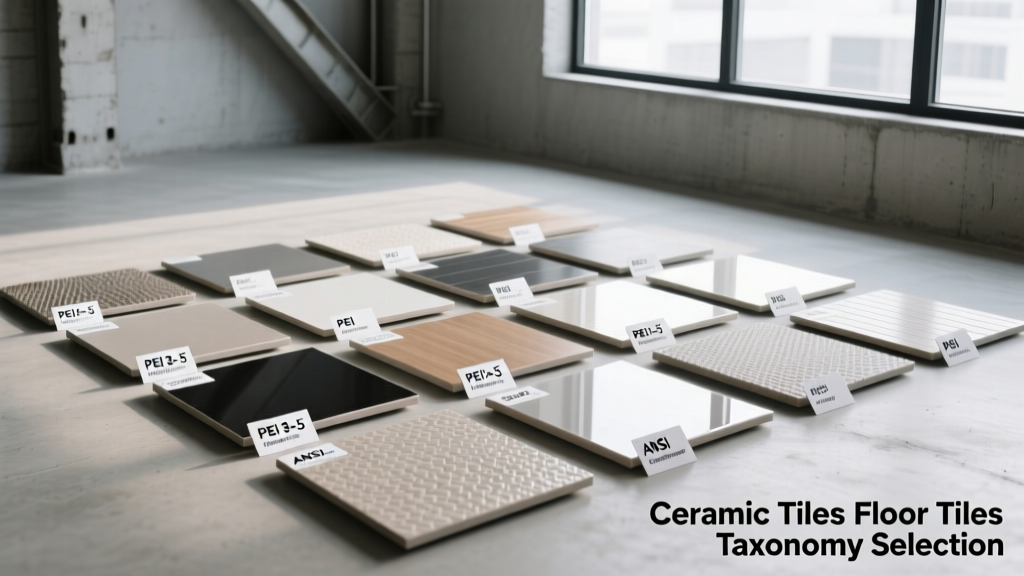
The Core Taxonomy: Porcelain vs. Non-Porcelain Ceramic
The term 'ceramic' in the flooring industry is an umbrella classification governed by Tile Council of North America (TCNA) standards, specifically ANSI A137.1. To select the correct material, you must first divide the category by water absorption rates, tested via the ASTM C373 vacuum/boil method. This single metric dictates whether a tile can survive freeze-thaw cycles, wet environments, and heavy point-loads.
| Classification | Water Absorption Rate | Material Density | Approved Floor Applications |
|---|---|---|---|
| Impervious (Porcelain) | 0.5% or less | High (Pressurized dust-pressed) | All interior/exterior, wet areas, commercial |
| Vitreous | 0.5% to 3.0% | Medium-High | Residential interior dry/light-wet areas |
| Semi-Vitreous | 3.0% to 7.0% | Medium | Residential interior dry areas only |
| Non-Vitreous | More than 7.0% | Low (Extruded or soft-pressed) | Wall-only; strictly prohibited for floors |
Surface Anatomy: Glazed, Unglazed, and Full-Body
Beyond the clay body composition, the surface treatment dictates maintenance requirements, scratch visibility, and long-term wear patterns.
Glazed Ceramic and Porcelain
Glazed tiles feature a liquid glass coating (frit) fired onto the bisque body. Modern digital inkjet printing allows for hyper-realistic stone and wood looks. However, the glaze is only 1-2mm thick. If a heavy object chips the surface, the contrasting clay body beneath becomes visible. Glazed tiles require a PEI rating (see below) to ensure the glaze can withstand foot traffic abrasion.
Unglazed and Through-Body (Full-Body) Porcelain
Unglazed tiles derive their color from mineral oxides mixed directly into the clay body before pressing. Through-body porcelain means the surface pattern and color extend entirely through the tile's thickness. If a 10mm through-body tile chips, the damage is virtually invisible because the underlying material matches the surface. This makes unglazed full-body porcelain the mandatory choice for high-impact commercial zones and heavy-residential entryways.
Double-Loaded Porcelain
A hybrid manufacturing process where a 3mm layer of highly pigmented, dense clay is pressed onto a standard 7mm base clay body. This provides the aesthetic depth of full-body tile at a 15-20% lower manufacturing cost, though deep gouges can still expose the base layer.
Decoding PEI Wear and DCOF Slip Metrics
Selecting ceramic tiles floor tiles requires matching two distinct friction and wear metrics to the specific environment. Relying solely on 'commercial grade' marketing labels leads to premature failure.
PEI Abrasion Resistance Scale
The Porcelain Enamel Institute (PEI) scale measures the surface glaze's resistance to abrasive wear, not the tile's structural breaking strength.
- PEI I: Wall use only. Zero foot traffic.
- PEI II: Residential bathrooms and bedrooms (barefoot or soft-soled footwear).
- PEI III: All residential floors, including kitchens and hallways. Standard for 90% of home installations.
- PEI IV: Light commercial (boutique retail, restaurant dining areas, hotel lobbies).
- PEI V: Heavy commercial (airports, malls, hospital corridors). Almost exclusively unglazed or heavily textured.
Slip Resistance: The Shift to DCOF
The industry has abandoned the outdated Static Coefficient of Friction (SCOF > 0.60) metric. According to the National Tile Contractors Association (NTCA), the current standard is the Dynamic Coefficient of Friction (DCOF) measured via the AcuTest method (ANSI A326.3). For level interior wet areas (bathrooms, commercial kitchens), specify tiles with a DCOF of ≥ 0.42. For ramped or sloped wet areas, require a DCOF ≥ 0.50 or specify abrasive-grit infused glazes.
Dimensional Stability, Rectification, and Lippage Control
As large-format tiles (defined by ANSI as any tile with one edge ≥ 15 inches) dominate 2026 design trends, dimensional stability becomes the primary installation variable. Fired clay shrinks unevenly in the kiln, resulting in 'caliper' (thickness) and 'facial' (length/width) variances.
Rectified Tiles: These are mechanically ground to exact dimensions after firing, allowing for tight 1/16-inch or 1/8-inch grout joints. However, rectification only addresses facial dimensions, not warpage. To mitigate warpage-induced lippage on tiles larger than 24x48 inches, installers must use mechanical lippage control systems (e.g., Tuscan Leveling System or Schluter leveling clips) and a premium large-and-heavy-tile (LHT) mortar.
Installation Material Taxonomy: Thinset and Grout
The tile is only as stable as the setting materials bonding it to the substrate. Standard dry-set mortars fail under the weight and low-porosity of modern ceramic tiles floor tiles.
| Setting Material (ANSI Standard) | Composition | Required Application |
|---|---|---|
| A118.1 (Unmodified) | Portland cement, sand, water retention | Only for porous, non-vitreous tiles over concrete. Rarely used for floors today. |
| A118.4 (Modified) | Cement + liquid latex polymers | Standard for vitreous and porcelain tiles over cement backer board or approved membranes. |
| A118.15 (Improved Modified) | High-polymer, non-sag formulation | Mandatory for Large-Format Tiles (LHT). Prevents tiles from sinking into the mortar bed during curing. |
| A118.12 (Crack Isolation) | Flexible polymer-modified mortar | Required when installing over young concrete slabs prone to shrinkage cracking. |
Grout Selection: For joints 1/8-inch or wider, use sanded cementitious grout (ANSI A118.6). For high-stain environments (kitchens, mudrooms), specify high-performance stain-resistant grout (ANSI A118.7) or 100% solids epoxy grout (ANSI A118.3), though epoxy requires specialized tooling and faster installation times.
2026 Cost Matrix: Material and Labor Variables
Pricing for ceramic tiles floor tiles varies wildly based on format size, rectification, and required substrate prep. The following matrix reflects national averages for professional installation in 2026.
| Cost Component | Standard Format (12x12 to 12x24) | Large Format (24x48 to 48x48) |
|---|---|---|
| Material (Tile) | $3.00 - $6.00 / sq. ft. | $5.50 - $12.00 / sq. ft. |
| Thinset Mortar (A118.4 vs A118.15) | $0.60 / sq. ft. | $1.25 / sq. ft. (requires deeper trowel notch) |
| Grout (Standard vs. Epoxy) | $0.40 - $1.50 / sq. ft. | $0.40 - $1.50 / sq. ft. |
| Lippage Control System | Not Required | $0.85 / sq. ft. (clips and wedges) |
| Labor (Subfloor prep & install) | $5.50 - $8.00 / sq. ft. | $8.50 - $14.00 / sq. ft. (two-person handling) |
| Total Installed Cost | $9.50 - $16.10 / sq. ft. | $16.45 - $29.25 / sq. ft. |
Selection Decision Tree: Matching Tile to Environment
Use this logic flow to finalize your material specification before purchasing:
- Scenario A: Bathroom Shower Floor (Wet, Sloped)
Selection: Impervious porcelain (≤0.5% absorption). Unglazed or textured glazed with DCOF ≥ 0.50. Format must be ≤ 2x2 inches to conform to the 1/4-inch per foot slope without cutting. Use A118.4 modified thinset and A118.3 epoxy grout. - Scenario B: Main Living Area over Radiant Floor Heating
Selection: Porcelain (superior thermal conductivity compared to natural stone or wood). Rectified edges for minimal grout joints (grout acts as a thermal break). Maximum thickness 10mm to ensure rapid heat transfer. Use A118.4 or A118.15 modified thinset rated for thermal cycling. - Scenario C: High-Traffic Mudroom with Pet Claws
Selection: Through-body (full-body) unglazed porcelain, PEI IV or V. Avoid high-gloss glazed tiles, which will show micro-scratches (scuffing) from sand and pet claws within months. Specify a matte or honed finish with a DCOF ≥ 0.42 to prevent slipping when wet from snow/rain. - Scenario D: Kitchen with Heavy Appliance Point-Loads
Selection: Any porcelain tile (PEI III minimum) with a high breaking strength (ASTM C648 ≥ 250 lbs). Ensure 95% thinset coverage during installation to prevent hollow spots that will crack when a 300-lb refrigerator is rolled across the floor.
By strictly adhering to ANSI water absorption classifications, matching PEI and DCOF metrics to the specific room's traffic profile, and pairing large-format tiles with A118.15 mortars and mechanical leveling systems, you eliminate the primary failure modes associated with ceramic floor installations.