Top Concrete Floor Epoxy Flooring Systems Reviewed 2026
Compare top concrete floor epoxy flooring systems for 2026. Deep dive into ArmorPoxy, Rust-Oleum, and Legacy Industrial specs, costs, and failure modes.
The Chemistry of Floor Epoxy Flooring Failures
When evaluating a floor epoxy flooring system for residential garages or commercial workshops, the primary cause of catastrophic failure is rarely the product itself, but rather a mismatch between the coating chemistry and the concrete substrate. The term floor epoxy flooring encompasses a wide spectrum of chemical formulations, ranging from water-based acrylic-epoxy hybrids to 100% solids cycloaliphatic amines. Understanding these distinctions is critical for preventing the three most common failure modes: osmotic blistering, hot tire pickup, and UV ambering.
Osmotic blistering occurs when moisture vapor transmission (MVT) from the concrete slab pushes through the coating. If a standard 100% solids epoxy is applied over a slab with an internal relative humidity (RH) exceeding 75%, the hydrostatic pressure will break the adhesive bond, creating bubbles that eventually pop and leave bare concrete. Hot tire pickup, conversely, is a thermal failure. Vehicle tires contain plasticizers and waxes that migrate into the coating when heated by friction. If the epoxy has a low Glass Transition Temperature (Tg), the heat softens the resin, allowing the tire to physically pull the coating off the slab upon departure.
2026 Brand Deep-Dive Matrix
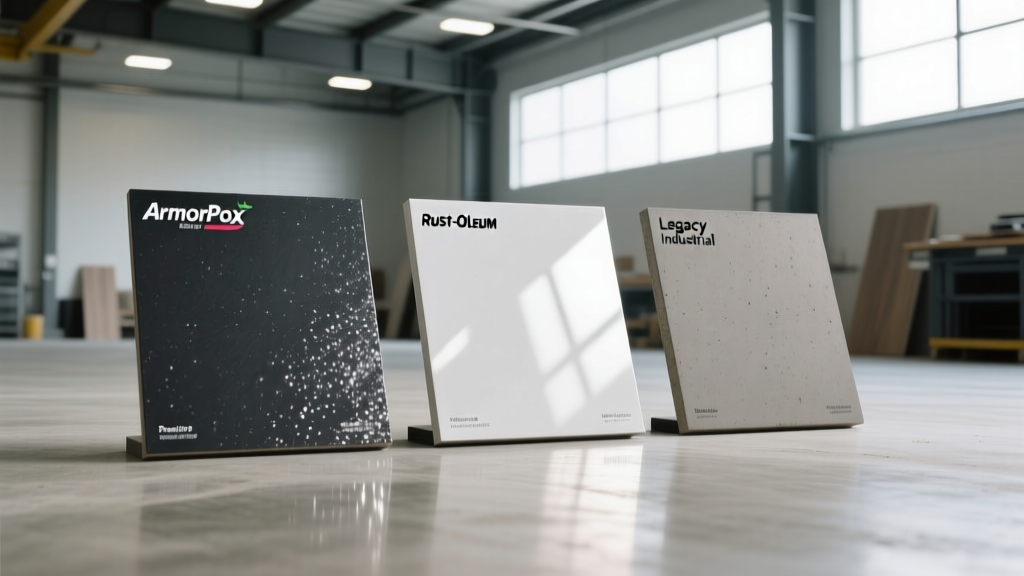
To provide actionable guidance, we have analyzed the three most prominent floor epoxy flooring systems on the market in 2026, comparing their technical data sheets (TDS), real-world dry film thickness (DFT), and installed costs.
| Brand / System | Core Chemistry | Solids Content | DFT (Mils) | Est. Cost / Sq Ft |
|---|---|---|---|---|
| Rust-Oleum RockSolid | Polycuramine (Modified Solvent) | ~65% | 3 - 4 mils | $1.20 - $1.60 |
| ArmorPoxy II System | 100% Solids Cycloaliphatic Epoxy | 100% | 10 - 12 mils | $2.40 - $3.10 |
| Legacy Industrial Nohr-S | Aliphatic Polyaspartic | 100% | 12 - 14 mils | $3.80 - $4.50 |
Rust-Oleum RockSolid: Big Box Reality Check
Rust-Oleum markets its RockSolid line as a 'polycuramine' formula, claiming it is 20 times stronger than standard epoxies. From a chemical engineering perspective, polycuramine is essentially a proprietary blend of solvent-based epoxy and polyamine hardeners designed to lower VOC emissions while maintaining a user-friendly pot life for DIYers. While it offers excellent initial gloss and deep color saturation, the solvent content means the product shrinks significantly as it cures, resulting in a very thin Dry Film Thickness (DFT) of roughly 3 to 4 mils.
Pros and Cons of RockSolid
- Pros: Extremely easy application via burst-pouch mixing; low odor compared to traditional solvent epoxies; highly accessible at big-box retailers; forgiving pot life (up to 2.5 hours at 70°F).
- Cons: Thin DFT requires a mandatory second coat for high-traffic areas; highly susceptible to hot tire pickup if the clear topcoat is omitted; requires strict acid etching or grinding, as the thin film cannot bridge substrate imperfections.
Verdict: Best suited for low-traffic residential garages, basement floors, or utility rooms where budget is the primary constraint and heavy mechanical abrasion is not expected.
ArmorPoxy II: The Commercial-Grade Benchmark
ArmorPoxy II represents the traditional gold standard for 100% solids floor epoxy flooring. Because it contains no solvents or water, what you roll onto the floor is exactly what remains after curing. This yields a robust 10 to 12 mil DFT in a single coat, providing exceptional impact resistance and structural bridging over minor concrete hairline cracks. The cycloaliphatic amine hardener used in ArmorPoxy II provides a higher Tg than standard aliphatic amines, making it highly resistant to hot tire pickup.
Installation requires mechanical preparation. Acid etching is insufficient for a 100% solids system; the concrete must be diamond ground to a Concrete Surface Profile (CSP) of 2 or 3, as defined by the International Concrete Repair Institute (ICRI) guidelines. This opens the pores of the concrete, allowing the high-viscosity epoxy to mechanically lock into the substrate.
Legacy Industrial Nohr-S: The Polyaspartic Upgrade
For environments demanding rapid return-to-service or extreme chemical resistance, Legacy Industrial’s Nohr-S polyaspartic system is the premium tier. Polyaspartics are technically aliphatic polyurea hybrids. They offer the high-build thickness and chemical resistance of 100% solids epoxy, but with a drastically accelerated cure time and inherent UV stability.
Unlike aromatic epoxies, Nohr-S is aliphatic, meaning its molecular structure does not break down under UV light. It will never yellow. Furthermore, polyaspartics can be applied in temperatures as low as 30°F and can withstand foot traffic in 4 hours and vehicle traffic in 24 hours. The primary drawback is the extremely fast pot life (15 to 30 minutes), which necessitates a two-person application crew and strict sectioning of the floor to maintain a wet edge.
Substrate Preparation & ASTM F2170 Compliance
The most expensive floor epoxy flooring system will fail if applied over a damp slab. Before purchasing any materials, you must test the slab for Moisture Vapor Transmission (MVT). The industry standard for this is ASTM F2170, which requires drilling holes into the concrete at 40% of the slab's depth and inserting in-situ relative humidity probes.
'If the in-situ RH probe reads above 75%, or if the calcium chloride test (ASTM F1869) exceeds 3 lbs per 1,000 square feet per 24 hours, a standard epoxy primer will fail. You must first apply a moisture-mitigating epoxy primer designed to penetrate and seal the capillaries.' — Standard Specification for Concrete Surface Preparation
Mandatory Preparation Steps for 100% Solids Systems
- Diamond Grinding: Use a planetary grinder with 30-grit to 40-grit metal-bonded diamonds to achieve a CSP 2-3 profile.
- Edge Detailing: Use a 7-inch hand grinder with a diamond shrouded dust guard to profile the perimeter within 1/2 inch of the wall.
- Crack Routing: V-out all structural cracks with a diamond blade, clean with compressed air, and fill with a 100% solids polyurea or epoxy crack filler.
- HEPA Vacuuming: Remove all silica dust. Do not use a standard shop-vac, as it will blow micro-dust back into the air and onto the slab.
True Cost Analysis for a 500-Square-Foot Garage
When budgeting a floor epoxy flooring project, consumers often look only at the material kit price. A comprehensive 2026 cost analysis for a standard 500-square-foot two-car garage reveals the true financial commitment required for a commercial-grade, flake-broadcast system.
- Equipment Rental: Planetary diamond grinder (1 day) + HEPA dust extractor: $220 - $280
- Moisture Mitigation Primer (if RH > 75%): $1.40 / sq ft = $700
- 100% Solids Epoxy Base Coat: $1.10 / sq ft = $550
- Vinyl Flake Broadcast (Full coverage): $0.45 / sq ft = $225
- Aliphatic Polyaspartic Clear Topcoat: $1.60 / sq ft = $800
- Consumables (spikes, rollers, mixing paddles, tape): $85
Total Estimated Cost: $2,580 to $2,640 (excluding moisture primer). This equates to roughly $5.20 per square foot for a professional-grade, UV-stable, hot-tire-resistant floor. While this is significantly higher than a $300 big-box kit, the lifecycle cost is vastly superior, as a properly installed 100% solids system with a polyaspartic topcoat will easily last 15 to 20 years without requiring recoating, whereas thin solvent-based kits typically require stripping and reapplication every 3 to 5 years in active garage environments.
For further reading on environmental compliance and VOC limitations during application, refer to the EPA guidelines on volatile organic compounds, which dictate the maximum allowable solvent content in architectural coatings across various municipalities.