Which Flooring Option Can Cost the Most? Room Guide
Discover which flooring option can cost the most. We break down ultra-premium materials room-by-room, from terrazzo to bookmatched marble.

The Anatomy of Ultra-Premium Flooring Costs
When evaluating high-end residential and commercial construction, the question of which flooring option can cost the most extends far beyond the raw material price. The ultimate cost ceiling is dictated by a triad of factors: material rarity, structural preparation requirements, and specialized artisan labor. While luxury vinyl plank and engineered hardwood dominate the mid-market, ultra-premium flooring categories—such as poured-in-place terrazzo, bookmatched natural stone, and exotic old-growth timber—routinely push installed costs past $100 per square foot.
This room-by-room breakdown analyzes the most expensive flooring options available in 2026, detailing the technical specifications, hidden structural multipliers, and exact cost ranges that define the luxury market.
Living Room: Exotic Hardwoods and Custom Parquetry
In formal living spaces, the highest cost per square foot is achieved through exotic, old-growth hardwoods and custom CNC-milled parquetry. While domestic white oak typically installs for $12 to $18 per square foot, exotic species like Brazilian Walnut (Ipe), Cumaru, and genuine Burmese Teak command a massive premium due to import restrictions, density, and specialized installation requirements.
Material Profile: Brazilian Walnut (Ipe)
Ipe boasts a Janka hardness rating of 3,680 lbf—nearly three times harder than domestic oak. This extreme density requires carbide-tipped saw blades and pre-drilling for every single fastener. According to the National Wood Flooring Association, exotic species also require stringent acclimation protocols, often needing 14 to 21 days in a climate-controlled environment to reach the target 6-9% moisture content before installation.
- Raw Material: $16.00 – $24.00 / sq. ft.
- Specialized Labor & Fasteners: $14.00 – $18.00 / sq. ft.
- Total Installed: $30.00 – $42.00 / sq. ft.
Kitchen: Poured-in-Place Epoxy Terrazzo
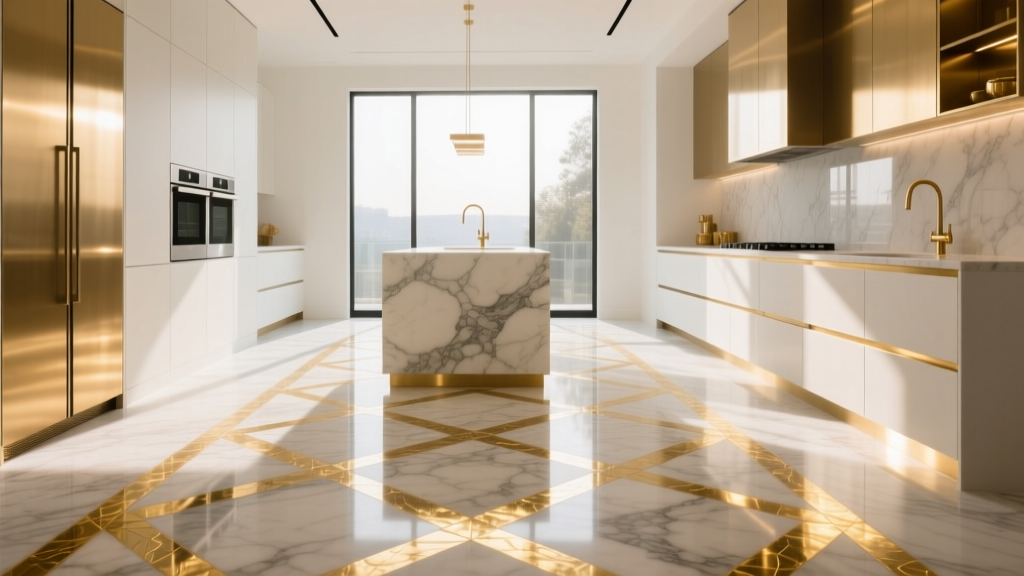
For kitchens and open-concept culinary spaces, poured epoxy terrazzo represents the pinnacle of seamless, durable flooring. Unlike traditional cementitious terrazzo, epoxy terrazzo is poured at a thin-set depth of 1/4 inch to 3/8 inch, allowing for intricate, multi-colored aggregate designs and ultra-thin zinc or brass divider strips.
The Labor and Moisture Multiplier
The material cost of the epoxy resin and marble/glass aggregates is secondary to the intense labor required. The National Terrazzo and Mosaic Association mandates strict moisture testing before installation. A calcium chloride test must show moisture vapor emission rates (MVER) of less than 3 lbs per 1,000 square feet per 24 hours. If the concrete slab fails this test, a premium moisture mitigation system like Bostik GreenForce or Mapei Eco Prim Grip must be applied, adding $3 to $5 per square foot.
Following the pour, the floor requires multiple passes with heavy planetary grinders, progressing through diamond grits from 40 up to 3,000 to achieve a glass-like polish. This multi-day process makes terrazzo one of the most expensive flooring options globally.
Primary Bathroom: Bookmatched Calacatta Marble
In luxury primary bathrooms, large-format natural stone is the undisputed cost leader. Bookmatching—the process of cutting and polishing adjacent slabs from the same stone block so their veins mirror each other like an open book—requires purchasing entire bundles of slab material, much of which is discarded to achieve the perfect visual symmetry.
Structural Deflection Requirements
Natural stone is highly susceptible to cracking under structural deflection. While standard tile installations require a floor deflection rating of L/360, the Natural Stone Institute strictly mandates an L/720 deflection rating for natural stone. Achieving this often requires structural engineers to sister existing floor joists with LVL (Laminated Veneer Lumber) or steel flitch plates, a massive hidden cost that can add $5,000 to $15,000 to a bathroom remodel before a single tile is laid.
"The true cost of bookmatched Calacatta Gold or Statuario marble isn't just the $40-per-square-foot slab price; it's the CNC waterjet cutting for custom drain integrations, the epoxy setting materials, and the structural reinforcement required to guarantee zero deflection."
Entryway: Sintered Stone and Artisan Encaustic Tile
Entryways demand extreme abrasion resistance and thermal shock tolerance. Ultra-premium entryways utilize large-format sintered stone (such as Dekton or Neolith) or hand-poured artisan encaustic cement tiles imported from specialized studios in Morocco or France.
Sintered stone is manufactured under extreme heat and pressure (up to 25,000 tons), creating a surface harder than granite. However, installing 126-inch by 59-inch slabs requires specialized suction lifters, continuous mechanical fastening at the edges, and specialized flexible thinsets like Laticrete 254 Platinum. The sheer weight and fragility of the slabs during transport and maneuvering result in high breakage rates, forcing contractors to order a 20% overage, drastically inflating the final invoice.
Ultimate High-End Flooring Cost Matrix (2026 Estimates)
| Room | Premium Material | Material Cost / Sq. Ft. | Installed Cost / Sq. Ft. | Primary Cost Driver |
|---|---|---|---|---|
| Living Room | Brazilian Walnut (Ipe) | $16 - $24 | $30 - $42 | Extreme density, pre-drilling labor |
| Kitchen | Epoxy Terrazzo | $15 - $25 | $45 - $75 | Multi-day grinding/polishing labor |
| Primary Bath | Bookmatched Calacatta Marble | $35 - $60 | $85 - $150+ | Slab waste, CNC cutting, L/720 framing |
| Entryway | Large-Format Sintered Stone | $22 - $38 | $55 - $80 | Handling equipment, 20% breakage overage |
The Hidden Structural Multipliers
When determining which flooring option can cost the most, homeowners and builders frequently overlook the sub-surface preparation required to support ultra-premium materials. The following hidden costs routinely inflate luxury flooring budgets by 15% to 30%:
- Subfloor Flattening: Large-format stone and sintered stone require a subfloor flatness tolerance of 1/8 inch over 10 feet. Achieving this requires pouring self-leveling underlayments (SLU) like ARDEX K-15, which can cost $4 to $7 per square foot just for the leveling compound and primer.
- Uncoupling Membranes: To prevent natural stone from cracking due to lateral substrate movement, premium installations mandate uncoupling membranes such as Schluter-DITRA. This adds $2.50 to $4.00 per square foot in materials and thinset.
- HVAC Acclimation: Exotic woods and natural materials require the building's permanent HVAC system to be operational and maintaining 35-55% relative humidity for at least two weeks prior to delivery. Temporary construction heating does not meet manufacturer warranty requirements.
Natural stone slabs (3cm thick) and poured terrazzo systems add significant dead load to a structure—often exceeding 15 lbs per square foot. Before specifying these materials on upper floors or cantilevered spaces, a licensed structural engineer must verify that the foundational footings and floor joists can support the increased static weight without compromising the building's integrity.
Ultimately, the most expensive flooring option in any given room is the one that demands the highest degree of structural intervention and artisan craftsmanship. While materials like Calacatta marble and epoxy terrazzo carry steep price tags, it is the invisible labor—joist sistering, moisture mitigation, and diamond-grit polishing—that truly drives luxury flooring costs into the stratosphere.
Written by
Marcus ChenMarcus Chen is a licensed structural engineer (PE) and building materials analyst with over 12 years of experience across residential, commercial, and industrial construction. He holds a Master of Science in Civil Engineering from UC Berkeley and spent six years at Thornton Tomasetti before transitioning to independent consulting and technical writing. Marcus specializes in material selection for seismic-prone regions, concrete reinforcement strategies, and lifecycle cost analysis. His work has been cited by the American Concrete Institute (ACI) and the Structural Engineers Association of California (SEAOC). When he is not on a job site or at his desk, you will find him hiking the Sierra Nevada or restoring a 1920s craftsman bungalow in Oakland, CA.
More from Marcus Chen
View all
Construction Cost
How Much Did the Eiffel Tower Cost to Build?
How much did the Eiffel Tower cost to build in 1889? We adjust for inflation and compare its budget to modern skyscraper construction.
Aug 4, 2026

Fire Resistance
What Is a Fire Resistant Material? Testing & Certification Guide
Discover what is a fire resistant material through ASTM and UL testing. Learn how fire ratings, certifications, and assemblies work in construction.
Aug 4, 2026

Construction Cost
How Much Did the Burj Khalifa Cost to Build?
How much did the Burj Khalifa cost to build? We break down the $1.5B project and extract 5 money-saving strategies for your next build.
Jul 30, 2026