How to Match Upright Carpet Cleaners to Specific Carpet Pile Types
Match upright carpet cleaners to your specific carpet pile and soil levels. Expert guide on suction, brush rolls, and moisture for optimal flooring care.
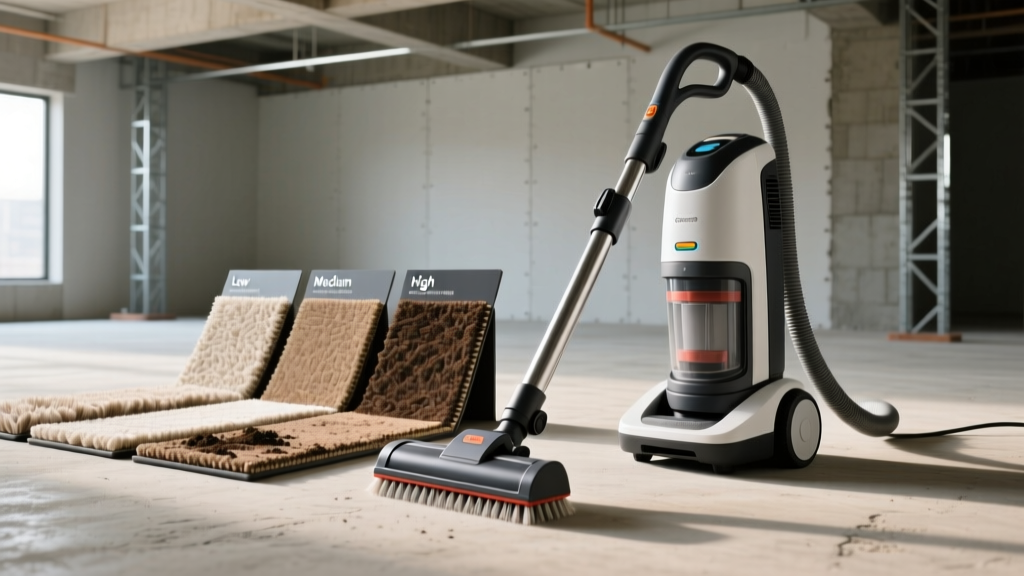
Using the wrong upright carpet cleaner on your specific flooring is one of the fastest ways to void a manufacturer’s warranty. Major carpet manufacturers like Shaw and Mohawk explicitly state that improper agitation or excessive moisture retention can lead to fiber fuzzing, loop snagging, and backing delamination. Selecting an upright carpet cleaner is not a one-size-fits-all decision; it requires matching the machine’s brush roll mechanics, suction power (measured in Air Watts), and moisture injection rates to your exact carpet pile construction and household soil profile.
The Mechanics of Fiber Damage: Why Application Fit Matters
The primary differentiator between upright carpet cleaners is the agitation mechanism. Agitation is necessary to break the surface tension of soil particles bonded to fibers, but the wrong brush stiffness or RPM will destroy the carpet architecture.
- Brush Roll RPM and Stiffness: High-RPM (3,000+) stiff-bristle brushes are designed for commercial level-loop carpets to dislodge embedded grit. If used on a delicate cut-pile Saxony, these bristles will fray the fiber tips, causing permanent "fuzzing" and a dull appearance.
- Suction and Water Lift: Suction is measured in Air Watts (AW) and Water Lift (inches). A machine with low water lift (under 50 inches) will leave excessive moisture in the carpet pad, drastically increasing drying times and the risk of microbial growth.
- Heat Injection: Machines with integrated heating elements (maintaining water at 140°F–190°F) improve the efficacy of cleaning surfactants, but high heat can melt or distort certain synthetic fibers like low-grade olefin if the dwell time is too long.
Scenario Matching Matrix: Carpet Pile vs. Cleaner Specifications
To prevent structural damage to your flooring, cross-reference your carpet type with the required machine specifications before purchasing or renting an upright unit.
| Carpet Pile Type | Required Brush Mechanism | Ideal Suction / Water Lift | Moisture Risk Profile | Recommended Machine Feature |
|---|---|---|---|---|
| Plush / Saxony (Cut Pile) | Soft bristle or microfiber rollers; low RPM | High (60+ inches water lift) | Moderate (shows water marks easily) | Variable speed brush control |
| Berber (Loop Pile) | NO beater bar; suction-only or soft static brush | Very High (70+ inches) | High (loops trap water at base) | Suction-only extraction mode |
| Frieze (Twisted Cut Pile) | Medium stiffness bristles; medium RPM | High (60+ inches) | Low (twists hide moisture marks) | HeatForce technology (140°F+) |
| Commercial Level Loop | Stiff bristles; high RPM (3,000+) | Medium (50+ inches) | Low (thin profile dries fast) | Dual-tank high-agitation system |
Deep Dive: Matching Cleaners to High-Traffic and Pet Scenarios
Households with pets or high foot traffic require upright carpet cleaners that go beyond basic agitation. These scenarios introduce complex soil types—specifically uric acid crystals, sebum, and tracked-in asphalt sealants—that require specialized machine architecture.
Pet Households and Enzymatic Integration
Standard upright extractors simply dilute pet urine and push it deeper into the polyurethane carpet pad. For pet scenarios, you need a machine with a targeted pretreatment system and high-velocity extraction. Models like the Bissell ProHeat 2X Revolution Pet Pro Plus (Model 2554A) feature a "CleanShot" pedal-activated pretreater that allows you to apply enzymatic solutions directly to the stain before the main brush roll passes over it. Furthermore, look for machines with a dedicated "Dry Only" or "Rinse" pass capability to flush out alkaline residue from pet stains, which otherwise attracts new dirt through capillary action.
Allergy Sufferers and Dust Containment
For homes managing asthma or severe allergies, the exhaust filtration of the upright cleaner is critical. Standard machines exhaust unfiltered air back into the room, aerosolizing micro-particulates. You must select an upright cleaner with a fully sealed HEPA filtration system on the exhaust vent. The Hoover SmartWash Automatic (FH52000) and similar premium models utilize multi-stage filtration that traps particles down to 0.3 microns, ensuring that the agitation process does not degrade your indoor air quality.
If your upright carpet cleaner lacks a powerful vacuum motor and leaves the carpet pad saturated, you risk secondary backing delamination. The latex adhesive binding the primary and secondary backings breaks down when submerged in water for more than 24 hours. Always perform a "dry pass" (trigger off, suction on) in multiple directions until no more water is visibly extracted.
Moisture Management and the "Wicking" Phenomenon
The most common failure mode in DIY carpet cleaning is "wicking." When an upright cleaner injects too much water, the liquid travels down the fiber and pools in the carpet pad. As the carpet dries, capillary action pulls the dirty, moisture-laden water back up to the fiber tips. This results in brown, crusty stains appearing 48 hours after cleaning.
According to the IICRC S100 Standard for Professional Cleaning of Textile Floor Coverings, carpets must be returned to a dry state within 24 hours, with 6 to 12 hours being the optimal target. To achieve this, your upright cleaner must have a high-efficiency extraction nozzle. Machines that utilize a "squeegee" lip behind the suction slot physically press water out of the pile before the vacuum extracts it, reducing residual moisture content by up to 30% compared to standard slot nozzles.
The CRI Seal of Approval: Your Baseline Filter
When evaluating any upright carpet cleaner, the absolute minimum baseline for consideration is the Carpet and Rug Institute (CRI) Seal of Approval. This independent testing protocol evaluates machines on three strict criteria: soil removal efficacy, dust containment (indoor air quality), and surface appearance change (ensuring the machine does not physically damage the fibers).
"The CRI Seal of Approval program tests vacuums and extractors to ensure they meet rigorous standards for soil removal and dust containment, while proving they do not cause excessive wear or color change to the carpet fibers. Using non-certified equipment is a primary cause of premature carpet replacement."
— Carpet and Rug Institute (CRI) Testing Protocols
If an upright carpet cleaner does not carry the CRI Bronze, Silver, or Gold rating, it should be immediately disqualified from your purchasing decision, regardless of brand marketing claims.
2026 Purchasing Decision Tree for Upright Extractors
Use this actionable framework to narrow down your equipment choice based on your specific flooring profile and maintenance frequency.
- Identify Your Pile Construction: Check your carpet sample or warranty card. If it is a loop pile (Berber), eliminate all machines with aggressive rotating beater bars. Restrict your search to suction-only extractors or machines with a brush-roll shutoff switch.
- Calculate Your Square Footage and Tank Capacity: For areas under 500 sq. ft., a compact 0.75-gallon tank (e.g., Bissell Little Green Pro) is sufficient and prevents water stagnation. For whole-home cleaning (1,000+ sq. ft.), mandate a 1.5-gallon dual-tank system to separate clean and dirty water completely, preventing cross-contamination.
- Verify the Drying Technology: If you live in a high-humidity climate or lack whole-home HVAC dehumidification, you must prioritize machines with built-in heated air exhaust (like Hoover's HeatForce technology) to accelerate evaporation and prevent mold spore germination in the pad.
- Confirm the CRI Certification: Cross-reference the exact model number on the CRI Seal of Approval directory to verify its soil removal rating. Aim for Silver or Gold ratings for high-traffic residential zones.
By rigorously matching the mechanical specifications of your upright carpet cleaner to your specific carpet pile and environmental conditions, you extend the lifespan of your flooring by years, maintain the validity of your manufacturer warranty, and ensure a healthier indoor environment.