True Cost to Install Carpet: Durability & Lifespan ROI
Analyze the true cost to install carpet by fiber type, face weight, and pad quality. Discover lifespan ROI and avoid premature replacement.
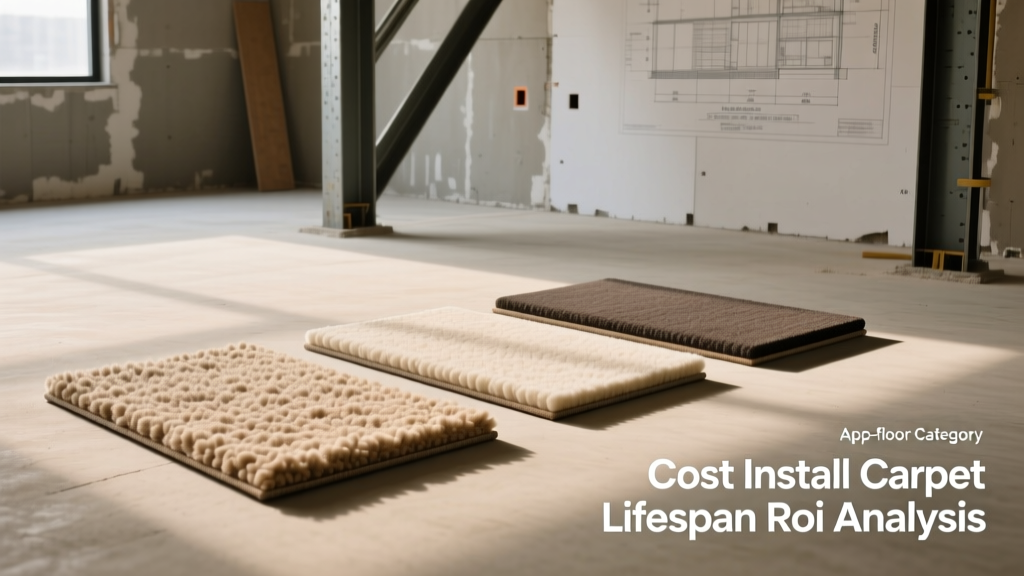
The Upfront Baseline: 2026 Cost to Install Carpet
Most homeowners evaluate the cost to install carpet strictly as a line-item expense, treating it as a short-term cosmetic fix. This approach fundamentally ignores the compounding costs of tear-out, disposal, subfloor prep, and baseboard adjustments. When you calculate the true financial impact of flooring, you must shift from 'cost per square foot' to 'cost per year of usable life.'
As of 2026, the national average for a complete carpet installation (including material, pad, labor, and old material disposal) ranges from $4.50 to $14.00 per square foot. However, the variance in this pricing is driven by fiber chemistry and structural density, which directly dictate how long the floor will survive under foot traffic.
| Cost Component | Budget Tier | Mid-Grade Tier | Premium Tier |
|---|---|---|---|
| Carpet Material | $1.50 - $2.50 | $3.50 - $5.50 | $7.00 - $11.00 |
| Pad / Underlayment | $0.30 (Rebond) | $0.60 (Froth) | $1.25 (Moisture-Barrier) |
| Labor & Installation | $1.50 | $1.75 | $2.50 |
| Disposal & Prep | $0.75 | $0.75 | $1.00 |
| Total Installed Cost | $4.05 - $5.25 | $6.60 - $8.60 | $11.75 - $15.75 |
Fiber Chemistry: The Science of Carpet Degradation
The lifespan of your installation is chemically determined the moment the fiber is extruded. Marketing terms like 'luxury feel' or 'plush comfort' are irrelevant to durability; molecular structure is everything.
Nylon 6,6 (The Durability Standard)
Nylon 6,6 remains the benchmark for high-traffic residential and commercial applications. The '6,6' designation refers to the carbon atom structure, which creates tight hydrogen bonding between polymer chains. This molecular memory allows the fiber to spring back after being crushed by heavy furniture or repetitive foot traffic. A high-quality Nylon 6,6 carpet will maintain its structural integrity for 12 to 15 years before showing permanent matting.
Triexta (PTT Polymer)
Market heavily under names like SmartStrand, Triexta (Polytrimethylene Terephthalate) offers exceptional stain resistance because the fiber is inherently hydrophobic—it repels water-based stains without needing topical chemical treatments. While its crush resistance is superior to polyester, it lacks the extreme tensile strength of Nylon 6,6. Expect a functional lifespan of 8 to 12 years in moderate-traffic zones.
Polyester (PET)
Polyester is the most common budget fiber, prized for its vibrant color clarity and low upfront cost. However, PET is oleophilic, meaning it attracts and holds oils. Over time, oils from bare feet, pet dander, and household aerosols bind to the fibers, acting as a magnet for particulate dirt. Furthermore, PET lacks molecular memory. Once a traffic lane is crushed, it stays crushed. Budget PET carpets typically require replacement within 3 to 5 years in active households.
The 'Face Weight' Illusion and Density Rating
Consumers frequently fixate on 'face weight' (measured in ounces per square yard), assuming a 50 oz. carpet is inherently superior to a 40 oz. carpet. This is a critical mistake that leads to premature replacement.
A 50 oz. carpet with a 0.75-inch pile height is actually less durable than a 40 oz. carpet with a 0.4-inch pile height. The tall, heavy fibers will bend and mat, while the shorter, dense fibers will stand up to abrasion.
Calculate the Density Rating:
(Face Weight × 36) ÷ Pile Height.Target: A minimum rating of 2,000 for standard residential use, and 3,000+ for heavy traffic or stairs.
Additionally, check the twist level. For cut-pile carpets (like frieze or saxony), the yarns are twisted together and heat-set. You want a minimum of 4 to 5 twists per inch (TPI). If the yarn easily unravels when you pinch it, the heat-set process was inadequate, and the carpet will fray and fuzz within months of installation.
Lifespan ROI: Cost Per Year of Wear (CPYW)
To understand the true financial impact, we must model the cost to install carpet over a fixed 15-year horizon. This matrix assumes a 1,000 square foot installation area and factors in the compounding labor and disposal costs of multiple replacements.
| Carpet Tier | Initial Installed Cost | Expected Lifespan | 15-Year Total Cost | Cost Per Year (CPYW) |
|---|---|---|---|---|
| Budget (PET / Low Density) | $4,500 | 4 Years | $16,875 (3 full installs) | $1,125 / year |
| Mid-Grade (Nylon / Med Density) | $7,500 | 10 Years | $13,125 (1 install + 1 half-life refresh) | $875 / year |
| Premium (Nylon 6,6 / High Density) | $12,500 | 15+ Years | $12,500 (1 single install) | $833 / year |
Note: The 15-year budget calculation includes the hidden costs of moving furniture, baseboard touch-ups, and subfloor leveling that occur during every subsequent tear-out.
The Underlayment: Your Carpet's Shock Absorber
The carpet pad absorbs up to 80% of the compressive force from foot traffic. If the pad bottoms out, the abrasive concrete or wood subfloor acts like sandpaper against the carpet backing, leading to delamination (where the secondary backing separates from the primary backing).
According to guidelines established by the Carpet and Rug Institute (CRI), residential carpet cushions should not exceed 7/16 of an inch in thickness and must meet a minimum density of 6 pounds per cubic foot for standard traffic, or 8 pounds for heavy traffic and stairs.
- Rebond (Urethane Foam): The most common and economical pad. Made from recycled foam scraps. It degrades faster under heavy point-loads (like sofa legs) and can emit volatile organic compounds (VOCs) if not properly sealed. The Environmental Protection Agency (EPA) recommends checking for CRI Green Label Plus certification to ensure low VOC off-gassing.
- Froth Polyurethane: Applied as a liquid that expands into a dense, uniform cellular structure. It provides superior support for high-density nylon carpets and resists permanent compression. Highly recommended for premium installations.
- Moisture Barrier Pads: Essential for installations over concrete slabs or in homes with pets. These feature a closed-cell top layer that prevents liquid spills from penetrating into the subfloor, preventing mold growth and subfloor rot.
Real-World Failure Modes and Edge Cases
Even premium materials will fail prematurely if installation parameters are ignored. Be aware of these specific failure modes:
Edge Raveling and Zippering
If the installer fails to seal the cut edges of the carpet with a latex-based seam sealer before binding or tucking, the lateral yarns will pull out. This creates a 'zipper' effect along walls or transitions. Always require edge-sealing in the installation contract.
UV Degradation and Fading
Solution-dyed fibers (where color is added to the liquid polymer before extrusion) are virtually immune to UV fading and bleach. Topically dyed fibers (where color is applied after extrusion) will bleach and fade in rooms with intense, direct southern-exposure sunlight. If installing in a sunroom or near floor-to-ceiling windows, specify solution-dyed Nylon or Triexta.
Delamination from Improper Stretching
Carpet must be power-stretched using a mechanical knee-kicker and power stretcher to achieve the manufacturer's required tension (usually 1-2% elongation). If installers rely solely on a knee-kicker to save time, the carpet will develop ripples and buckles within the first year as the backing relaxes, creating tripping hazards and accelerating wear on the crests of the wrinkles.
Expert Directive: Do not evaluate the cost to install carpet based solely on the showroom sample. Demand the manufacturer's specification sheet to verify the fiber type (Nylon 6,6 vs. PET), the exact pile height, the face weight, and the CRI-approved pad requirements. A $12.00/sq ft premium installation that lasts 15 years is mathematically superior to a $4.50/sq ft budget installation that requires replacement three times in the same window.