The Best Pontoon Boat Flooring Options by Deck Zone
Discover the best pontoon boat flooring options for every deck zone. Compare EVA foam, woven vinyl, and marine carpet by cost, weight, and durability.

The Aluminum vs. Plywood Substrate Reality
Pontoon boats present a unique structural challenge compared to traditional fiberglass V-hulls. The deck substrate—typically either marine-grade plywood or extruded aluminum—dictates which flooring materials will perform long-term. Plywood sub-decks are highly susceptible to core rot if moisture becomes trapped beneath non-breathable flooring. Conversely, aluminum sub-decks do not rot but are prone to galvanic corrosion and thermal expansion. According to the National Marine Manufacturers Association (NMMA), utilizing certified marine-grade materials that accommodate thermal expansion is critical for preventing premature structural degradation and fastener blowout.
When evaluating pontoon boat flooring options, a one-size-fits-all approach inevitably leads to compromised performance. By treating your pontoon as a series of distinct micro-environments—the helm, the main lounge, and the wet transom—you can optimize for weight, traction, and barefoot comfort while keeping your vessel within its maximum gross weight capacity.
Zone 1: The Helm and High-Traffic Walkways
The helm station and primary walkways demand maximum slip resistance, fatigue reduction, and impact absorption. The captain is often standing for hours, and the walkways endure the highest concentration of foot traffic, wet shoes, and dropped gear.
Material Spotlight: Closed-Cell EVA Foam
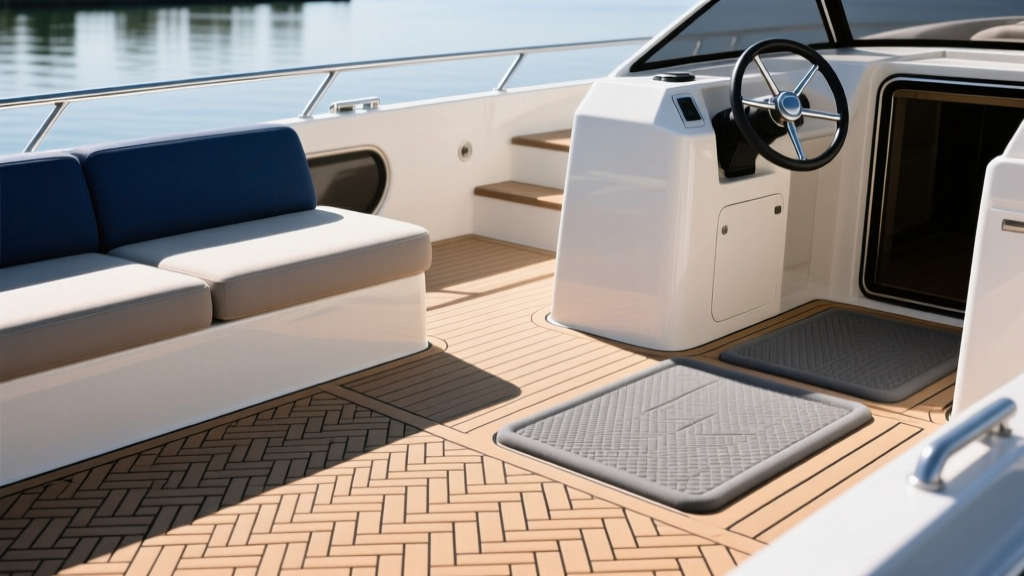
Closed-cell Ethylene-Vinyl Acetate (EVA) foam (popularized by brands like SeaDek and Treadmaster) is the undisputed leader for helm zones. Modern marine-grade EVA foam is manufactured with a 45 Shore C durometer, providing the exact balance of firmness for stability and cushioning for joint relief.
- Specifications: 20mm to 30mm thickness, UV-stabilized top layer, closed-cell structure to prevent water absorption.
- Weight Impact: Extremely light at approximately 0.3 lbs per square foot, preserving your pontoon’s buoyancy and planing efficiency.
- Cost: $5.00 to $9.00 per square foot for custom CNC-cut kits.
Zone 2: The Main Lounge and Entertainment Deck
The main seating area requires a material that balances luxury aesthetics with aggressive stain resistance. This zone faces constant exposure to spilled beverages, food, and bare feet. Traditional marine carpet, once the industry standard, is rapidly being phased out in this zone due to its tendency to harbor mold, mildew, and pet odors.
Material Spotlight: Woven Polypropylene Vinyl
Woven vinyl (such as Infinity Luxury Woven Vinyl or AquaMat) has revolutionized pontoon lounge decks. Unlike traditional PVC sheet flooring, woven vinyl is constructed from 100% solution-dyed polypropylene yarns woven over a flexible, antimicrobial backing.
- Thermal Properties: Solution-dyed polypropylene reflects UV radiation rather than absorbing it, keeping surface temperatures up to 30°F cooler than traditional dark-colored vinyl or composite decking.
- Maintenance: Spills bead up on the surface. A simple mixture of mild soap and water removes wine, grease, and fish slime without degrading the material.
- Cost: $8.00 to $15.00 per square foot, depending on the complexity of the weave pattern.
BoatUS maintenance guidelines emphasize that trapping moisture beneath non-breathable flooring can accelerate plywood delamination. Woven vinyl allows micro-ventilation, making it significantly safer for plywood sub-decks than solid sheet vinyl.
Zone 3: The Swim Platform and Rear Transom
The rear transom and swim platform represent the harshest environment on a pontoon. This area is constantly submerged during boarding, battered by docking impacts, scratched by fishing gear, and clawed by pets re-entering the boat.
Material Spotlight: Vulcanized Rubber and Aluminum Tread Plate
For the rear wet zones, you must abandon comfort-focused materials in favor of pure abrasion resistance. Heavy-duty vulcanized rubber (often featuring a raised DOT or coin pattern) or marine-grade 5052 aluminum diamond tread plate are the optimal choices.
- Durability: 5052 aluminum offers superior corrosion resistance in both freshwater and brackish environments compared to standard 6061 aluminum.
- Traction: Raised coin-pattern rubber provides aggressive grip even when covered in algae or lake scum.
- Cost: $3.00 to $6.00 per square foot for rubber; $7.00 to $12.00 per square foot for marine aluminum plate.
Pontoon Flooring Comparison Matrix
Use the following matrix to cross-reference materials against your specific pontoon usage profile and budget constraints.
| Material | Best Zone | Cost / Sq Ft | Weight / Sq Ft | Lifespan |
|---|---|---|---|---|
| Closed-Cell EVA Foam | Helm / Walkways | $5 - $9 | 0.3 lbs | 7 - 10 Years |
| Woven Polypropylene Vinyl | Main Lounge | $8 - $15 | 0.8 lbs | 10 - 15 Years |
| Traditional Marine Carpet | Budget Full-Deck | $3 - $6 | 1.1 lbs | 4 - 7 Years |
| Synthetic Teak (PVC) | Luxury Accents | $18 - $28 | 1.8 lbs | 15+ Years |
| Vulcanized Rubber (Coin) | Swim Platform | $3 - $6 | 1.5 lbs | 10+ Years |
Installation Chemistry: Adhesives vs. Snap-In Systems
The method of attachment is just as critical as the material itself. Choosing the wrong adhesive chemistry will result in catastrophic delamination or make future replacement impossible.
1. Permanent Adhesive Bonding
For woven vinyl and marine carpet applied directly to plywood or aluminum, use a marine-specific acrylic or polyurethane adhesive. Roberts 6700 Indoor/Outdoor Carpet Adhesive is the industry benchmark for porous materials, offering a strong bond while remaining flexible enough to handle the thermal expansion of aluminum decks. For synthetic teak or solid PVC sheeting, a two-part polyurethane marine adhesive is required to prevent edge curling under high UV exposure.
2. Snap-In and Track Systems
Many modern pontoons utilize a perimeter track system where the flooring features a beaded edge that snaps into an aluminum extrusion. This allows owners to remove the entire lounge carpet or vinyl mat for winter storage and deep cleaning. Never use permanent adhesives on snap-in flooring; instead, rely on the mechanical tension of the track and use marine-grade Velcro strips only in the center of large mats to prevent wind lift.
3. Peel-and-Stick (PSA) Backings
While EVA foam often comes with a 3M Pressure Sensitive Adhesive (PSA) backing, PSA is generally not recommended for large, continuous sheets of woven vinyl on exterior pontoon decks. PSA degrades under sustained high heat and constant moisture exposure, leading to bubbling. Reserve PSA for small, custom-cut helm pads and step risers.
Common Failure Modes and Prevention
Even premium pontoon boat flooring options will fail prematurely if installed without addressing these common edge cases:
- Edge Curling from UV Expansion: Synthetic materials expand in direct sunlight. If woven vinyl or EVA foam is installed butt-to-butt against rigid aluminum trim with zero expansion gap, the material will buckle and curl. Always leave a 1/8-inch gap at the perimeter, concealed by trim molding.
- Galvanic Corrosion under Aluminum Tread Plate: If you install aluminum diamond plate directly over a steel or untreated aluminum sub-frame without a dielectric barrier (like closed-cell foam tape), moisture will trigger galvanic corrosion, eating through the sub-deck. Always isolate dissimilar metals.
- Adhesive Starvation: When gluing down woven vinyl, using a notched trowel with teeth that are too small (e.g., 1/16-inch instead of the recommended 1/8-inch) results in adhesive starvation. This creates microscopic air pockets where moisture accumulates, eventually leading to black mold growth beneath the flooring.
By mapping specific materials to their optimal deck zones and respecting the chemical requirements of marine adhesives, you can engineer a pontoon deck that remains pristine, safe, and structurally sound for over a decade of heavy use.
Written by
Priya KapoorPriya Kapoor is a real estate market analyst and construction economics researcher with expertise in housing affordability, development feasibility, and infrastructure investment. She holds a Master of Regional Planning from Cornell University and previously worked as a senior analyst at CBRE's Investment Properties group, where she modeled returns for $4B in mixed-use development pipelines. Priya now runs an independent research practice advising developers, municipalities, and REITs on construction cost forecasting and market timing. She publishes the quarterly "BuildMat Market Pulse" report tracking material price indices across 12 commodity categories. Based in Austin, TX, Priya serves on the board of Habitat for Humanity Austin and is a marathon runner.
More from Priya Kapoor
View all
Construction Cost
Cost to Build a 1600 Sq Ft Home in 2026: Full Breakdown
Accurate 2026 cost to build a 1600 sq ft home—material, labor, and regional pricing breakdowns included. Plan your budget with real-time estimates.
Aug 11, 2026

Wood & Lumber
Name the Types of Wood for Pressure Treatment and Preservation
Learn how to name the types of wood best suited for pressure treatment. Compare species treatability, chemical retention levels, and 2026 preservation costs.
Aug 4, 2026

Stone & Masonry
Stone Veneer Suppliers Lindenhurst: 2026 Cost Analysis
Analyze 2026 stone veneer costs in Lindenhurst, NY. Compare local supplier pricing, delivery fees, and Suffolk County installation labor rates.
Aug 4, 2026