Dish Soap for Carpet Stains: Chemical Specs and Performance Ratings
Analyze the chemical performance of dish soap for carpet stains. Compare pH, surfactant types, and fiber compatibility against IICRC standards.
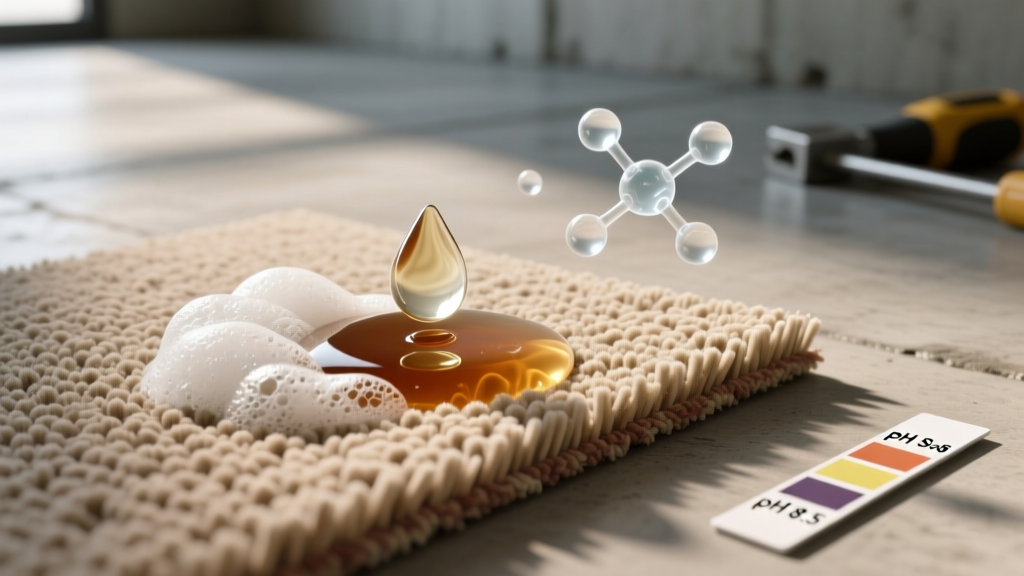
The Chemistry of Dish Soap on Carpet Fibers
When evaluating dish soap for carpet stains from a materials science perspective, it is critical to understand that dish detergents are engineered for hard, non-porous surfaces (ceramics, glass, stainless steel), not complex textile matrices. The primary active ingredients in standard dish soaps are anionic surfactants, typically Sodium Laureth Sulfate (SLES) or Linear Alkylbenzene Sulfonates (LAS). These molecules possess a hydrophilic (water-loving) head and a hydrophobic (oil-repelling) tail, allowing them to encapsulate grease and suspend it in water.
However, carpet fibers act as a mechanical filter. According to the IICRC S100 Standard for Professional Carpet Cleaning, cleaning agents must possess specific suspension and extraction properties to prevent chemical buildup. Because dish soaps are formulated to produce high-foaming lather—a sensory cue consumers associate with cleaning power on dishes—they create massive air-to-liquid surface tension in carpet piles. This high-foaming characteristic severely impedes the extraction process, trapping the surfactant deep within the carpet backing and primary latex layer.
⚠️ Performance Warning: The Residue Trap
Anionic surfactants left behind after improper extraction dry into a sticky, hygroscopic film. This residue acts as a powerful magnet for cationic soil particles (dust, dirt, pet dander). A carpet spot treated with dish soap and inadequately rinsed will typically exhibit rapid, localized resoiling within 7 to 14 days, often appearing darker than the original stain.
Surfactant Performance & Soil Suspension Ratings
To objectively rate dish soap against industry benchmarks, we must compare its chemical specifications to solutions that carry the Carpet and Rug Institute (CRI) Seal of Approval. The CRI testing protocol measures soil removal, resoiling, and colorfastness under strict laboratory conditions.
| Chemical Specification | Standard Dish Soap (e.g., Dawn Ultra) | CRI-Approved Carpet Extractor Solution |
|---|---|---|
| pH Level | 8.7 - 9.3 (Alkaline) | 7.0 - 8.5 (Neutral to Mildly Alkaline) |
| Primary Surfactant | SLES / LAS (Anionic) | Nonionic / Amphoteric Blends |
| Foam Profile | High-foaming (impedes vacuum extraction) | Low-foaming (rapid moisture recovery) |
| Residue Left Behind | High (>5% by weight, highly sticky) | Minimal (< 1% by weight, crystalline) |
| Optical Brighteners | Frequently included (Tinopal derivatives) | Strictly prohibited by CRI standards |
Fiber Compatibility Matrix
Carpet performance and chemical tolerance vary drastically by polymer type. Applying an alkaline, anionic dish soap solution yields vastly different results depending on the extruded fiber.
- Nylon 6,6: The most common residential carpet fiber. Nylon dye sites are inherently cationic (positively charged). When anionic dish soap residue remains in the pile, it binds ionically to the dye sites. This not only causes rapid resoiling but can also strip the acid-dye resistors applied during manufacturing, leading to permanent localized fading from subsequent UV exposure.
- Wool: A natural protein fiber highly sensitive to alkalinity. Dish soaps with a pH above 8.5 cause alkaline hydrolysis. This chemical reaction breaks the disulfide bonds in the keratin protein, stripping the natural lanolin lipid layer. The result is severe fiber embrittlement, yellowing, and a harsh, crunchy texture that cannot be reversed.
- Olefin (Polypropylene): Highly hydrophobic and stain-resistant, but lipophilic (oil-attracting). Dish soap lacks the specific solvent action required to break down oil-based stains on olefin. The mechanical agitation required to force the dish soap into the fiber often causes permanent fuzzing and pilling of the yarn.
- Polyester (PET / Triexta): Similar to olefin, polyester attracts oils. While dish soap will emulsify the oils moderately well, the high surface tension of the soap prevents deep penetration into the dense PET extrusion, often leaving a superficial clean with deep-set oil residue remaining at the fiber base.
The pH Factor and Optical Brighteners
Many modern dish soaps contain optical brighteners (fluorescent whitening agents). These chemicals absorb invisible ultraviolet light and re-emit it as visible blue light, making dishes appear 'whiter.' When deposited onto carpet fibers, these brighteners create uneven, glowing patches under natural sunlight or UV-heavy LED lighting. Furthermore, the alkaline pH (typically 9.0) accelerates the oxidation of natural tannins in stains like coffee or wine, effectively setting the stain permanently into the polymer matrix if not neutralized immediately.
Exact Dilution Ratios and Neutralization Protocols
If a homeowner must use dish soap for an emergency spot treatment, strict adherence to dilution ratios and immediate chemical neutralization is mandatory to prevent structural damage to the carpet backing and localized resoiling.
- Precise Dilution: Mix exactly 1/4 teaspoon (1.25 ml) of clear, non-lotion, non-bleach dish soap per 32 ounces (946 ml) of distilled water. Using tap water introduces calcium and magnesium ions, which react with the anionic surfactants to form insoluble soap scum inside the carpet pile.
- Application and Agitation: Apply the solution sparingly using a spray bottle. Do not pour. Agitate gently with a soft-bristle upholstery brush in a single direction to prevent yarn untwisting. Allow a 3-minute dwell time for micelle encapsulation.
- Extraction: Blot aggressively with dry, high-pile microfiber towels. Apply downward pressure; never scrub laterally. Repeat with fresh towels until no moisture transfers to the cloth.
- Chemical Neutralization (Critical): Mix 1 ounce (30 ml) of standard 5% white vinegar (acetic acid) into 32 ounces of distilled water. Spray the neutralizer over the treated area to drop the pH back to a neutral 7.0. This breaks the anionic bonds and converts the sticky soap residue into a soluble salt that can be easily vacuumed once dry.
- Moisture Management: Elevate the carpet slightly or use a high-velocity air mover to dry the area within 4 hours. Prolonged moisture combined with alkaline soap residues will degrade the latex secondary backing, leading to delamination.
When to Abandon Dish Soap: Edge Cases and Failure Modes
Dish soap is strictly a temporary, mild emulsifier. It completely fails against specific chemical categories of stains. Attempting to use dish soap on the following will result in permanent carpet damage:
Critical Failure Modes
- Cationic Stains (Mustard, Iodine, Curry): These carry a positive charge. Anionic dish soap will bind to them, creating an insoluble complex that permanently dyes the nylon.
- Protein Stains (Blood, Vomit): Alkaline dish soap will coagulate the proteins, setting them into the fiber matrix. Cold water and enzymatic cleaners are required.
- Solvent-Soluble Stains (Ink, Nail Polish, Tar): Dish soap has zero solvent capability. Attempting to scrub these with soap will only spread the pigment across a wider surface area of the carpet pile.
For optimal carpet longevity and warranty compliance, always defer to cleaning agents that explicitly display the Carpet and Rug Institute Seal of Approval. While dish soap provides an accessible emergency intervention for minor, fresh, water-based spills, its chemical specifications fundamentally contradict the material science requirements for long-term textile maintenance.