Floor Desk Maintenance: Protecting Floors Under Low Workspaces
Master floor desk maintenance with our 2026 cleaning playbook. Learn to protect hardwood, LVP, and carpet from low-profile desk drag, moisture, and wear.
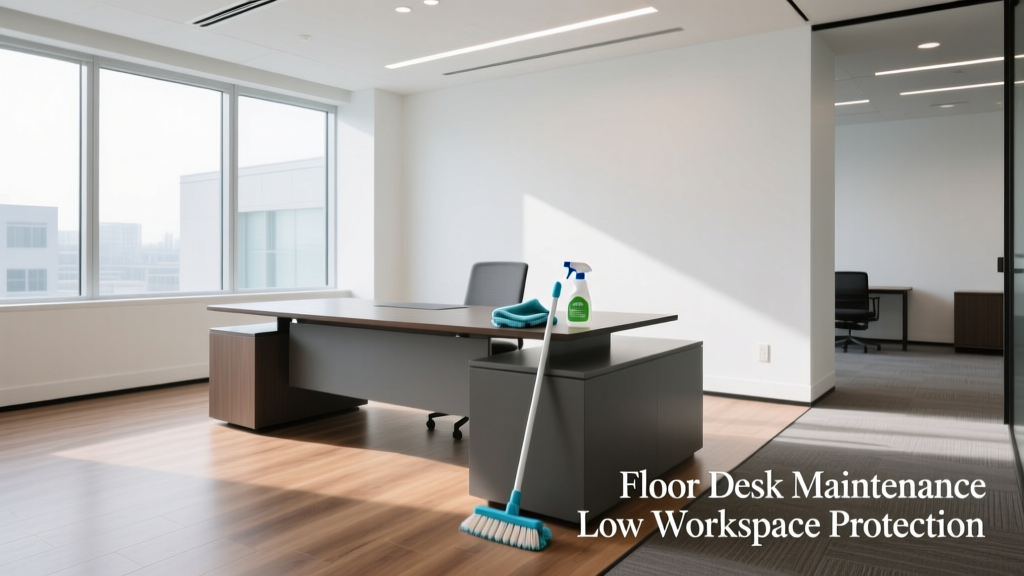
The Rise of the Floor Desk: Unique Flooring Challenges
The shift toward Japandi aesthetics and ergonomic floor-sitting has popularized the floor desk—a low-profile, legless, or ultra-short workspace designed for use with floor cushions (zabutons) and low-seating chairs. While visually striking and beneficial for posture variation, a floor desk introduces severe, localized stress to your flooring that traditional standing or sitting desks do not.
Unlike standard desks that distribute weight across four widely spaced legs, a floor desk often rests on a continuous wooden base or short, concentrated pegs. This creates immense point-load pressure. Furthermore, the floor desk environment traps dust, restricts airflow beneath heavy floor cushions, and exposes the floor surface to barefoot sebum (skin oils), which chemically degrades modern polyurethane finishes over time. According to the Environmental Protection Agency (EPA), restricted airflow in micro-environments like the space beneath heavy floor furniture can elevate localized humidity, accelerating moisture-related flooring failures.
Leaving dense foam or cotton floor cushions flat against engineered hardwood or luxury vinyl plank (LVP) for more than 48 hours without rotation traps ambient moisture. This micro-climate causes engineered wood veneers to cup and LVP seams to peak. Always store cushions vertically when not in use.
Material Vulnerability Matrix: Floor Desk Impact
Not all flooring reacts to a floor desk setup equally. The following matrix outlines the specific failure modes for common residential flooring materials when subjected to low-profile workspaces.
| Flooring Type | Primary Threat from Floor Desk | Vulnerability (1-10) | Required Protection Strategy |
|---|---|---|---|
| Solid Hardwood | Surface scratching from dragging; sebum degradation of finish | 8 | 1/4-inch vulcanized rubber base pads; pH-neutral cleaning |
| Engineered Wood | Moisture cupping under cushions; point-load denting | 9 | Daily cushion rotation; 3mm polycarbonate mat |
| Luxury Vinyl (LVP) | Permanent plasticizer indentation from heavy static loads | 7 | Wide-load distribution boards; avoid rubber pads (staining) |
| Wool/Synthetic Carpet | Crushing of pile; dust mite accumulation in low-airflow zones | 6 | Weekly HEPA vacuuming; monthly steam extraction |
| Polished Concrete | Micro-abrasions from sliding desk base; sealant wear | 4 | Felt glide pads; annual topical sealant reapplication |
The Daily & Weekly Cleaning Playbook
Maintaining the floor beneath a floor desk requires a specialized routine. Standard mopping is insufficient because it fails to address the unique biological and mechanical contaminants present in floor-sitting zones.
Step 1: Micro-Dusting and Airflow Restoration
Floor desks act as massive dust catchers. The American Lung Association notes that settled dust in low-airflow zones harbors allergens and particulate matter that gets kicked up when you sit or stand.
- Daily: Use a 36-inch flat microfiber dust mop with an electrostatic charge to pull dust from beneath the desk overhang. Do not use a broom, which simply launches particulates into the breathing zone.
- Weekly: Lift the floor desk entirely (or tilt it safely on its side) to expose the hidden footprint. Vacuum the perimeter using a hard-floor setting with the beater bar disengaged.
Step 2: Sebum and Oil Removal (The Barefoot Factor)
Users of floor desks frequently work in socks or bare feet. Human sebum contains squalene and fatty acids that slowly break down water-based polyurethane and acrylic floor finishes, leaving a dull, hazy trail where your feet rest.
- Mix a cleaning solution of 1 gallon warm water (85°F) and 2 ounces of a pH-neutral hardwood cleaner (e.g., Bona Hardwood Floor Cleaner, pH 7.0).
- Apply the solution via a spray bottle directly to the high-traffic foot zones, not the mop. This prevents excess moisture from seeping into floor seams.
- Agitate lightly with a white melamine pad (magic eraser) only if hazing has already set in, then immediately buff dry with a clean microfiber towel.
Protective Gear: What Actually Works in 2026
Placing a floor desk directly on bare flooring is a critical error. However, using the wrong protective pads can cause equal damage. Here is the exact hardware required for 2026 flooring standards.
Standard adhesive felt pads compress under the 40-80 lb weight of a loaded solid-wood floor desk, bottoming out and allowing the hard plastic or wood base to scrape the floor. Upgrade to Slipstick GorillaPads or equivalent 1/4-inch thick vulcanized rubber cups, which absorb shock without flattening.
Polycarbonate Mats for LVP and Engineered Wood
If you are rolling a low-profile ergonomic floor chair (like a Leggett & Platt or similar caster-based floor seat) beneath your desk, you need a chair mat. Avoid PVC mats, which off-gas and yellow. Purchase a 3mm thick, 100% polycarbonate mat with a flat edge (no bevels). Polycarbonate distributes the point-load of chair casters across a 4-square-foot area, reducing PSI on the LVP wear layer by up to 85%.
Load Distribution Boards for Carpet
For carpeted rooms, the continuous base of a floor desk will permanently crush the carpet pile and underlying foam pad within three months. Place a 1/2-inch thick MDF or plywood board, wrapped in a breathable linen fabric, beneath the desk base to distribute the weight evenly across the carpet fibers.
Troubleshooting Common Floor Desk Damage
If your flooring has already sustained damage from a floor desk setup, use these targeted remediation techniques before resorting to full replacement.
Symptom: White Haze or Clouding on Hardwood
Cause: Moisture trapped beneath a floor cushion has penetrated the microscopic cracks in the polyurethane finish, or sebum has oxidized on the surface.
Fix: Dampen a microfiber cloth with mineral spirits (odorless paint thinner). Rub the hazy area in the direction of the wood grain. The mineral spirits will dissolve the oxidized oils and draw out trapped surface moisture without stripping the polyurethane. Buff immediately with a dry cloth.
Symptom: Permanent Indentations in LVP
Cause: The plasticizers in the LVP have permanently deformed under the static load of the desk base.
Fix: Remove the desk. Use a heat gun on a low setting (keep it moving, never exceeding 140°F) to gently warm the indented vinyl. As the vinyl softens, use a smooth, flat wooden block to press the material back into its original plane. Hold for 60 seconds while it cools and re-hardens.
Symptom: Carpet Crushing and Matting
Cause: Prolonged compression of the carpet tufts and backing.
Fix: Place three ice cubes directly into the deepest part of the indentation. Allow them to melt completely (approx. 2 hours). The water will swell the crushed synthetic or wool fibers. Blot the excess water with a towel, then use a stiff-bristled nylon brush to aggressively lift the pile. Finish with a handheld steam cleaner to set the fibers upright.
'The longevity of flooring in a floor-sitting workspace is dictated not by the weight of the furniture, but by the frequency of micro-climate disruption. Moving the desk and cushions just two inches a week prevents 90% of moisture and compression failures.' — 2026 Residential Flooring Maintenance Standards