Most Durable Flooring Options for Bathrooms: Moisture & Wear Analysis
Analyze the most durable flooring options for bathrooms. Compare porcelain, SPC vinyl, and sheet materials for moisture resistance, slip ratings, and wear.

The Physics of Bathroom Flooring: Beyond the "Waterproof" Label
When evaluating flooring options for bathrooms, the industry heavily markets the term "waterproof." However, true durability in a high-moisture, high-traffic environment requires analyzing three distinct physical properties: hydrostatic resistance (the material's ability to block water transmission), surface abrasion tolerance, and dimensional stability under thermal and moisture cycling. A material may be entirely impervious to water, but if it lacks structural rigidity or features a low dynamic coefficient of friction (DCOF), it will fail prematurely or pose severe safety hazards.
This analysis dissects the most viable bathroom flooring materials—porcelain tile, rigid core luxury vinyl (SPC/WPC), and commercial sheet vinyl—focusing on their actual failure modes, subfloor requirements, and long-term wear characteristics in wet environments.
Porcelain Tile: Impervious Surfaces and Deflection Limits
Porcelain remains the benchmark for bathroom durability, but its performance is entirely dependent on correct material specification and subfloor preparation. According to standards set by the Tile Council of North America (TCNA), true porcelain must meet the ASTM C373 standard for water absorption, registering at 0.5% or less (classified as "Impervious"). Ceramic tiles, which typically absorb 3% to 7% of their weight in water, are fundamentally unsuited for wet-area floors and will degrade when exposed to standing water and freeze-thaw cycles in unconditioned spaces.
The most common cause of porcelain tile failure is not water damage to the tile itself, but cracking caused by subfloor deflection. The TCNA mandates a maximum deflection limit of L/360 for ceramic and porcelain tile installations. For a floor joist spanning 14 feet, the floor cannot deflect more than 0.46 inches under a 300-pound concentrated load. If your subfloor exceeds this, the tiles will not fail from moisture; the grout lines will fracture, breaking the waterproof seal and allowing water to destroy the wood subfloor beneath.
Grout Selection and Moisture Management
The tile is impervious; the grout is not. Standard cementitious grout is porous and requires sealing, which degrades within 12 to 18 months in a shower environment. For maximum durability, specify 100% solids epoxy grout (such as LATICRETE SpectraLOCK PRO or Mapei Kerapoxy). Epoxy grout has a water absorption rate of virtually zero, resists staining from harsh chemical cleaners, and eliminates the need for topical sealers. While the material cost is roughly 3 to 4 times higher than cementitious grout, the lifecycle cost is vastly lower due to zero maintenance requirements.
Rigid Core Vinyl (SPC vs. WPC): The Moisture Trap Paradox
Rigid core luxury vinyl plank (LVP) has captured significant market share due to its 100% waterproof core claims. However, "waterproof flooring" does not equate to a "waterproof installation." Water can still migrate through the microscopic seams, become trapped beneath the floating floor, and create an ideal incubator for mold against a wood subfloor. The Environmental Protection Agency (EPA) notes that mold requires moisture, a food source (like wood subfloors or drywall paper), and stagnant air to proliferate—conditions perfectly replicated under a tightly locked floating vinyl floor.
SPC vs. WPC: Structural Density and Point Loads
When selecting rigid core vinyl for a bathroom, understanding the difference between Stone Plastic Composite (SPC) and Wood Plastic Composite (WPC) is critical for long-term durability.
| Feature | SPC (Stone Plastic Composite) | WPC (Wood Plastic Composite) |
|---|---|---|
| Core Density | High (Limestone powder + PVC) | Medium (Foamed PVC + wood dust) |
| Point Load Resistance | Excellent. Resists denting from heavy vanities or clawfoot tubs. | Poor to Fair. Susceptible to permanent indentation under heavy, static loads. |
| Thermal Stability | Highly stable. Minimal expansion/contraction under radiant heat. | Moderate. Expands more significantly; requires larger expansion gaps. |
| Subfloor Telegraphing | High. Thin, dense core will mirror subfloor imperfections over time. | Low. Thicker, softer core bridges minor subfloor flaws. |
Procurement Directive: For bathrooms, SPC is generally superior due to its resistance to point loads from heavy bathroom fixtures. However, you must specify a minimum 20-mil wear layer (not the overall product thickness, which is often deceptively marketed as 5mm or 8mm). A 20-mil urethane or ceramic-bead-coated wear layer is required to withstand the abrasive grit tracked into bathrooms, whereas a 12-mil layer will show micro-scratches and dulling within three years in high-traffic zones.
Commercial Sheet Vinyl: The Seamless Advantage
Often overlooked in residential design, commercial-grade homogeneous sheet vinyl offers the highest true waterproof integrity of any flooring option because it eliminates seams entirely. When heat-welded at the perimeters and flash-coved up the wall by 2 to 4 inches, sheet vinyl creates a monolithic, watertight basin. This is the standard for healthcare and commercial wet areas precisely because water has no physical pathway to reach the subfloor.
The primary durability drawback of sheet vinyl is surface abrasion. Homogeneous vinyl wears evenly, but it lacks the rigid scratch resistance of porcelain or the thick urethane wear layers of luxury vinyl. To mitigate this, specify sheet vinyl with a minimum 0.75mm (30-mil) wear layer and a high-density urethane topcoat for chemical resistance against bathroom cleaning agents.
Slip Resistance: Navigating the ANSI A326.3 Standard
Durability also encompasses safety. A floor that becomes dangerously slick when wet is functionally obsolete for a bathroom environment. The industry standard for measuring slip resistance is the Dynamic Coefficient of Friction (DCOF), tested under the ANSI A326.3 protocol.
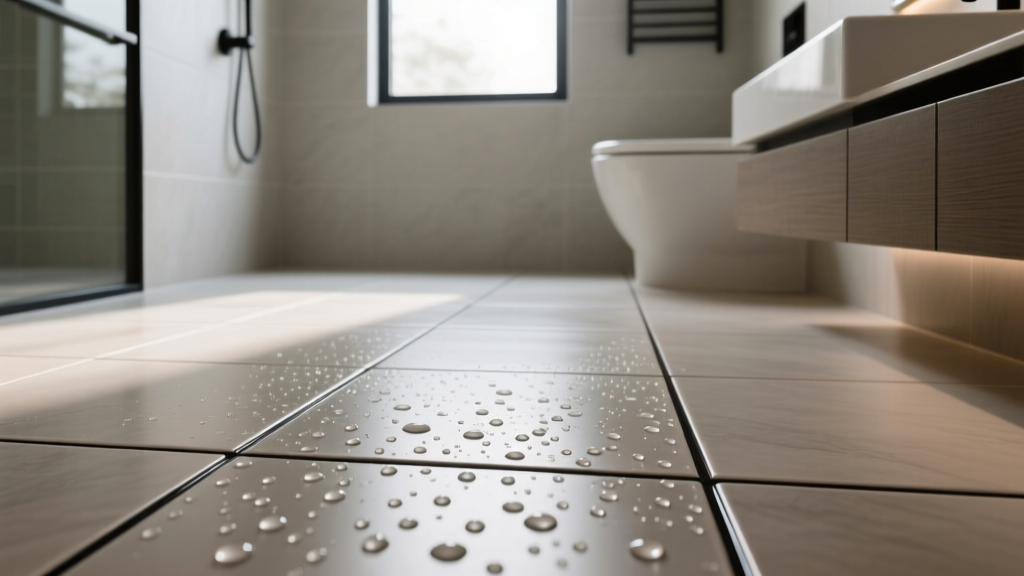
For a bathroom floor to be considered safe for wet conditions, the material must achieve a DCOF of 0.42 or greater when tested with a slightly soapy water solution. Highly polished tiles or smooth vinyl planks often fail this test, registering DCOF values as low as 0.25 when wet. When procuring tile, demand the manufacturer's ANSI A326.3 test certificate. Look for tiles with micro-textured surfaces, honed finishes, or structured profiles (often labeled as "R10" or "R11" in European DIN 51130 ratings) to ensure adequate wet traction.
The Subfloor Reality: Where Installations Actually Fail
No flooring material can overcome a compromised subfloor. In bathroom renovations, the existing subfloor is frequently damaged by prior water leaks, rot, or inadequate structural framing. According to building science principles documented by Building Science Corporation, managing bulk water and vapor diffusion is critical to preventing structural decay.
Subfloor Preparation Matrix
- For Porcelain Tile: Remove any existing resilient flooring. Install a minimum 1-1/8" exterior-grade tongue-and-groove plywood subfloor, or use a cementitious backer unit (CBU) like Durock over 3/4" plywood. For superior vapor management and crack isolation, utilize an uncoupling membrane such as Schluter-DITRA, which allows the subfloor and tile to move independently while providing a waterproofing layer when seams are sealed with Kerdi-Band.
- For Rigid Core Vinyl (SPC/WPC): The subfloor must be perfectly flat (within 3/16" over a 10-foot radius). Any deviation will cause the click-lock mechanisms to snap under foot traffic, breaking the waterproof seal between planks. Use a self-leveling underlayment (SLU) over the wood subfloor to achieve the required tolerances. Never install a secondary vapor barrier over a wood subfloor beneath a floating floor, as this can trap ambient moisture against the wood, leading to rot.
- For Sheet Vinyl: Requires a perfectly smooth underlayment. Install 1/4" lauan or specialized floor patch underlayment, taping and filling all seams with a Portland cement-based patching compound. Any nail heads or seam ridges left unfilled will eventually telegraph through the vinyl sheet, creating wear points that will tear under foot traffic.
Actionable Procurement & Specification Checklist
When sourcing materials for a bathroom flooring project, use this exact specification checklist to ensure you are procuring durable, code-compliant products:
- Tile Water Absorption: Must be certified < 0.5% (Impervious per ASTM C373).
- Tile Slip Resistance: Must meet or exceed DCOF 0.42 per ANSI A326.3 for wet environments.
- Tile Grout: Specify 100% solids epoxy grout; reject standard cementitious grout for wet areas.
- Vinyl Core Type: Specify SPC (Stone Plastic Composite) for high point-load resistance under vanities.
- Vinyl Wear Layer: Minimum 20-mil (0.5mm) thickness with a ceramic bead or urethane topcoat.
- Subfloor Deflection (Tile): Verify joist span meets L/360 deflection limits before installation.
- Subfloor Flatness (Vinyl): Verify subfloor is level to 3/16" over 10 feet; use self-leveling underlayment if required.
- Transition Moldings: Use 100% silicone sealant at all perimeter expansion gaps and transition moldings to prevent surface water from migrating beneath floating floors.
By prioritizing hydrostatic integrity, structural deflection limits, and verified slip resistance over superficial aesthetics, you ensure the selected flooring will withstand the rigorous physical demands of a bathroom environment for decades.
Written by
Sarah WhitfieldSarah Whitfield is a chartered quantity surveyor (MRICS) and construction cost analyst with 15 years of experience in material pricing, procurement strategy, and project budgeting. She earned her degree in Construction Management from the University of Reading (UK) and has worked on projects ranging from $2M custom homes to $180M mixed-use developments across North America and Europe. Sarah currently leads cost estimating for BuildMat Insight, maintaining a proprietary database of 4,000+ material price points updated quarterly. She is a frequent contributor to RSMeans cost data panels and has presented at the International Cost Engineering Council (ICEC) congress. Based in Denver, CO, Sarah is an avid trail runner and volunteer mentor for Women in Construction.
More from Sarah Whitfield
View all
Wood & Lumber
What Are the Different Types of Wood? A Builder's Guide
Compare structural softwoods, finish hardwoods, and engineered lumber. Analyze Janka ratings, MOE values, and 2026 pricing for construction.
Aug 4, 2026

Walls & Panels
Steel Framing vs Wood Framing: Corrosion and Moisture Defense
Compare steel framing vs wood framing for moisture resistance. Learn about galvanized coatings, condensation risks, and corrosion protection strategies.
Jul 21, 2026

Stone & Masonry
How to Cut Stone Veneer: Wet Saw vs Grinder Comparison
Compare the best tools for cutting stone veneer. We review wet saws, angle grinders, and chop saws to help you achieve clean, chip-free cuts.
Jul 21, 2026