Floor Under Heating Specs: Best Flooring Materials Rated
Explore technical specs, thermal conductivity ratings, and failure modes for floor under heating systems across tile, wood, and vinyl materials.
The Physics of Heat Transfer: Conductivity vs. Insulation
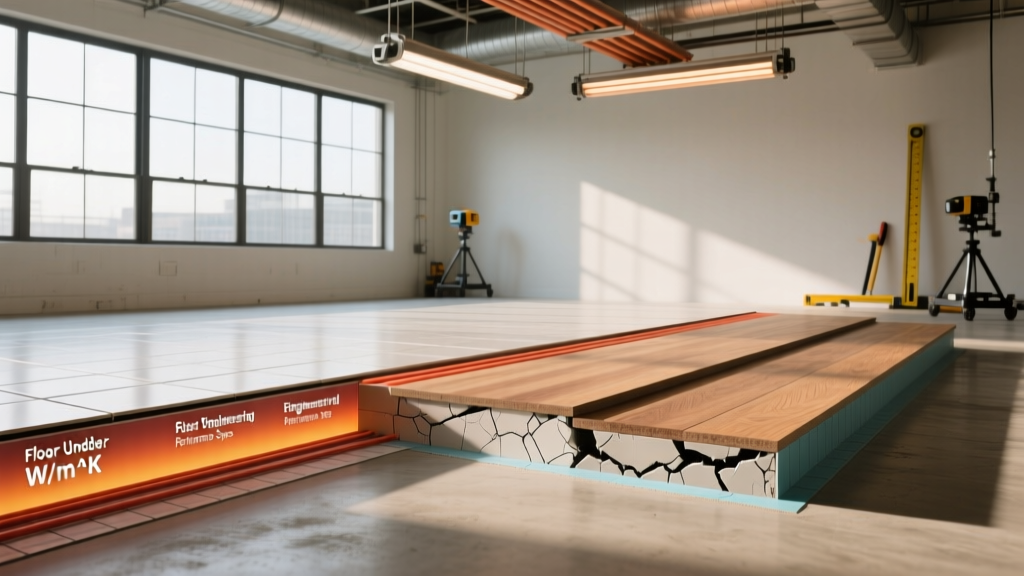
When evaluating materials for a floor under heating system, the primary physical property to analyze is thermal conductivity, measured in Watts per meter-Kelvin (W/m·K). This metric dictates how efficiently heat transfers from the embedded hydronic tubes or electric resistance cables through the floor covering and into the living space. A secondary, equally critical metric is the material's R-value (thermal resistance). According to the U.S. Department of Energy, the total R-value of the floor covering should remain as low as possible to prevent the heating system from overworking, which reduces energy efficiency and increases operational costs.
Material Performance Matrix: Ratings & Limits
The following matrix benchmarks the most common flooring categories against strict performance criteria required for radiant heat applications. These specifications account for dimensional stability, thermal transfer, and manufacturer warranty limitations.
| Material Category | Thermal Conductivity (W/m·K) | Max Surface Temp Limit | Max Thickness Limit | Dimensional Stability |
|---|---|---|---|---|
| Porcelain / Ceramic Tile | 1.30 - 1.50 | 104°F (40°C) | No strict limit | Excellent |
| Natural Stone (Marble/Slate) | 1.70 - 2.50 | 104°F (40°C) | No strict limit | Excellent |
| Engineered Hardwood | 0.12 - 0.18 | 80°F - 85°F (27°C-29°C) | 3/4 inch (19mm) | Good (Species dependent) |
| Rigid Core SPC Vinyl | 0.20 - 0.25 | 85°F (29°C) | 8mm (including pad) | Very Good |
| Laminate (HDF Core) | 0.10 - 0.15 | 80°F - 82°F (27°C-28°C) | 10mm (including pad) | Moderate |
Deep-Dive Specifications by Material Category
Ceramic & Porcelain Tile: The Thermal Benchmark
Tile and stone remain the undisputed champions of floor under heating applications due to their high thermal mass and conductivity. However, installation specifications must be strictly adhered to in order to prevent mechanical failure. Large-format tile (defined by ANSI A137.1 as any tile with at least one edge greater than 15 inches) requires a minimum 95% mortar contact area. Air gaps trapped beneath the tile act as localized thermal insulators, creating uneven surface temperatures and inducing differential expansion that leads to cracked grout lines or tile fracture.
For installations over heated concrete slabs, the use of an uncoupling membrane (such as Schlüter-Ditra or Mapei Mapeguard) is highly recommended. According to Penn State Extension building science guidelines, these membranes not only absorb the lateral shear forces caused by thermal expansion and contraction but also feature dovetailed structures that distribute heat evenly across the substrate, eliminating localized hot spots directly above the PEX tubing.
Engineered Hardwood: Managing Hygroscopic Movement
Wood is a hygroscopic material, meaning it absorbs and releases moisture in response to ambient humidity. When subjected to the drying effect of a floor under heating system, wood shrinks. Solid hardwood is generally prohibited by manufacturers for radiant applications due to severe cupping and gapping risks. Engineered hardwood, featuring a cross-ply core (typically 5 to 9 layers of Baltic birch), restricts tangential and radial shrinkage, making it viable.
- Species Selection: Quartersawn White Oak and American Walnut exhibit superior dimensional stability compared to plainsawn Hickory or Maple. Quartersawn cuts reduce the coefficient of thermal expansion by up to 30%.
- Width Restrictions: Limit plank width to a maximum of 5 inches. Wider planks experience greater absolute shrinkage across their face, increasing the likelihood of edge-checking and finish delamination.
- Adhesive Specifications: Use 100% solids urethane adhesives (e.g., Bona K850 or STAUF PUA-106). Water-based acrylic adhesives can re-emulsify and lose bond strength under prolonged thermal cycling and fluctuating moisture conditions.
Rigid Core SPC vs. WPC Vinyl: The Synthetic Alternative
Not all luxury vinyl plank (LVP) is created equal when exposed to continuous heat. WPC (Wood Plastic Composite) cores contain a foaming agent that introduces microscopic air pockets, providing underfoot comfort but acting as a thermal insulator. Conversely, SPC (Stone Plastic Composite) cores are formulated with limestone powder and PVC, resulting in a dense, highly conductive, and dimensionally stable plank.
When specifying vinyl for floor under heating, always mandate SPC core construction. Furthermore, verify the manufacturer's off-gassing certifications (such as FloorScore or GREENGUARD Gold). At temperatures exceeding 85°F (29°C), lower-quality PVC wear layers and plasticizers can degrade, releasing volatile organic compounds (VOCs) into the indoor environment. SPC cores maintain structural rigidity up to 100°F without expanding, provided the perimeter expansion gaps are strictly maintained at 1/4 inch.
Preventing Catastrophic Failure Modes
Ignoring the physical limitations of flooring materials over radiant heat leads to expensive, irreversible damage. Below are the most common failure modes and their technical preventative measures.
Tenting occurs when tile pops up in a tent-like ridge, usually at the center of a room. This happens when the floor covering expands due to heat but is constrained by rigid perimeter walls or cabinetry without adequate expansion joints. Fix: Install soft perimeter joints filled with 100% silicone caulk (color-matched to grout) and incorporate field expansion joints every 20 to 25 feet in heated areas, per TCNA Handbook guidelines.
Delamination in Engineered Wood: The top veneer layer separates from the plywood core. This is almost exclusively caused by rapid temperature fluctuations that create severe moisture gradients between the top and bottom of the plank. Fix: Strictly enforce the system commissioning ramp-up protocol (detailed below) and maintain indoor relative humidity between 35% and 55% using a whole-home humidifier during the heating season.
Subfloor Off-Gassing and Adhesive Failure: Using standard OSB or particleboard subfloors with certain radiant systems can lead to formaldehyde off-gassing when heated. Fix: Specify APA-rated Exposure 1 plywood or high-density fiberboard (HDF) underlayment with CARB Phase 2 compliance for formaldehyde emissions.
System Commissioning & Temperature Ramping Protocol
The most critical phase of a floor under heating installation occurs after the flooring is laid but before the space is occupied. Rapid heating will shock the materials, causing immediate checking in wood or micro-fractures in tile grout. The system must be commissioned using a strict ramping schedule.
- Initial Cure Period: For hydronic systems embedded in a concrete slab or self-leveling underlayment, wait a minimum of 21 to 28 days before activating the heat. This allows the cementitious materials to achieve full compressive strength and off-gas excess moisture.
- Baseline Activation: Set the water temperature (for hydronic) or thermostat (for electric) to 70°F (21°C) or the minimum operational setting. Maintain this for 48 hours.
- Incremental Ramping: Increase the temperature by a maximum of 5°F (3°C) per day. Do not exceed this rate, even if the space feels cold.
- Maximum Threshold: Continue daily increments until reaching the desired setpoint or the manufacturer's maximum surface temperature limit (typically 80°F for wood, 85°F for vinyl, 104°F for tile), whichever is lower.
- Cool-Down Protocol: At the end of the heating season, reverse the process. Decrease the temperature by 5°F per day until the system is off. Sudden shutdowns cause rapid contraction and subsequent gapping in wood floors.
By adhering to these precise thermal conductivity metrics, material thickness limits, and commissioning protocols, builders and homeowners can ensure that their floor under heating system operates at peak efficiency while preserving the structural integrity and aesthetic quality of the finished floor covering.