Quantity Surveying Floor Finishes Options: 2026 Cost Comparison
Compare 2026 supply, labor, and lifecycle costs for commercial floor finishes. A quantity surveyor's guide to LVT, terrazzo, concrete, and tile.
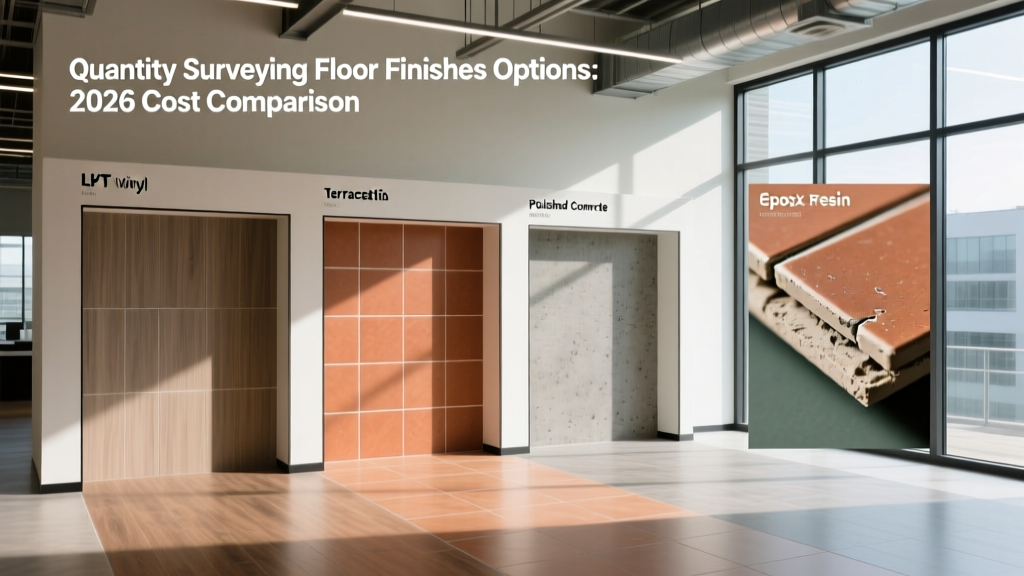
The Estimator’s Matrix: Supply, Labor, and Waste Factors
When evaluating quantity surveying floor finishes options, estimators must look beyond the base material rate. Accurate cost planning requires a synthesis of supply chain pricing, skilled labor outputs, and material-specific waste factors. The 2026 commercial flooring market has seen a stabilization in polymer-based material costs, but skilled labor rates for specialized finishes like terrazzo and polished concrete have increased by 6-8% due to trade shortages.
The following matrix breaks down the baseline unit rates (per square meter) for mid-to-high-tier commercial specifications. These figures exclude subfloor preparation, which is detailed in the subsequent section.
| Floor Finish Type | Supply Rate ($/m²) | Labor Rate ($/m²) | Waste Factor | Output (m²/day) |
|---|---|---|---|---|
| Luxury Vinyl Tile (LVT) - 2.5mm Glue-Down | $35 - $65 | $25 - $40 | 5% - 7% | 45 - 60 |
| Engineered Oak - 15mm Click/Floating | $85 - $140 | $45 - $70 | 8% - 10% | 30 - 45 |
| Polished Concrete - Burnished (Existing Slab) | $15 - $25 | $60 - $90 | 2% | 35 - 50 |
| Poured Terrazzo - Epoxy Matrix (10mm) | $120 - $180 | $150 - $220 | 3% | 15 - 25 |
| Epoxy Resin - Heavy Duty Flake (3mm) | $20 - $35 | $35 - $55 | 5% | 40 - 60 |
| Porcelain Tile - 600x600mm Rectified | $40 - $75 | $50 - $80 | 10% - 15% | 15 - 20 |
Subfloor Preparation: The Silent Budget Killer
The most frequent cause of flooring budget overruns is inadequate allowance for subfloor remediation. According to the Resilient Floor Covering Institute (RFCI) Installation Manual, resilient flooring failures are predominantly linked to moisture and substrate irregularity. Quantity surveyors must explicitly separate floor preparation into a distinct Bill of Quantities (BoQ) section rather than burying it in provisional sums.
Moisture Mitigation Protocols
Before pricing any adhesive-bound finish, estimators must account for relative humidity (RH) testing per ASTM F2170. If in-situ RH probes indicate moisture levels exceeding 75% (or 85% for specific permeable LVTs), a two-part epoxy Damp Proof Membrane (DPM) is mandatory.
- Standard Self-Leveling Underlayment (SLU): $14 - $18/m² (assumes a 3mm depth).
- Two-Part Epoxy DPM: $18 - $25/m² (required prior to SLU if RH > 75%).
- Moisture-Tolerant SLU: $22 - $28/m² (alternative to DPM, applied directly over damp concrete).
Acoustic Underlayments and Impact Insulation
For multi-family residential and Class A office spaces, building codes mandate strict Impact Insulation Class (IIC) ratings. Pricing an acoustic underlay requires understanding the Delta Lw (impact sound reduction) value. A standard 2mm closed-cell polyethylene foam provides a Delta Lw of 17dB and costs $4.50/m². However, achieving a Delta Lw of 22dB+ requires a 5mm rubber-cork composite underlay, pushing the material cost to $14.00 - $18.50/m² and reducing the installation output rate of the primary floor finish by 15%.
Lifecycle Costing and NRM Compliance
Modern quantity surveying extends beyond initial capital expenditure (CapEx). In alignment with the RICS Professional Standards for Whole Life Costing, estimators must model the operational expenditure (OpEx) of floor finishes over a 20-to-40-year asset lifespan. A finish with a low initial cost may incur punitive maintenance cycles that destroy its net present value (NPV).
Maintenance Cycles and Replacement Timelines
| Material | Expected Lifespan | Routine Maintenance Cost ($/m²/yr) | Refurbishment Cycle |
|---|---|---|---|
| LVT (Commercial Grade) | 12 - 15 Years | $2.50 - $4.00 | Strip and re-polish every 2 years |
| Engineered Oak | 25 - 40 Years | $1.50 - $3.00 | Sand and refinish every 10-15 years (max 3 times) |
| Polished Concrete | 20+ Years | $0.80 - $1.50 | Re-apply guard coat every 5-7 years |
| Epoxy Terrazzo | 40+ Years | $1.00 - $2.00 | Diamond hone and reseal every 10 years |
As noted in the National Wood Flooring Association (NWFA) Technical Resources, engineered wood flooring can only be sanded and refinished a limited number of times, dictated by the thickness of the top lamella. A 15mm engineered board with a 4mm wear layer allows for approximately three full sandings over its lifecycle. Estimators must factor in the $35 - $55/m² cost of commercial dustless sanding and polyurethane recoating at year 15 and year 30.

Hidden Cost Drivers in Floor Finish Quantification
Junior estimators often miss the secondary components required to execute a flooring specification. When building your rate buildup, ensure the following line items are captured:
- Transition Profiles and Schluter Systems: Where LVT meets carpet or tile, aluminum or brass transition strips are required. Budget $18 - $35 per linear meter for heavy-duty commercial profiles.
- Movement Joints in Tiling: Per TCNA and ANSI A108.01 standards, large-format porcelain installations require perimeter and field movement joints every 6 to 7.5 meters. Quantify color-matched silicone and specialized joint profiles at $12/m linear.
- Stair Nosing and Edge Trims: Prefabricated epoxy or aluminum stair nosings with abrasive inserts cost $45 - $85 per linear meter and require specialized two-part structural adhesives.
- Floor Outlet and Penetration Cutting: Core drilling and cutting floor boxes into hardened terrazzo or large-format tile incurs a labor penalty. Allow $35 - $60 per penetration.
Decision Framework: Selecting Finishes by Asset Class
To optimize value engineering (VE) proposals, quantity surveyors should map flooring options to the specific operational demands of the asset class. The following framework aids in defending material selections against aggressive cost-cutting measures during the tender stage.
Class A Commercial Office (High Traffic, High Aesthetics)
- Optimal Choice: Epoxy Terrazzo in lobbies; Heavy-duty 20-mil wear layer LVT in open-plan workspaces.
- QS Rationale: Terrazzo provides a seamless, 40-year lifecycle with near-zero maintenance in high-spill entry zones. LVT offers acoustic dampening and modular replacement capabilities in desk areas, reducing long-term patch-repair costs.
Healthcare and Clinical Environments
- Optimal Choice: Heat-welded homogeneous vinyl sheet (2mm) with flash-coved skirtings.
- QS Rationale: Eliminates seams where bacteria harbor. Flash-coving (extending the vinyl 100mm up the wall) requires specialized labor ($45/m linear) but is non-negotiable for infection control compliance. Do not substitute with LVT planks in sterile zones.
Industrial and Logistics Warehousing
- Optimal Choice: Dry-shake metallic aggregate hardener with a lithium silicate densifier applied to the fresh concrete slab.
- QS Rationale: Applying the finish during the initial concrete pour eliminates secondary flooring trades entirely. The material cost is negligible ($4 - $7/m²), and it withstands heavy forklift point-loads without delaminating, unlike post-applied epoxy coatings which can peel under thermal shock.
Written by
Marcus ChenMarcus Chen is a licensed structural engineer (PE) and building materials analyst with over 12 years of experience across residential, commercial, and industrial construction. He holds a Master of Science in Civil Engineering from UC Berkeley and spent six years at Thornton Tomasetti before transitioning to independent consulting and technical writing. Marcus specializes in material selection for seismic-prone regions, concrete reinforcement strategies, and lifecycle cost analysis. His work has been cited by the American Concrete Institute (ACI) and the Structural Engineers Association of California (SEAOC). When he is not on a job site or at his desk, you will find him hiking the Sierra Nevada or restoring a 1920s craftsman bungalow in Oakland, CA.
More from Marcus Chen
View all
Construction Cost
How Much Did the Eiffel Tower Cost to Build?
How much did the Eiffel Tower cost to build in 1889? We adjust for inflation and compare its budget to modern skyscraper construction.
Aug 4, 2026

Fire Resistance
What Is a Fire Resistant Material? Testing & Certification Guide
Discover what is a fire resistant material through ASTM and UL testing. Learn how fire ratings, certifications, and assemblies work in construction.
Aug 4, 2026

Construction Cost
How Much Did the Burj Khalifa Cost to Build?
How much did the Burj Khalifa cost to build? We break down the $1.5B project and extract 5 money-saving strategies for your next build.
Jul 30, 2026