Matching Flooring to Radiant Floor Heating Systems by Room
Match flooring materials to radiant floor heating systems. Compare R-values, room scenarios, and installation limits for tile, wood, and LVP.
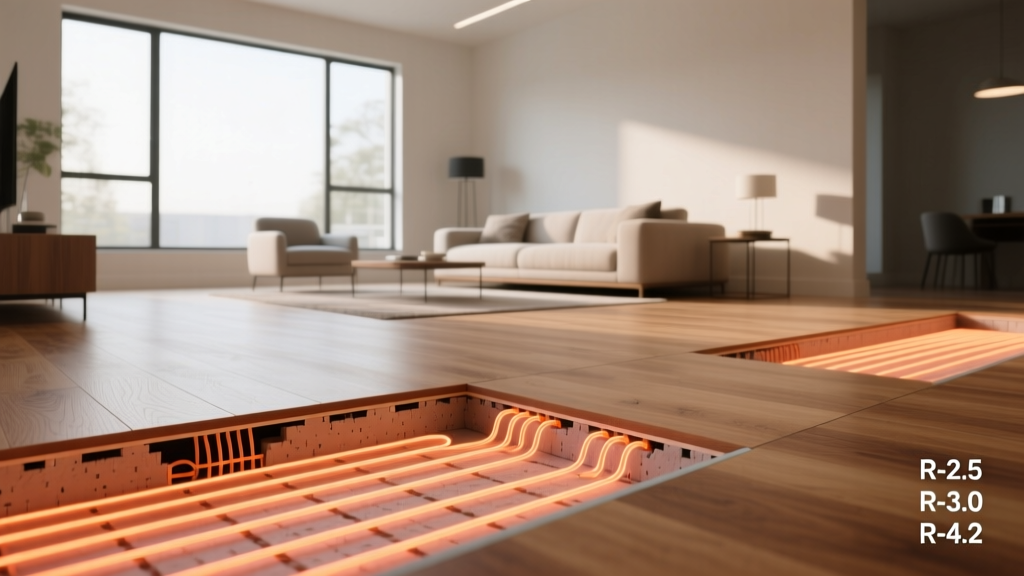
The Thermodynamics of Radiant Heat Transfer
The efficiency of radiant floor heating systems is entirely dictated by the thermal conductivity of the flooring material installed above it. Heat moves from the source (hydronic tubing or electric resistance cables) through the subfloor, underlayment, and finish flooring via conduction. Every material possesses a specific thermal resistance, measured as an R-value. As a baseline rule in radiant design, every 1.0 increase in the total R-value of the floor assembly reduces the upward heat output by approximately 50%.
According to the U.S. Department of Energy, radiant systems operate most efficiently when paired with highly conductive surfaces that allow low-temperature water or electricity to effectively warm the room without overworking the boiler or drawing excessive amperage. Selecting the wrong flooring material not only wastes energy but can lead to catastrophic material failure, such as warped hardwood or delaminated vinyl.
System Selection Matrix: Hydronic vs. Electric
Before selecting the finish flooring, the underlying heating system must be matched to the structural scenario. Hydronic systems pump heated water through PEX tubing, while electric systems use resistance cables or mats.
| Feature | Hydronic (Water-Based) | Electric (Cable/Mesh) |
|---|---|---|
| Best Application | Whole-house, new construction, slab-on-grade | Small areas, bathrooms, above-grade retrofits |
| Installed Cost | $8.00 - $14.00 per sq. ft. | $10.00 - $16.00 per sq. ft. |
| Operating Cost | Low (especially with condensing boilers/geo) | High (electricity is expensive per BTU) |
| Response Time | Slow (hours to heat up and cool down) | Fast (minutes to reach target temperature) |
| Floor Height Added | 1.25" to 1.5" (requires sleepers or pour) | 1/8" to 1/4" (embeds in thinset or SLC) |
Material Compatibility Matrix: R-Values and Limits
Not all flooring is created equal when subjected to continuous thermal cycling. Below is a technical breakdown of how common flooring categories perform over radiant floor heating systems.
1. Porcelain, Ceramic, and Natural Stone
- Average R-Value: 0.05 to 0.10 (Excellent conductor)
- Max Surface Temp: 104°F (40°C)
- Installation Method: Modified thinset mortar over an uncoupling membrane.
Tile and stone are the undisputed champions of radiant heating. Their high thermal mass absorbs heat and radiates it evenly. However, the primary failure mode is cracking due to differential expansion between the heated subfloor and the rigid tile. To prevent this, install an uncoupling membrane like Schlüter-Ditra-Heat, which houses the electric cables while neutralizing lateral shear stresses.
2. Engineered Hardwood
- Average R-Value: 0.35 to 0.50 (Moderate insulator)
- Max Surface Temp: 85°F (29.4°C)
- Installation Method: Floating or full-spread urethane glue-down.
Solid hardwood is generally prohibited over radiant heat due to severe cupping and checking risks. Engineered wood is the required alternative, but not all engineered products qualify. The National Wood Flooring Association (NWFA) mandates that wood over radiant heat should be quarter-sawn or rift-sawn for maximum dimensional stability. Avoid planks wider than 4 inches, and never use steam-mopped or high-moisture cleaning methods, as the combination of heat and moisture will destroy the veneer adhesive.
3. Luxury Vinyl Plank (LVP) and SPC
- Average R-Value: 0.20 to 0.30 (Good conductor)
- Max Surface Temp: 80°F to 85°F (varies strictly by manufacturer)
- Installation Method: Floating click-lock or glue-down.
Stone Plastic Composite (SPC) and Wood Plastic Composite (WPC) rigid core vinyls perform exceptionally well over radiant systems because they do not expand or contract with temperature fluctuations like traditional PVC. However, you must verify the manufacturer's specific radiant heat warranty. Brands like COREtec and NuCore explicitly test their SPC lines for radiant compatibility, but cheaper, flexible LVP with felt backing will trap heat, leading to off-gassing and permanent deformation.
4. Carpet and Padding
- Average R-Value: 1.0 to 2.5+ (Severe insulator)
- Max Surface Temp: 80°F (29°C)
- Installation Method: Stretch-in over low-R padding.
Carpet acts as a thermal blanket, actively fighting the radiant system. If carpet must be used, the combined R-value of the carpet and the pad must not exceed 2.5. Use a dense, thin rubber or rebond pad (R-value ~0.2) rather than thick polyurethane foam. Expect the boiler or electric system to work 40% harder to achieve the same ambient room temperature compared to a tile installation.
Room-by-Room Application Scenarios
Scenario A: The Master Bathroom (High Moisture, Small Area)
Recommended System: Electric radiant mesh mats (e.g., SunTouch or Nuheat) embedded in self-leveling compound or thinset.
Recommended Flooring: Large-format porcelain tile or honed marble.
Why it works: Bathrooms require rapid heat response for morning comfort and are too small to justify the mechanical overhead of a hydronic manifold. Electric mats provide precise zoning directly under the tile, and the stone/porcelain surface handles the moisture and high thermal output flawlessly.
Scenario B: Slab-on-Grade Basement (High Thermal Mass, Moisture Risk)
Recommended System: Hydronic PEX-a tubing embedded in a 1.5-inch concrete over-pour or stapled to rigid insulation with a gypsum concrete (Gyp-Crete) pour.
Recommended Flooring: SPC luxury vinyl plank or porcelain tile.
Why it works: Basements are prone to moisture vapor transmission. Engineered wood and carpet are high-risk here. SPC vinyl is 100% waterproof and conducts heat efficiently, while the hydronic system leverages the massive thermal storage of the concrete slab to maintain steady, low-cost background heat throughout the winter.
Scenario C: Above-Grade Living Room Retrofit (Limited Floor Height)
Recommended System: Low-profile hydronic overlay panels (e.g., Uponor Quik Trak) or ultra-thin electric foil mats.
Recommended Flooring: Floating engineered hardwood (quarter-sawn oak, max 4" width).
Why it works: Retrofitting above-grade rooms often means dealing with existing door clearances and stair risers. Low-profile overlay panels add less than 5/8" of height. A floating engineered floor accommodates the minor seasonal expansion without requiring adhesive, which can degrade under continuous heat.
Critical Installation Failures to Avoid
Even with the correct material selection, improper installation techniques will destroy both the flooring and the heating system. Adhere strictly to these technical parameters:
- Never Blind-Nail Hardwood: If installing engineered wood over a hydronic sleeper system, never use pneumatic cleats or staples that penetrate deep enough to puncture the PEX tubing. Always use a floating installation or a full-spread urethane adhesive specifically rated for radiant heat (e.g., Bona Kemi or Sika).
- Use Polymer-Modified Self-Leveling Compounds: When encasing electric cables, standard cementitious levelers will crack from thermal expansion. You must use a high-flex, polymer-modified compound like Ardex K-15 or Mapei Novoplan, mixed strictly with the manufacturer's liquid polymer additive, not just water.
- Mandatory Acclimation and Gradual Commissioning: Before turning on the system, the flooring must acclimate to the home's baseline humidity for 7-14 days. When commissioning the system for the first time, increase the water temperature or thermostat setting by only 5°F per day until reaching the target. Shocking a cold floor with immediate high heat will cause instantaneous delamination in vinyl and micro-fractures in tile grout.
- Floor Sensor Placement: Always install a secondary floor temperature sensor probe directly in the flooring plane, separate from the ambient wall thermostat. If the floor sensor fails, the system relies solely on air temperature, which can easily result in the floor surface exceeding the manufacturer's 85°F safety limit, causing irreversible damage to wood and LVP.