Durability and Lifespan Analysis of Common Types of Flooring
Analyze the durability, expected lifespan, and common failure modes of major types of flooring to calculate accurate 50-year ownership costs.
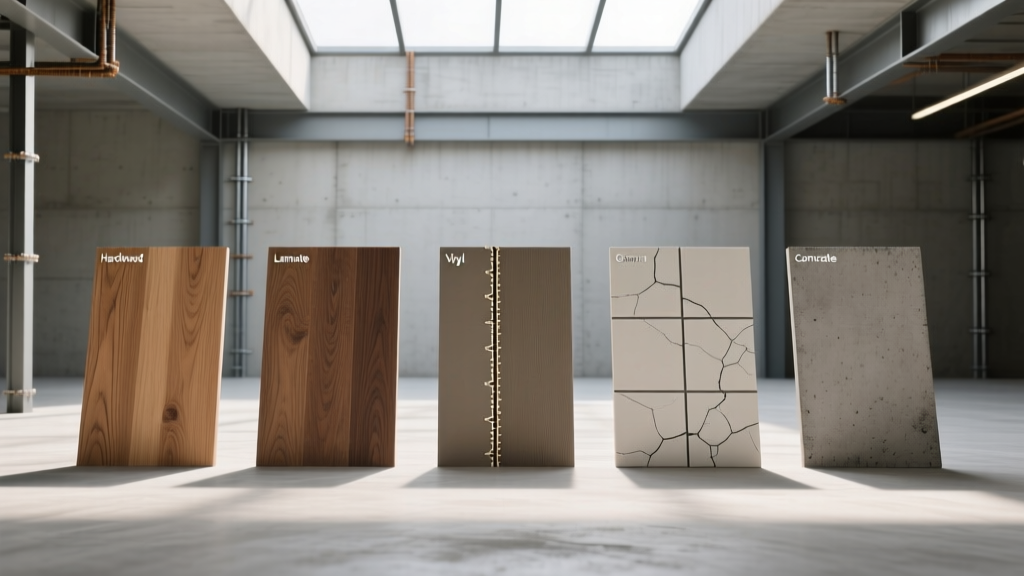
The Hardness and Abrasion Matrix
Evaluating the true lifespan of flooring requires moving beyond manufacturer warranties and examining material science. The durability of any floor covering is dictated by its resistance to three primary vectors: surface abrasion, impact denting, and moisture-induced structural degradation. The matrix below establishes the baseline physical properties for the most prevalent flooring categories installed in 2026.
| Material Category | Hardness Metric | Average Value | Base Lifespan (Years) |
|---|---|---|---|
| Solid Hardwood (Red Oak) | Janka Scale (lbf) | 1,290 lbf | 75 - 100+ |
| Porcelain Tile | PEI Rating / Mohs | PEI IV / 7-8 | 50 - 75 |
| SPC Luxury Vinyl Plank | Wear Layer (mils) | 20 - 28 mils | 15 - 25 |
| Engineered Hardwood | Janka Scale (lbf) | 1,290 - 3,680 lbf | 30 - 50 |
| Polished Concrete | Mohs Scale | 6 - 8 (with densifier) | 100+ |
Material-Specific Lifespan and Failure Mode Analysis
Solid and Engineered Hardwood
Solid hardwood remains the benchmark for longevity because it is a renewable surface. A standard 3/4-inch solid oak plank possesses a sandable wear layer of approximately 5/16 inch above the tongue-and-groove profile. Because professional sanding removes roughly 1/32 inch of material, a solid hardwood floor can be refinished 5 to 7 times, effectively resetting its aesthetic lifespan every 15 to 20 years.
Primary Failure Modes: The most common catastrophic failure in hardwood is not surface scratching, but moisture-induced dimensional instability. When ambient relative humidity (RH) drops below 30% for extended periods, solid planks undergo tangential shrinkage, leading to edge-splitting and gapping. Conversely, when moisture vapor emission rates (MVER) from a concrete subfloor exceed 3 lbs per 1,000 square feet per 24 hours (tested via ASTM F1869 calcium chloride method), engineered hardwood experiences edge-bond failure and cupping. According to the National Wood Flooring Association (NWFA), maintaining an indoor RH between 35% and 55% is non-negotiable for preserving structural integrity.
Porcelain and Ceramic Tile
Fired ceramic and porcelain tiles are virtually impervious to surface abrasion and UV degradation. Porcelain, fired at temperatures exceeding 2,200°F, achieves a water absorption rate of less than 0.5%, making it immune to freeze-thaw spalling in exterior or unconditioned applications.
Primary Failure Modes: Tile itself rarely fails; the installation system does. The most frequent point of failure is grout degradation and thin-set mortar delamination. Standard cementitious grout is porous and susceptible to efflorescence and microbial growth. In high-traffic or wet environments, the grout will erode within 10 to 15 years, requiring labor-intensive removal and reapplication. Furthermore, if the subfloor deflection exceeds L/360 (where L is the span length), the rigid tile assembly will crack under dynamic loads. The Tile Council of North America (TCNA) mandates the use of uncoupling membranes (such as Schluter-DITRA) over wood-framed subfloors to isolate the tile from lateral substrate movement.
Stone Plastic Composite (SPC) Luxury Vinyl
SPC luxury vinyl plank (LVP) has dominated the market due to its 100% waterproof core, composed of limestone powder and polyvinyl chloride. Unlike older Wood Plastic Composite (WPC) cores, SPC offers superior impact resistance and dimensional stability, preventing the plank from expanding or contracting with temperature fluctuations.
Primary Failure Modes: The lifespan of LVP is entirely dependent on the urethane wear layer. A 12-mil wear layer will show high-traffic walk patterns within 5 to 7 years. For long-term residential durability, a minimum 20-mil wear layer is required, while commercial applications demand 28 mils or higher. The secondary failure mode is plasticizer migration and UV photodegradation. Prolonged direct sunlight will cause the printed decorative film to fade and the PVC core to become brittle, leading to corner-chipping. Additionally, SPC requires a perfectly flat subfloor (within 3/16 inch over a 10-foot radius); otherwise, the rigid click-lock mechanisms will shear under point loads.
Polished and Sealed Concrete
When properly densified and polished, concrete floors offer a lifespan that matches the structural foundation of the building itself. The process involves applying a lithium silicate densifier that reacts with the free lime (calcium hydroxide) in the concrete to form calcium silicate hydrate (C-S-H), permanently hardening the surface to a Mohs 7 or 8.
Primary Failure Modes: Micro-cracking due to substrate settling or thermal expansion is the primary aesthetic flaw over time. Unlike tile, concrete cannot accommodate structural movement without cracking. Furthermore, if the concrete is not properly cured before polishing, or if the surface is contaminated with curing compounds, the chemical densifier will fail to penetrate, resulting in a soft surface that dusts and degrades rapidly under foot traffic.
Environmental Degradation Vectors
Understanding how environmental factors accelerate wear is critical for accurate lifecycle modeling.
- Moisture Vapor Emission Rates (MVER): Any adhesive-based flooring (LVT, engineered wood, carpet tile) installed over a concrete slab with an MVER exceeding 5 lbs/1,000 sq ft/24hrs will suffer adhesive emulsion breakdown. The floor will blister and delaminate within 12 to 18 months. Always mandate a relative humidity probe test (ASTM F2170) prior to installation.
- Thermal Expansion Coefficients: Materials like laminate and traditional vinyl expand significantly with heat. In rooms with floor-to-ceiling south-facing windows, surface temperatures can reach 120°F. Without adequate perimeter expansion gaps (minimum 1/2 inch), these floors will peak and buckle at the seams.
- UV Radiation: Direct UV exposure breaks down the lignin in natural wood (causing yellowing or graying) and degrades the polymers in vinyl and laminate. Specify UV-inhibitive finishes for hardwood and low-E window glazing to protect the flooring asset.
50-Year Total Cost of Ownership (TCO) Projection
Initial material cost is a poor indicator of long-term value. The following analysis projects the 50-year TCO per square foot, factoring in 2026 average installation costs, mandatory replacement cycles, and routine maintenance.
| Flooring Type | Initial Installed Cost (2026) | 50-Year Replacement Cycles | Maintenance/Refinishing | Estimated 50-Yr TCO |
|---|---|---|---|---|
| Solid Hardwood | $14.00 - $18.00 | 0 (Refinish 3x) | $12.00 / sq ft | $26.00 - $30.00 |
| Porcelain Tile | $16.00 - $22.00 | 0 (Regrout 2x) | $8.00 / sq ft | $24.00 - $30.00 |
| SPC Luxury Vinyl | $7.00 - $10.00 | 2 (Replace at yr 20, 40) | $2.00 / sq ft | $23.00 - $32.00 |
| Polished Concrete | $9.00 - $14.00 | 0 (Burnish 5x) | $4.00 / sq ft | $13.00 - $18.00 |
As demonstrated, while SPC LVP has the lowest barrier to entry, its mandatory replacement cycles push its 50-year cost parity with porcelain and hardwood. Polished concrete yields the highest long-term ROI, provided the architectural design accommodates an exposed slab.
Prescriptive Maintenance Protocols to Maximize Lifespan
Improper maintenance destroys flooring faster than foot traffic. Adhere to these specific chemical and mechanical protocols:
- Hardwood & Laminate: Use only pH-neutral (pH 7.0) cleaners specifically formulated for polyurethane finishes. Avoid oil soaps, which leave a lipid residue that prevents future screening and recoating. Never use steam mops; the forced vapor drives moisture into the micro-seams, causing edge-swelling.
- Luxury Vinyl: Clean with a neutral pH detergent. Avoid high-alkaline cleaners (pH > 9) or abrasive scrubbing pads, which will micro-scratch the urethane wear layer, creating a dull appearance and trapping dirt.
- Porcelain Tile: Seal cementitious grout lines annually with a penetrating silane/siloxane sealer. Use an enzymatic cleaner for organic stains rather than acidic cleaners (like vinegar), which will slowly etch the grout and degrade the glaze on natural stone tiles.
- Concrete: Maintain the densified surface using an alkaline-conditioning cleaner that leaves a microscopic burnishable layer. Avoid acidic spillages (e.g., citrus, wine, vinegar), which will chemically etch the calcium silicate hydrate matrix, leaving permanent dull spots.
For comprehensive guidelines on resilient flooring maintenance and chemical compatibility, refer to the technical bulletins published by the Resilient Floor Covering Institute (RFCI). Selecting the right flooring is a capital allocation decision; matching the material's physical properties to the specific environmental and mechanical loads of the space is the only way to ensure the asset reaches its maximum engineered lifespan.